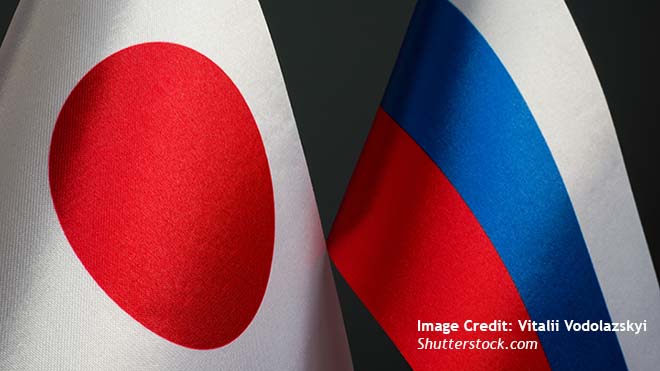
Northern Territories' Dispute a Bellwether for Japanese Foreign Policy

Despite their relative economic and strategic insignificance, the Kuril Islands, especially the southernmost part of the chain, known in Japan as the Northern Territories, have long played a decisive role in determining the state of Russian-Japanese relations. More than a piece of territory, the islands hold immense symbolic value for both parties, and to leave the issue uncontested would surely spell snowballing changes to both perceptions of national identity as well as prestige and stature, especially when it comes to other territorial disputes. Unlike the Chinese-claimed Senkaku Islands (Diaoyu in Chinese) or Korean-held Takeshima (Dokdo in Korean), the Northern Territories were historically populated by Japanese citizens who were deported following Soviet occupation — making progress on the issue increasingly urgent for those who wish to revisit what they used to call their home or the graves of their relatives. The territorial dispute has subsequently colored much of the relations between the two countries.
Break in diplomatic relations
Despite Russian seizure of the Crimean Peninsula from Ukraine in 2014, Japan under ShinzÅ Abe took a careful diplomatic approach to Russia compared to other G7 countries. This was done in the hopes of finally concluding a peace treaty in which the status of the contested islands would be solved. Following the Russian invasion of Ukraine, however, now Prime Minister Fumio Kishida opted to break with this long running approach and instead join forces with Western countries to employ unprecedented economic sanctions, effectively ending all peace treaty negotiations.
Not only have the talks been put on hold, but measures by both countries have reversed much of the previous progress reached. For instance, Japan has for the first time since 2003 again listed the Northern Territories as illegally occupied, while Russia has conducted military drills on the islands and ended visa exemptions for Japanese nationals visiting the area.
As Japan, in tandem with likeminded countries, returns to a freeze of relations with Russia reminiscent of the Cold War, Tokyo may find itself in a position to act without taking too much consideration to how it will affect the possibility of solving the territorial issue, which hitherto has not been the case. While this could be interpreted as giving up on improving relations, it underlines that other aspects, such as respect for international law, are of higher priority for Japan.
With its new, tougher position towards Russia, Japan will no longer have to appease the Russian leadership. It also allows Tokyo to adopt a strong posture which would translate to other territorial disputes it is engaged in. Japan’s neighbors would be reminded of Tokyo’s ability to not only engage in constructive diplomacy, but also that they do not shy away from taking a hardline approach.
Problems that come with peace
While solving the dispute as quickly as possible may sound like the best thing to do, the prospects of having the contested islands transferred back to Japan during the present international circumstances are very low, and simply not realistic. There is some precedent as in 2004, China and Russia agreed on how to define the borderline, taking into consideration the contested set of islands on the Amur River. In 1956, Soviet and Japanese leaders agreed, through a joint declaration, that Japan would receive two of the contested islands following a bilateral peace treaty. This has subsequently been brought up in recent times. How genuine this position is remains unclear, as it has come with the prerequisite that Japan would first recognize Russian sovereignty over the island chain. The islands have a significant symbolic value also for Russia, and it is no coincidence that the region is the country’s most subsidized per capita. It should also be noted that former Russian prime minister and president Dimitry Medvedev visited the islands in his official capacity, much to Japan’s dismay, and that he recently proclaimed that a transfer of any of the islands to Japan was never going to happen.
Another sometimes overlooked point is that in the unlikely event that Russia would give back the islands, Japan would be presented with an array of new challenges, the most obvious one being the population on the islands. While the Soviet Union had no qualms about deportations, democratic Japan would be less keen to engage in policies of that nature. Ignoring the logistical and judicial headache which the 30,000 strong Russian population would bring to the Japanese government, another challenge would be how Moscow could make use of the situation. Russia is well known for its practice of using expatriate nationals as an excuse for aggressive behavior and exaggerated demands. Abkhazia and South Ossetia in Georgia, Transnistria in Moldova and most recently Crimea and the Donbas in Ukraine are the most obvious examples. The Northern Territories may not be a casus belli in the same way that separatist regions in eastern Europe are but it would surely make relations with Russia even more precarious.
Towards foreign policy normalcy
The shift from Japan’s cautious Russia policy may be a manifestation of a larger change in its foreign policy. This change mirrors pressure from some legislators that Japan ought to finally reassess its security position in an increasingly hostile environment. The crisis in Ukraine may not be the causal factor in this, but perhaps it has come to present a window of opportunity for Japan to underline the very principles on which its foreign policy is based, i.e., respect for international law, human rights, principles of the rule of law and democracy.
Just a couple of weeks before Russia invaded Ukraine, North Korea was making headlines by firing missiles, landing in Japan’s exclusive economic zone. China’s quest for regional hegemony is ever present and concerns have been amplified by Beijing refraining from condemning Moscow’s invasion of Ukraine. Japan, given its precarious situation, is well aware that it more than ever needs allies and needs to improve its relations with countries adhering to a similar mindset. The United States is Japan’s closest ally, but there are still some doubts among Japanese decision makers whether the United States will come to the rescue if China invades Taiwan, in spite of the fact that Japan will be deeply affected by such a crisis. How far the US will go in protecting the Senkaku Islands is another discussion point. To widen its network of like-minded countries and allies would also make Tokyo less dependent on who is in power in Washington D.C., and it would make it more difficult for Beijing and Moscow to use any potential future rift between Japan and the United States to their benefit.
Recent changes in the international situation have led to calls from some leading politicians in Japan, not least former prime minister ShinzÅ Abe, to abandon its three non-nuclear principles of not possessing, producing, or hosting nuclear weapons. While a debate about revising the pacifist constitution has continued since its inception 75 years ago, a shift to a debate on whether nuclear armament is on the table is unprecedented, and perhaps not something that will make it easier to solve bilateral problems. However, increasing threats from Moscow, Beijing and Pyongyang will not lead to more appeasement from Tokyo, who increasingly seems to be giving up on the idea of keeping a low profile. Read More...