Novel rare skin mutation gene identified by whole exome sequencing - BGI Case Report

Identification of a novel rare mutation in ABCA12 gene linked to Harlequin Ichthyosis through BGI genetic tests
Harlequin ichthyosis (HI) is a severe genetic skin disorder characterized by thick white, brown, or dark brown patches on the skin covering a newborn's entire body. HI has a low incidence of 1 per 300,000 live births but comes with the highest mortality rate among skin conditions. It is caused by a mutation in the ABCA12 gene, which codes for a protein involved in transporting lipids necessary for the formation of the skin barrier. Such protein shortage leads to a weaker epidermal barrier.
A recent study, co-authored by BGI Genomics Dr. Thomas Qiu, published in Frontiers in Pediatrics covers the case of an infant born prematurely at the Vietnam Quang Ninh Obstetrics and Pediatrics Hospital with a birth weight of 2.2 kg and covered with thick plate-like scales separated by dark red fissures of the skin, who was then diagnosed with HI disorder.
Five days after birth, the child was transferred to the Vietnam National Hospital of Pediatrics with severe infection, other HI-related symptoms, breathing difficulties and died 15 hours after.
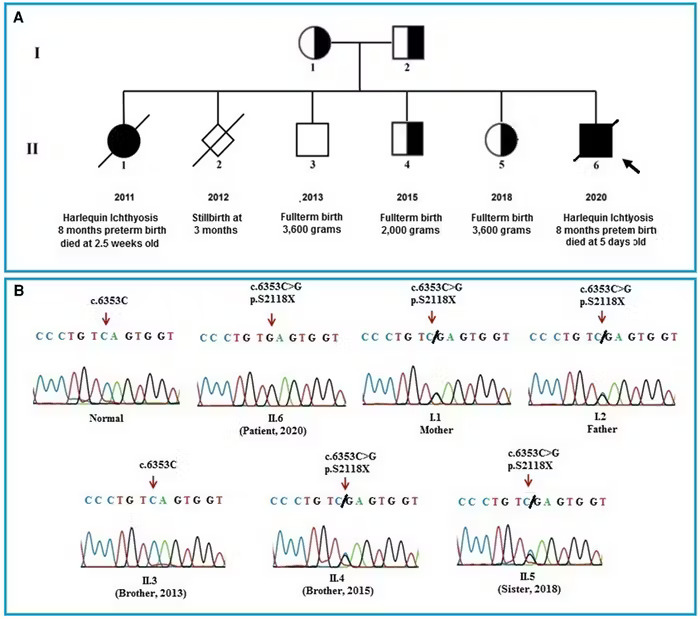
The infant had an older sister, born 8 months premature who died at 2.5 weeks old with HI symptoms as well, and a stillborn brother at 12 weeks gestation. He also has two brothers and a sister, full health. A blood sample for whole exome sequencing (WES) was collected on the patient to find the cause of the disease.
Whole exome sequencing results show that a homozygous mutation (c.6353C > G, p.S2118X) leads to a truncated ABCA12 protein, commonly reported among HI cases. Read More…