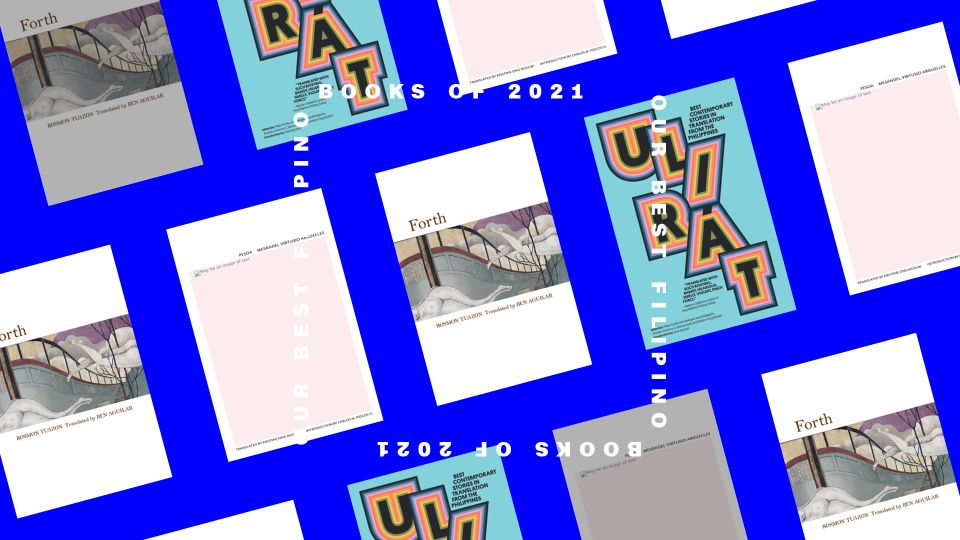
Our best Filipino books of 2021: ‘Forth,' ‘Pesoa,' and ‘Ulirat'

“Forth” by Rosmon Tuazon, translated to English by Ben Aguilar (Balangay Books, 2021)
A lacerating hardness dominates Rosmon Tuazon’s “Forth.” Lines cut, break, and shape. An underlying force of anxiety (best exemplified in the title poem “Mula” (Forth), often takes us to the brink but Tuazon assures us that the darkened edge will give way to the light (“Sa paanan ng tagdan, isinusukong parang alay / ang balumbon ng lubid, bago / ang muling pagtalikod, / ang pananatili sa tanaw ng posibilidad na makalayo”). Aguilar’s translation doesn’t just transform Tuazon’s words into another language — he shows us that the path is there (“At the foot of the pole, surrendered as if an offering / the coil of the rope, before / the turning back again, / keeping in view the possibility of getting far). But a path to what? Tuazon and Aguilar allow us to recognize it by ourselves, whether it’s out of desperation (“Silid ng Lahò”) or just simply a road to travel on.
Tuazon uses the aid of past figures (Methuselah, Akhenaton, and even the tragic figure of the Vietnamese monk Thích Quảng Äức — a poem that is disturbing yet so tender) to approximate the harshness of history that continues to plague our every moment. Even in the softest moments of “Forth” there are hints of struggle — the flesh being gouged, movement stalled, bodies being dragged. But Tuazon’s command of language takes us through this labyrinth, though unscathed, but never the same.
“Pesoa” by Mesándel Virtusio Arguelles, translated to English by Kristine Ong Muslim (Balangay Books, 2021)
It’s hard not to think of Fernando Pessoa when reading Mesándel Virtusio Arguelles’ “Pesoa” even though it’s an erasure of Rene O. Villanueva’s essay collection “Personal” (see what Arguelles did in the title?). It’s one letter away from being mistaken as a collection of the Portuguese writer’s work, whose breadth ranges from prose, poetry, literary criticism to translation. Arguelles acknowledges the mingling/multiplicity of selves in “Pesoa” — always via Villanueva’s words: “Fernando, Joaquin, Virgilio, at iba pa. Mga tao mula sa nakalipas, sumibol, sa aking ang kanilang mundo at panahon. Malayo ito sa buhay ko.” Thus begins Arguelles’ powerful meditation on the self.
“Pesoa” was originally published in 2014, with a flip-type landscape format that when read aloud, will make you seem like you’re talking to yourself. This year, “Pesoa” gets an English translation by Kristine Ong Muslim who has already translated many of Arguelles’ poetic works. This serves as a mirror or a parallel to Arguelles’ original. Reading it with the context of the uncertainty and degradation of self thanks to the pandemic, “Pesoa” acts like a continuous questioning of identity.
As a mystic figure Pessoa is no stranger to conceptualizing selves. As a teenager, the author has created many “heteronyms” for his works “imagined authors to whom he attributed the voluminous collection of poems, essays, occult writings, dialogues, philosophical reflections, short stories, manifestoes, and enigmatic prose pieces that he left behind in manuscript when he died from cirrhosis at forty-seven, and on which his position as one of the central figures of European modernism now rests,” noted Max Nelson. Voices fill Pessoa’s work and “Pesoa” is an echo of imprints, not exclusively of Pessoa of course, but of Arguelles, Villanueva, and others in them.
Halfway into the book, “he” slowly collects the self from an avalanche of questions. “All people seem to be just one person; each one is the first person. I suddenly remember the poems. My favorite poems — sometimes they resemble a round object, sometimes a river; poems that are made up of one poem and only one poem.” The translation amplifies the questioning. There is resistance and when it seems that the question is around the bend “he” hits an even taller wall. “Time has not helped me develop a firm grasp on things. My memory registers nothing. Ever since, there has been no way for me to pretend that I am knowledgeable. A self is derived from self and that is enough.” I continue with “his” struggle but I also wonder what Villanueva was wrestling with. I read “Personal” many years ago and my question will remain unanswered since it is apparently out of print.
“Pesoa” is more than to know oneself. Muslim’s translation accompanies the original, combining redaction and translation, to “surrender our memories to language, and the many contingencies of violence that the form inflicts on our own past if only to conjure an open ended futurity” as Carlos M. Piocos III notes in his introduction to this new edition. Shadows exist in “Pesoa” — to ask, confuse, and — with hope — illumine. Arguelles is our guide to that long walk, and alongside us, the many spectres that Villanueva and he have conjured up in their works.
“Ulirat: Best Contemporary Stories in Translation from the Philippines” edited by Tilde Acuña, John Bengan, Daryll Delgado, Amado Anthony G. Mendoza III, and Kristine Ong Muslim, translations (from seven Philippine languages) by Tilde Acuña, Merlie M. Alunan, Roy Vadil Aragon, John Bengan, Erika M. Carreon, Shane Carreon, Bernard Capinpin, Soleil David, Daryll Delgado, Eliodora L. Dimzon, Sunantha Mendoza-Quibilan, Amado Anthony G. Mendoza III, Kristine Ong Muslim, Eric Gerard H. Nebran, and Ariel Sotelo Tabág (Gaudy Boy, 2021)
Given the vast scope of “Ulirat” and the number of people involved in it, it makes sense that it took four years to bring this book into fruition. But also, why is it only now that we get something as extensive as this sampling of Filipino writers not writing in English? The writers — and editors — included in this volume (I pray we get a second volume, and a third one, and a fourth one…) are not the usual writers that you see in anthologies, which tend to include a small circle of writers. “Ulirat” gives us a concrete view of the world outside the usual confines of the publishing that we know.
“Ulirat” is certainly not the first to compile translated works from Philippine languages. There’s “Sa Atong Dila: Introduction to Visayan Literature” (2013) by Merlie M. Alunan and “An Orosipon kan Bikolnon: Interrupting the Philippine Nation” (2017) by Peñafrancia Raniela E. Barbaza. The subversion presented by “Ulirat” is notable in itself and it is a goddamn joy to read. From the exhaustive introduction by the editors (which they wrote with great care), to Gina Apostol’s delicious foreword, to the stories themselves.
“I think we say it pretty clearly in the introduction, [that] one of the things that we wanted to achieve with the anthology was to propose a way of anthologizing that departs from how it’s been done in the past or how it’s still being done… that’s one. That’s a process that we wanted to promote,” says “Ulirat” co-editor Daryll Delgado. “And then of course… It’s not a simple problem. It’s a post-colonial problem. It’s a class issue, and economic and political problem and we’re not saying that a single anthology will be able to address all of these problems.
“Ulirat” is a window into our islands, into our world — because it’s published by a foreign outfit. It took several tries for “Ulirat” to get published until it was finally picked up by the imprint of New York-based literary non-profit Singapore Unbound. Read More…