Physicists Find a Shortcut to Seeing an Elusive Quantum Glow
-
 Loading...
 - Lucas Foster
- 26 May 2022
- 300 Views
- 0 Like
- 0 Comment
Theoretical physics is full of weird and wonderful concepts: wormholes, quantum foam and multiverses, just to name a few. The problem is that while such things easily emerge from theorists’ equations, they are practically impossible to create and test in a laboratory setting. But for one such “untestable” theory, an experimental setup might be just on the horizon.
Researchers at the Massachusetts Institute of Technology and the University of Waterloo in Ontario say they’ve found a way to test the Unruh effect, a bizarre phenomenon predicted to arise from objects moving through empty space. If scientists are able to observe the effect, the feat could confirm some long-held assumptions about the physics of black holes. Their proposal was published in Physical Review Letters on April 21.
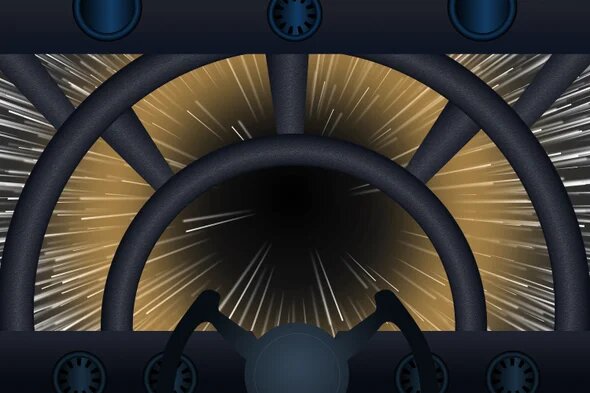
If you could observe the Unruh effect in person, it might look a bit like jumping to hyperspace in the Millennium Falcon—a sudden rush of light bathing your view of an otherwise black void. As an object accelerates in a vacuum, it becomes swaddled in a warm cloak of glowing particles. The faster the acceleration, the warmer the glow. “That’s enormously strange” because a vacuum is supposed to be empty by definition, explains quantum physicist Vivishek Sudhir of M.I.T., one of the study’s co-authors. “You know, where did this come from?”
Where it comes from has to do with the fact that so-called empty space is not exactly empty at all but rather suffused by overlapping energetic quantum fields. Fluctuations in these fields can give rise to photons, electrons, and other particles and can be sparked by an accelerating body. In essence, an object speeding through a field-soaked vacuum picks up a fraction of the fields’ energy, which is subsequently reemitted as Unruh radiation.
The effect takes its name from the theoretical physicist Bill Unruh, who described his eponymous phenomenon in 1976. But two other researchers—mathematician Stephen Fulling and physicist Paul Davies—worked out the formula independently within three years of Unruh (in 1973 and 1975, respectively).
“I remember it vividly,” says Davies, who is now a Regents Professor at Arizona State University. “I did the calculations sitting at my wife’s dressing table because I didn’t have a desk or an office.”
A year later Davies met Unruh at a conference where Unruh was giving a lecture about his recent breakthrough. Davies was surprised to hear Unruh describe a very similar phenomenon to what had emerged from his own dressing-table calculations. “And so we got together in the bar afterward,” Davies recalls. The two quickly struck up a collaboration that continued for several years.
Davies, Fulling and Unruh all approached their work from a purely theoretical standpoint; they never expected anyone to design a real-world experiment around it. As technology advances, however, ideas that were once relegated to the world of theory, such as gravitational waves and the Higgs boson, can come within reach of actual observation. And observing the Unruh effect, it turns out, could help cement another far-out physics concept.
“The reason people are working on the Unruh effect is not because they think that accelerated observers are so important,” says Christoph Adami, a professor of physics, astronomy and molecular biology at Michigan State University, who was not involved in the research. “They are working on this because of the direct link to black hole physics.”
Essentially, the Unruh effect is the flip side of a far more famous physics phenomenon: Hawking radiation, named for the physicist Stephen Hawking, who theorized that an almost imperceptible halo of light should leak from black holes as they slowly evaporate.
In the case of Hawking radiation, that warm fuzzy effect is essentially a result of particles being pulled into a black hole by gravity. But for the Unruh effect, it’s a matter of acceleration—which is, per Einstein’s equivalence principle, gravity’s mathematical equal. Read More...