Portugal’s Tage Studios Promises to Be Europe’s First Entirely Green Shooting Facility
-
 Loading...
 - Tiago Rodrigues
- 23 Mar 2023
- 67 Views
- 0 Like
- 0 Comment
This story is part of The Hollywood Reporter’s 2023
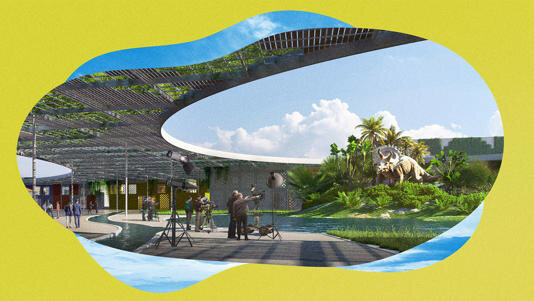
Just outside of Lisbon, plans are underway to build Europe’s, and maybe the world’s, first truly green film studio. The €200 million ($215 million) Tage Studios project, which is set to begin breaking ground near the town of Palmela, southeast of Lisbon, in late 2024 or early 2025, would be the first backlot in Europe built top to bottom with environmental sustainability in mind. Every soundstage and facility building is designed to be a near-zero-energy structure, with rooftop photovoltaic panels providing electricity and rainwater recovery and reuse systems cutting down on water waste. Landscaping will be done to ensure preservation of local biodiversity. Even much of the material used for construction will be locally sourced and/or recycled, with at least 85 percent recovery of all site construction waste.
“The idea was to create a benchmark studio, one that will be eco-friendly and self-sustainable from day one, making it the world’s first for film and television facilities,” says David Hallyday, founder and director of Tage Studios (and, in his day job, a French singer-songwriter and son of late Gallic rock legend Johnny Hallyday, aka the “French Elvis”). “When we started this project, five years ago now, we couldn’t find any studio anywhere that was designed like this, to be a green facility from the start.
“There are a lot of measures that we are taking during construction to save resources, from water to energy to things like lighting and heating,” says Maria Quiros Grande, a real estate director at consultancy giant Deloitte, which is advising Tage on the environmental design of the studio. “We know, for example, that our solar panel system will provide 100 percent of the energy consumption for the studio during the day and more than 50 percent overall.”
Tage Studios’ design will also take into account the operation’s broader environmental impact, with planners working with ecologists to preserve local biodiversity and reduce damage to flora and fauna in the region. “Biodiversity is something that will be integrated into every stage of the project,” says Grande. “It impacts things as seemingly trivial as window design. All our windows will be deglazed to avoid bird collisions. And the lighting system will be such so that there is minimal light pollution, and operations at night do not disturb the nocturnal rhythms of the surrounding wildlife.” Read More…