
Pride at Play is a wonderful celebration of queer games
-
 Loading...
 - aalbrecht emma
- 27 Feb 2023
- 67 Views
- 0 Like
- 0 Comment
The history of queer art, particularly queer video games, is poorly documented – thanks to decades of neglect, and selective curation with often purposeful ignorance. But queer stories can tell us so much about life, culture, and creativity. Each tale reflects the values of its times, and represents progress in its many forms. Pride at Play, a new games-focused exhibit showing at the University of Sydney during Sydney WorldPride 2023, aims to correct this imbalance, with a public showcase of queer games and history open to everyone.
With the opening of Pride at Play, the Macleay Building (A12) at USYD has become a thriving hub of activity. On walls littered with screenshots and interviews with queer game developers from Australia, New Zealand, Japan, the Philippines, and Malaysia, the dense history of queer games is celebrated enthusiastically.
Unpacking‘s tale of self-discovery and queer love is spelled out, with its path to award-winning success explained as part of a wider movement towards acceptance of mainstream queer stories. ‘I feel that queer games can be just as commercially viable as any other game,’ Wren Brier, developer at studio Witch Beam shared with Pride at Play. ‘There are publishers and investors out there who are interested in bringing different stories and experiences to players, and queer stories are a good fit for that.’
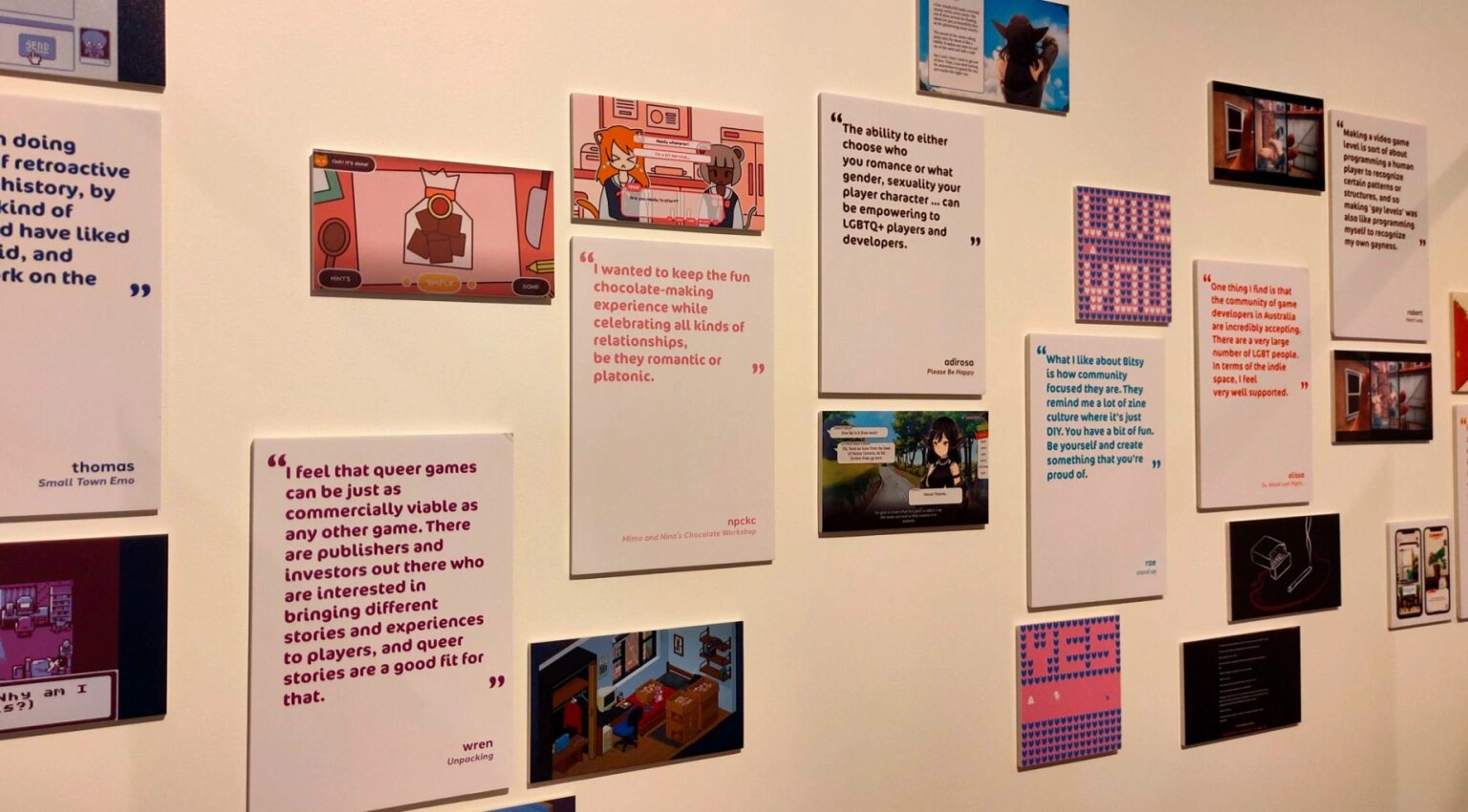
Adirosa, one of the developers of Please Be Happy, a romantic adventure about a young Korean fox spirit who finds a place in a magical version of Wellington, New Zealand, shared their journey of empowerment in the Pride at Play showcase. ‘The ability to either choose who you romance or what gender, sexuality, your player character … can be empowering to LGBTQ+ players and developers,’ Adirosa said.
Likewise, Thomas of Fnife Games described how Small Town Emo, a Game Boy-style adventure game about working through an awkward crush, allowed them to explore their own identity, and embrace a sense of belonging that was previously hard to grasp. ‘I feel like I’m doing some kind of retroactive rewriting of history, by making the kind of game I would have liked to see as a kid, and having it work on the hardware,’ Thomas said.
Elsewhere in the Pride at Play showcase, other queer stories were on full display, painted on walls and shared on monitors inviting keen viewers to engage with winding explorations of gender, sexuality, and the human (and occasionally not-so human) need to connect.
Via a projector, a group of attendees sat around playing Lilypad Days, an adorable pixel adventure about a young frog stuck in lockdown in the animal kingdom, looking for love in the world of online dating. The ‘queer-positive’ game had an entire group in the Pride at Play media session enraptured, as each dialogue choice played out.
It wasn’t the only game to attract an audience, with plenty of folks gathered around computer screens – and the awaiting tabletop. There was plenty on show, including a number of standouts:
In Our Mundane Supernatural Life, a storytelling card game for two players, you must attend to the needs of your partner, noting how their unique quirks – lycanthropy, being a ghost, being employed as an accountant – may change your interactions, and their daily life.
In Kinder World, you must look after yourself by healing through houseplants, taking mindful steps towards self-understanding with the help of an adorable non-binary puppy.
In “so, about last night…”, you wander through a fictional Los Angeles, at the mercy of a strange ‘disease’ you caught from another woman – one that comes with fangs, and a taste for blood.
In Wylde Flowers, you forge new relationships with friendly neighbours, in a town where queerness is accepted, but being a witch is not.
Each of the queer games shared in Pride at Play spotlight aspects of lived experiences – deep, emotional connections, the impact of heartbreak, the intricacies of the human body, and the importance of belonging. Taken as a whole, the exhibit presents a wonderful insight into the modern queer experience, while also enlightening visitors to a history that’s often been forgotten. Read More…