Rare five-planet alignment to dazzle the night sky
-
 Loading...
 - Bahiti Salem
- 22 Jun 2022
- 164 Views
- 0 Like
- 0 Comment
We had the strawberry supermoon earlier in the month, the summer solstice on the 21 June, and now we’re being treated to an exciting planetary alignment.
The last time the planets aligned in a similar way was back in 2004, and it won’t happen again until 2040, so it’s worth getting a glimpse if you can.
One of the best things about this planetary alignment is the brightness. Under clear skies, it should even be visible from cities and towns, and you’ll need an unobstructed view of the eastern and southern horizon.
But when exactly can you see these planets performing their majestic line-up? And which constellations will each of the planets appear in? Answers to these questions, and more, are below.
If you’re looking forward to making the most of clear nights this year, why not plan ahead with our full Moon UK calendar and astronomy for beginners guide? There are also plenty more meteor showers due to light up the skies in 2022, including the Perseids, Orionids and Geminids. We’ve rounded them all up in this handy meteor shower calendar.
Which planets will I be able to see?
The five bright planets will be visible with the naked eye, and rather excitingly for stargazers, will appear in the same order as they are in their orbits around the Sun.
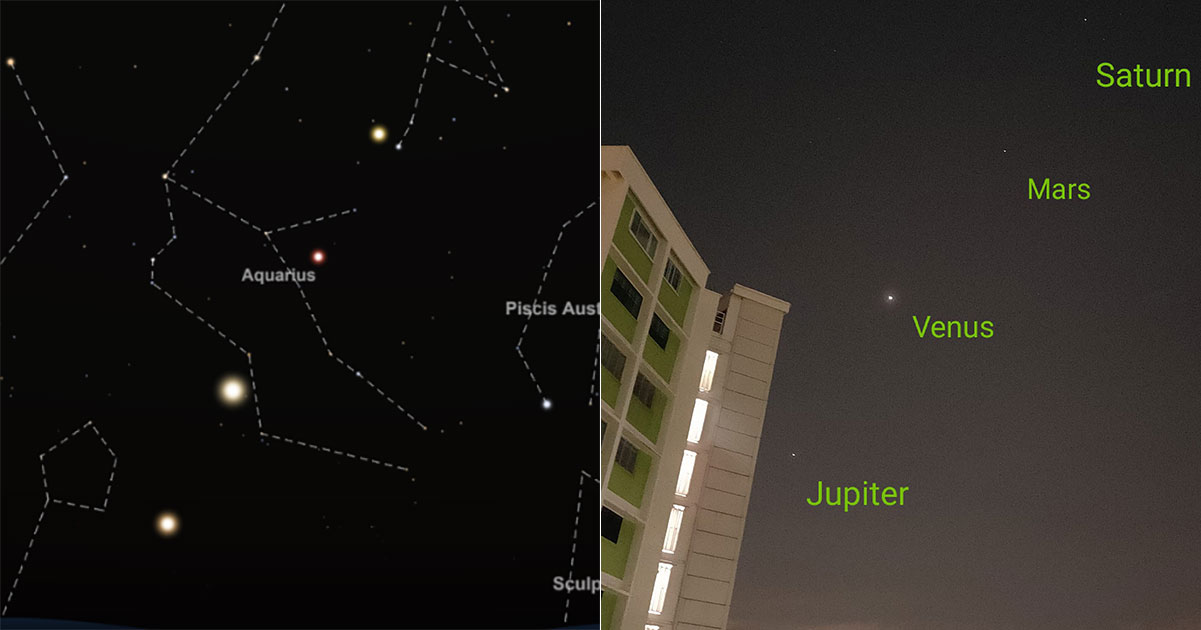
From the east-northeast horizon looking towards the right, you’ll be able to see Mercury, Venus, Mars, Jupiter and Saturn with the naked eye. If you have a pair of good binoculars or a telescope, you may also be able to glimpse Uranus between Venus and the Moon, although it is difficult to see, and conditions will need to be near-pristine for this.
A waning crescent Moon will join the party from 23 to 25 June and will mark Earth’s relative position between Venus and Mars. From 26 June, the Moon will start to shift closer to the horizon, appearing to move backwards through the planetary line-up, moving first past Venus and then Mercury before slipping below the horizon to the left of the planets.

When can I see the planetary alignment?
You’ll need to get up early to see this planetary parade at its best, around an hour before dawn on the morning of the 23 and 24 June 2022, when Mercury rises above the horizon.
The best time to see the planets align will be between 3:39am and sunrise at 4:43am on the morning of 24 June 2022.
Saturn will be the first of the planets to appear, rising above the horizon just before midnight. Saturn’s rings contribute to its brightness (and therefore our ability to see it with the naked eye) and like much in astronomy, the appearance of Saturn’s rings is cyclical. As viewed from the Earth, the planet is gradually becoming more edge-on, and will be completely edge-on by 2025. During the planetary line-up in 2022, Saturn will appear in its classic representation with its northern hemisphere tilted towards us, and the rings clearly visible through a telescope, sitting between the constellations Aquarius and Capricornus.
Jupiter will be next to rise, around 1:07am in the early morning of the 24 June. It will shine brightly, more than twice as brightly as Sirius, the brightest star in the night sky, and will sit in the constellation Pisces.
Next, Mars will rise at around 1:37am, and you’ll be able to recognise it by the distinctive orangey-yellow hue. Mars will join Jupiter in the constellation Pisces.
Venus will be the penultimate of the planets to rise at 3:03 am, becoming the brightest member of the line-up. Venus will sit in the constellation Taurus, and on a clear night, you might also be able to make out the Pleiades star cluster above it.
Mercury is the fifth, and last, planet to join the heavenly hurrah, which starts to peep above the horizon from 3:39am. The small planet will join Venus in Taurus and will remain near to the horizon until the sunrise at 4:43am washes all planets from the sky.
Over the next few months, the planets will spread out, and the line will disperse. Read More...