Rock Climbing in Korea
R.O.K. Climbing: Vertical Endeavors in Korea
Why the hell am I doing this?
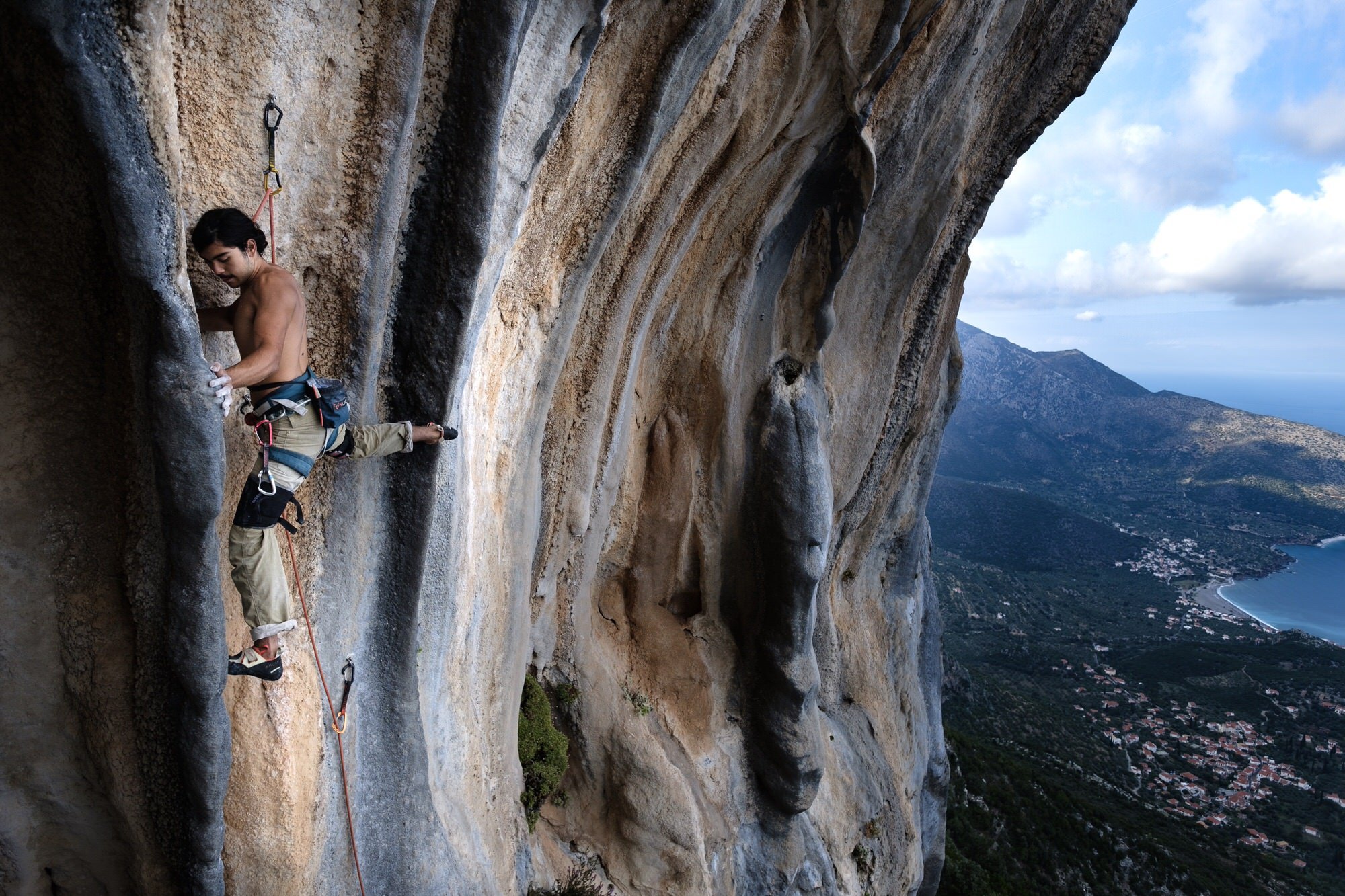
The question invariably passes through the psyche of every rock climber at some point, often when clinging desperately to some obscure dime-edge of granite, shaking, exhausted, sweating, frantically attempting to push fear and the thought of falling into the far recesses of the mind while fumbling to clip the rope through a carabiner. It’s a gripping moment, and the thought claws at the brain’s more gravity-compliant sensibilities with the threat of paralyzing panic. But the moment quickly passes, the clipping of the rope is successful, and safety from a fall is quickly reinstated. Exhale. Rock climbing in Korea is amazing with its beautiful landscape.
In many ways, rock climbing isn’t a rational pursuit. It goes against everything our brains and bodies are naturally inclined to do. Having both feet firmly planted on terra firma implies safety—grappling with various granite outcroppings forty meters off the deck does not. But climbing is only as scary or adrenaline-fueled as the climber wants it to be, provided that the climber is safe and knowledgeable.
Hollywood productions such as “The Eiger Sanction,” “Cliffhanger,” and “Vertical Limit” would have the common viewer under the impression that rock climbing is better reserved for neon-clad adventure addicts stimulating their own adrenal glands for more stoke juice. In reality, climbing is quite the opposite. Core strength and proper footwork quickly trump upper body build.
The unlikely equipment failures that seep through the storyline and drive the ill-fated plot of “Vertical Limit” are rare and are nearly always avoidable. “For those who see climbing as a dangerous or scary activity, but want to try it out, I always say that yes, indeed, it [can be scary or dangerous], but it doesn’t have to be,” says Peter Jensen-Choi, who owns and operates Seoul-based climbing guide service Sanirang Alpine Networks. “A person’s first few experiences out on the rock count for a lot, so it’s important for these experiences to be an especially safe, positive, friendly, and trouble-free introduction.”
Rock Climbing in Korea
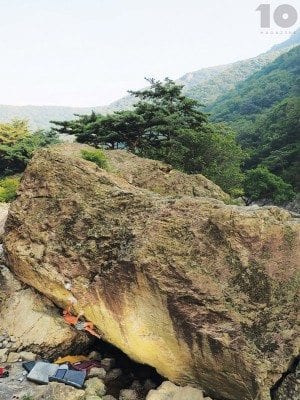
For being such a small nation, South Korea boasts a respectable amount of rock. Climbers have discovered and developed nearly every inch of an exposed vertical face with the same fervent sense of urgency that helped the populace rise from post-war poverty to a state of economic prominence. Despite this, the country remains a relative unknown in the international climbing circuit. It lacks the dripping limestone overhangs and seaside white sand approaches of Thailand and Vietnam, the eternal sprawl of warped sandstone boulders of South Africa, and southern India’s granite outcroppings strewn between ancient Hindu temples.
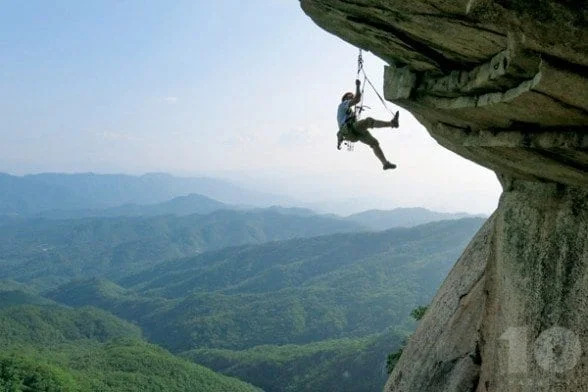
If Korea isn’t a preeminent international destination, however, then it certainly has a top-tier variety of climbing to offer residents. Rolling mountains cover roughly 80% of the country, exposing rock everywhere from the long granite lines of northern Gangwon’s Seoraksan National Park to seaside sport climbing on the southern tip of the peninsula. In between the abundance of natural rock is a myriad of steeply overhanging outdoor walls, impossibly small basement bouldering gyms, and indoor artificial ice walls. All of which have been quietly churning out world-class competition climbers and alpinists alike, including recent IFSC lead climbing world champion Jain Kim; 2013 UIAA overall lead ice climbing winner Hee Yong Park; and accomplished alpinist Chi Young Ahn. Who recently made the alpine-style first ascent of Pakistan’s Gasherbrum V with Nak Jong Seong.

Although climbing is beginning to take hold with younger generations in Korea, those who climb regularly outside typically hail from an older demographic, especially when compared to other niche sports such as surfing. “One thing that stood out straight away was the age diversity of the people dedicated to climbing,” says Madeleine Carlsson, a Swedish professor living in Seoul. “Before coming to Korea I never had any friends over 40, nor did I know anyone as mentally and physically strong as the older Korean climbers I go climbing with on a weekly basis.”
The group mentality that pervades much of Korean culture is also present in climbing. Large groups are common at outdoor climbing areas, and trips are typically done with entire climbing clubs or gyms. Korean climbers tend to focus heavily on repetition and training, which is especially present in the gym culture. “I pretty much spent my first two years with no foreign friends,” recalls American Sonia Knapp.
“Koreans train hard, and in the first year I went from 10b to sending my first 11d.” In a similar vein, Eimir McSwiggan, who had never climbed consistently before leaving Ireland to teach English in Korea in 2009. She attributes much of her ice climbing success to the regimented work ethic of Korean climbers. McSwiggan competed in the 2013 and 2014 Korean installments of the UIAA Ice Climbing World Cup (finishing 13th overall the latter year), and hopes to travel to compete in other legs of the circuit in 2015.
As with all communities rooted in expatriate life, the foreign climbing contingent in Korea draws from a constantly rotating pool of faces. Despite this (or perhaps because of it), the community remains tightly woven and inclusive. “It’s easy for a lot of people to get into climbing here because everyone is super supportive of beginners and everybody has an extra gear and is willing to take out newbies,” says Theresa Mowat, who learned to rock climb after coming to Korea in 2009, and has gone on to climb in China, India, Greece, South Africa, Turkey, and Thailand.
“When I was first getting into climbing I liked the sense of community. I would take a bus-train-bus-taxi to some random crag in the middle of nowhere with a bunch of people and go climbing and camping for the weekend. It was an adventure.”
People who were experienced climbers before moving to Korea share a similar sentiment. “I started climbing in Squamish, British Columbia,” says Chloe Sharpe, who has been teaching in Korea since 2012. “[BC] attracts climbers from all over the world, [and] the community is so large that I often found it difficult to find a solid crew of people to climb with. Korea welcomed me into its small community, and I found that there was a lot of support and encouragement from others, even from people I had just met.”
The accessibility of route information and the ease with which people organize climbing trips and find climbing partners in Korea has not always been as prevalent as it is today. Prior to the widespread use of social media, the foreign climbing population existed mostly in isolated pockets spread across the country. Limited English resources made it difficult to find partners, and the majority of expats climbed with their local Korean climbing gyms or clubs. “The expat climber scene was pretty scattered and small in comparison to today,” says Jake Preston, who has lived and taught in Korea since 2001. “Via the grapevine, we knew of a few expats here and there, but there were no Facebook, Twitter, or smartphones then. Hell, most of us didn’t even have a cell phone!” Read More…