Russia’s Crude Exports Still Show Little Sign of Production Cuts
-
 Loading...
 - Helena Guskov
- 28 Apr 2023
- 65 Views
- 0 Like
- 0 Comment
Russia’s crude oil exports are showing no sign of dropping, even as the government says output has been cut.
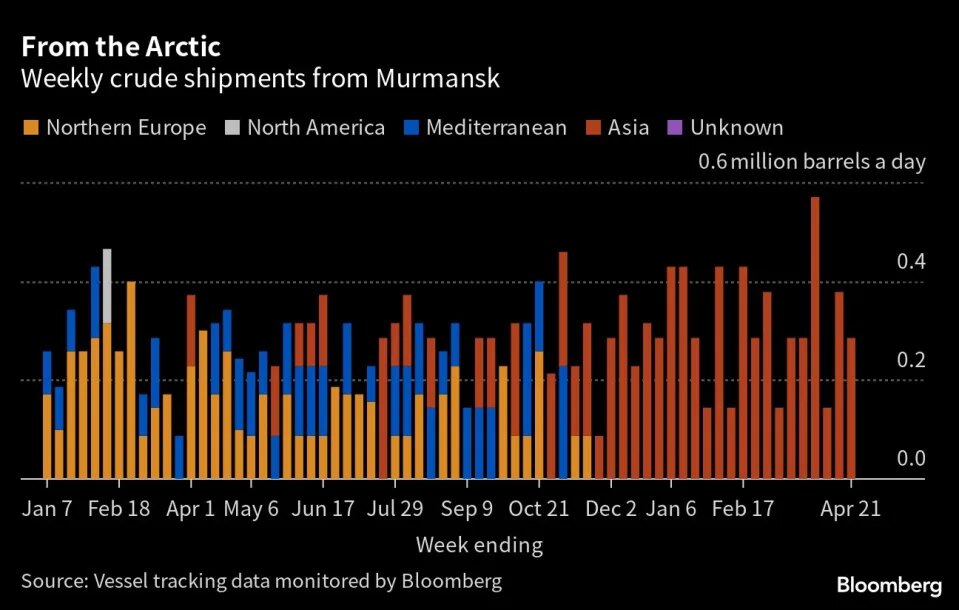
Flows from Russian ports were virtually unchanged after the previous week’s recovery, averaging 3.4 million barrels a day, according to tanker-tracking data compiled by Bloomberg. Strong demand from Russia’s remaining buyers — mostly confined to China, India and Turkey — helped volumes hit a new high on a four-week average basis.
Seaborne exports still aren’t reflecting a production cut that Moscow’s energy ministry said was as big as 700,000 barrels a day in March. It doesn’t appear that refinery runs in Russia have dropped much either. The latest figures show processing rates remain virtually unchanged from the start of the year and, up to April 19, were 720,000 barrels a day higher than the same full month last year.
The output reduction, which was scheduled to begin in March, ought to have started to show up in export figures by now, but it hasn’t. Russia has relatively little storage capacity that it can use as a buffer against a production cut. With most of the tanks required for the normal operation of the country’s vast pipeline network, it’s unlikely that exports have been maintained by draws from storage tanks.
The diversion of crude previously delivered to Poland and Germany through the Druzhba pipeline has boosted seaborne flows during the early part of this year to an average of 3.32 million barrels a day, compared with 2.94 million barrels a day during the equivalent period at the end of 2022. Flows to Germany halted at the end of 2022 and deliveries to Poland were stopped in late February. Poland’s state-controlled oil refiner PKN Orlen SA has terminated its last contract with a Russian supplier in response to the halt in oil shipments via Druzhba. Read More…


