Santa Fe de Antioquia and highlands of Colombia's Occidente
-
 Loading...
 - Lisbeth Medina
- 09 Sep 2022
- 65 Views
- 0 Like
- 0 Comment
At the final climb to reach one of Colombia’s most well-preserved heritage towns – Santa Fe de Antioquia – a giant fluorescent green iguana gazes out at the highlands from behind a waterslide. What surprises me isn’t finding a reptile so close to the road, but rather, one made from fiberglass to draw attention to the local aquatic theme park Kanaloa. Then again, with Santa Fe de Antioquia nestled in a brush forest, the region clearly is inspired by its local fauna.
Two hours on a “bullet bus” from Medelli?n’s northern bus terminal Terminales de Transportes del Norte, and you enter the heartland of the 19th century Antioquia colonization, and by the number of luxury 4x4s on the road laden with sacks of food, seems still on-going and pushing speed limits.
Medelliin’s urban patchwork unravels at the edge of the Valle de Aburrá, and during the next 80 km on the San Jerónimo road, one can appreciate the many flower farms where, in late August, silleteros elaborate their colorful flower tableaux. Thanks to a time-saving tunnel and fast descent to the Cauca River, the verdant green ridges of the western highlands give way to orchards, palms and brute force of nature evidenced by giant smooth boulders. Passing a suspension bridge, a Chiva joins us on the road and announces our imminent arrival in Santa Fe de Antioquia.
Founded in 1541 by Marshall Jorge Robledo, Santa Fe is home to many well-preserved colonial buildings and a pristine central square that rivals others in the department, among them Tamesis, Jardín and Jericó.
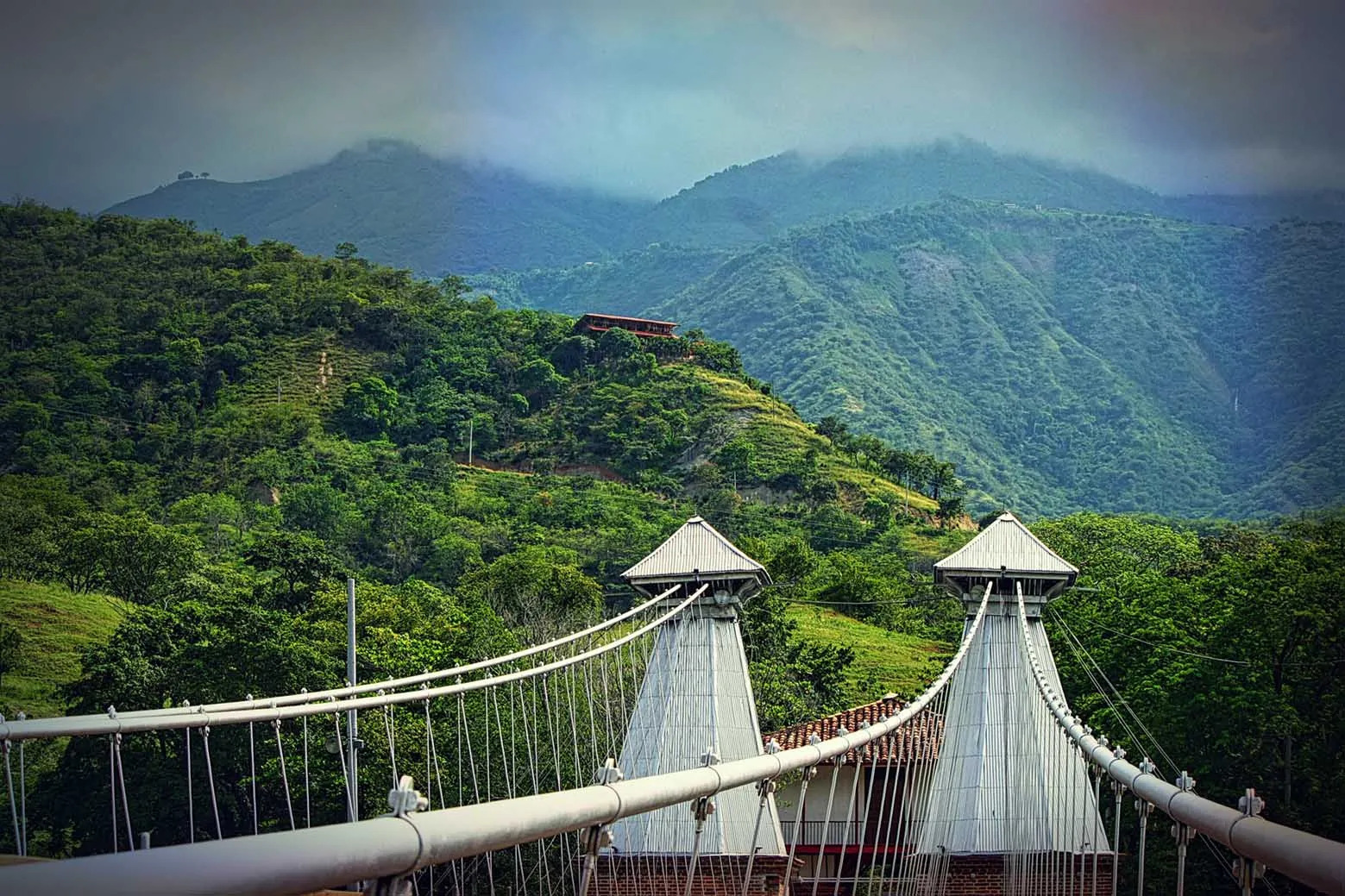
It was in the mid 19th century, however, that engineer José María Villa gave the town one of the architectural marvels of the new Republic, Puente de Occidente, designed to unite the Pacific lowlands with the interior. María Villa went on to work on the construction of another landmark: Brooklyn Bridge.
The construction of the Medellín to Urabá highway put the old Santa Fe – Sopetrán road out of commission, and today, Robledo’s bridge stands as a monument to the enterprising spirit of Antioqueños.
Because Santa Fe is an easy day trip from Medellín, join the tourists with a walk across the 291 meters of the old bridge, which offers spectacular views of the Cauca River. On its silent run to join the Magdalena River, the Río Cauca has witnessed every period in Antioquia’s history: from the age of mules and coffee to the industrial revolution powered by coal and steam. Read More...