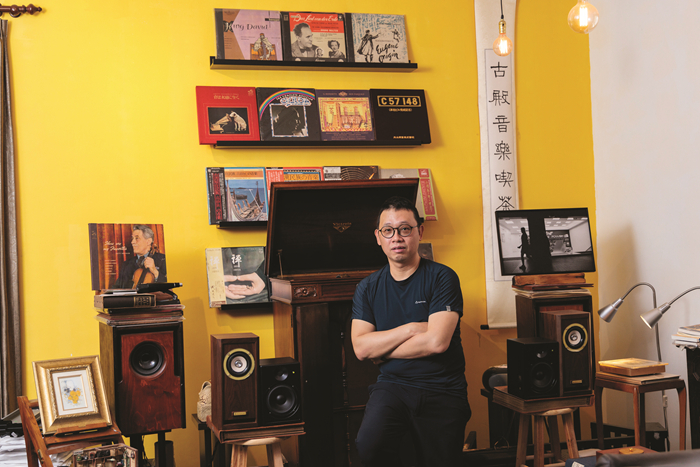
Sound Tripping: The Life of a Vinyl Record Transcriptionist
-
 Loading...
 - Ndari Aisah
- 12 Oct 2022
- 71 Views
- 0 Like
- 0 Comment
With the rise of digital technology and music streaming platforms, it’s difficult for people nowadays to imagine using a hand-cranked gramophone to play vinyl records. Nevertheless, Friedman Wang (王信凱), founder and director of the Classical Palace Society (å¤æ®¿æ¨‚è—) near MRT Mingde Station (æ·é‹æ˜Žå¾·ç«™), has devoted his entire life to the promotion and transcription of vinyl records here in Taipei.
Differences Between Shellac Records, Vinyl Records, and CDs
Unbeknownst to many, shellac records existed long before vinyl records. “Actually, shellac was sort of the ‘father’ of vinyl,” Wang tells us. “The technology was just beginning to develop at the time, right around the era of the gramophone during the late 1890s to the mid-1900s.” So, what’s the difference? “When shellac records were born, one song could only be pressed on one record. But due to its material, it was very fragile and could be damaged if played too many times,” Wang shares.

“However, with the improvement of technology, people began using plastic instead, which has become what we now know as vinyl records. But, in fact, the appearance is no different. It’s only the material and technology that have changed.”
Modern technology has brought about the digitization of sound. Hot on the heels of cassette tapes, CDs became the more popular music medium. With technology changing every day, the ways of listening to music have undergone change, too. “Actually, with the recent introduction of online music streaming, even CDs are becoming obsolete now!” Wang laughs.

History of Taipei’s Vinyl Records
Shellac records came to Taiwan in the 1910s, during the Japanese era, and began their journey of popularization. The local record industry reached its peak from the 1960s to the 1970s, as the production process of vinyl records was optimized, and so shellac records occupied only a small niche in the market due to its high price. “I remember most of the record stores were clustered in Gongguan (公館), since many of the professors at [nearby] National Taiwan University (NTU, 國立å°ç£å¤§å¸) enjoyed listening, and were the minority who could afford [to buy records]” Wang recalls. Read More…