South Africa grants Putin and Brics leaders diplomatic immunity for summit
-
 Loading...
 - Cortez Javier
- 30 May 2023
- 69 Views
- 0 Like
- 0 Comment
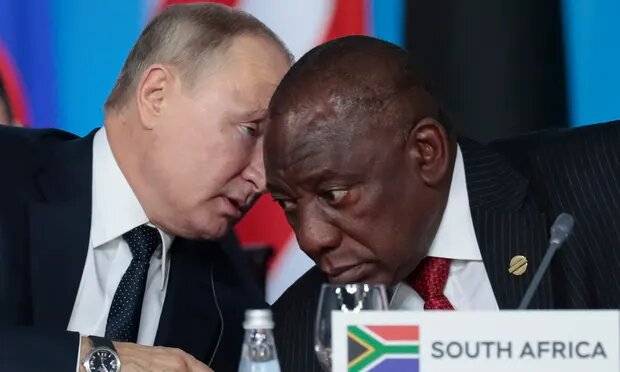
South Africa has granted comprehensive diplomatic immunity to all participating leaders of an upcoming summit in August. This move raises the possibility that Vladimir Putin, the Russian President, could attend the summit in Johannesburg without fear of being arrested based on an international criminal court warrant.
South African officials have emphasized that the broad immunity offer, published in a government gazette, may not supersede the ICC arrest warrant. As a member of the ICC, South Africa faces pressure, and potentially a legal obligation, to apprehend Putin. The court issued a warrant for his arrest in March due to allegations of forcibly deporting children from Ukraine to Russia.
The Brics group, consisting of Brazil, China, India, Russia, and South Africa, will be holding a summit in South Africa in August. A preliminary meeting of foreign ministers is scheduled to take place this Thursday.
On Tuesday, the Department of Foreign Affairs stated, "This is a standard conferment of immunities that we grant for all international conferences and summits held in South Africa, regardless of the participants. The immunities are conferred upon the conference and not specific individuals. Their purpose is to safeguard the conference and its attendees from the jurisdiction of the host country for the duration of the event."
In April, South African President Cyril Ramaphosa established an inter-ministerial committee led by Deputy President Paul Mashatile to examine how the law applies to a potential visit by the Russian President. The government is exploring the wording of the Rome Statute, the charter that established the ICC, in search of a loophole that would allow Putin to attend without South Africa being obligated to arrest him.
Article 98 of the ICC Rome Statute states: "The court may not proceed with a request for surrender or assistance that would require the requested State to act inconsistently with its obligations under international law regarding the State or diplomatic immunity of a person from a third state unless the court can first obtain the cooperation of that third state to waive the immunity." Some argue that this provision provides South Africa with an opportunity to invite Putin without being obliged to arrest him.
A similar controversy arose in 2005 when Sudanese President Omar al-Bashir visited South Africa. He quickly left the country as the South African High Court was likely to rule that he should be apprehended.
Russia has been intensifying its efforts to strengthen ties with Africa as a countermeasure to the strained relations with the West resulting from its invasion of Ukraine. Russia plans to host an Africa-Russia summit in St Petersburg in July.
It remains unclear whether Putin would be willing to help South Africa avoid this diplomatic predicament by not attending the summit in person. On Tuesday, the Kremlin stated that Russia would participate at the "appropriate level." Foreign Minister Sergei Lavrov is already scheduled to attend the planning meeting.
The BRICS group of prominent emerging economies is increasingly viewed as a competitor to the Western industrialized countries in the G7.
When asked about the possibility of an arrest warrant during a regular news briefing, Dmitry Peskov, the Kremlin spokesperson, commented, "Of course, we expect that partner countries in such an important forum will not be guided by such illegitimate decisions."
South Africa has been accused of remaining neutral in Russia's invasion of Ukraine. The US embassy recently alleged that South Africa had supplied weapons to Russia. Support for Russia within the ruling African National Congress (ANC) is strong due to the Soviet Union's historical role in opposing colonialism.
The government's notice regarding immunity, published on Monday, is a routine protocol to protect the conference, according to the Ministry of Foreign Affairs. The ministry added, "These immunities do not supersede any warrants that may have been issued by international tribunals against any attendee of the conference."