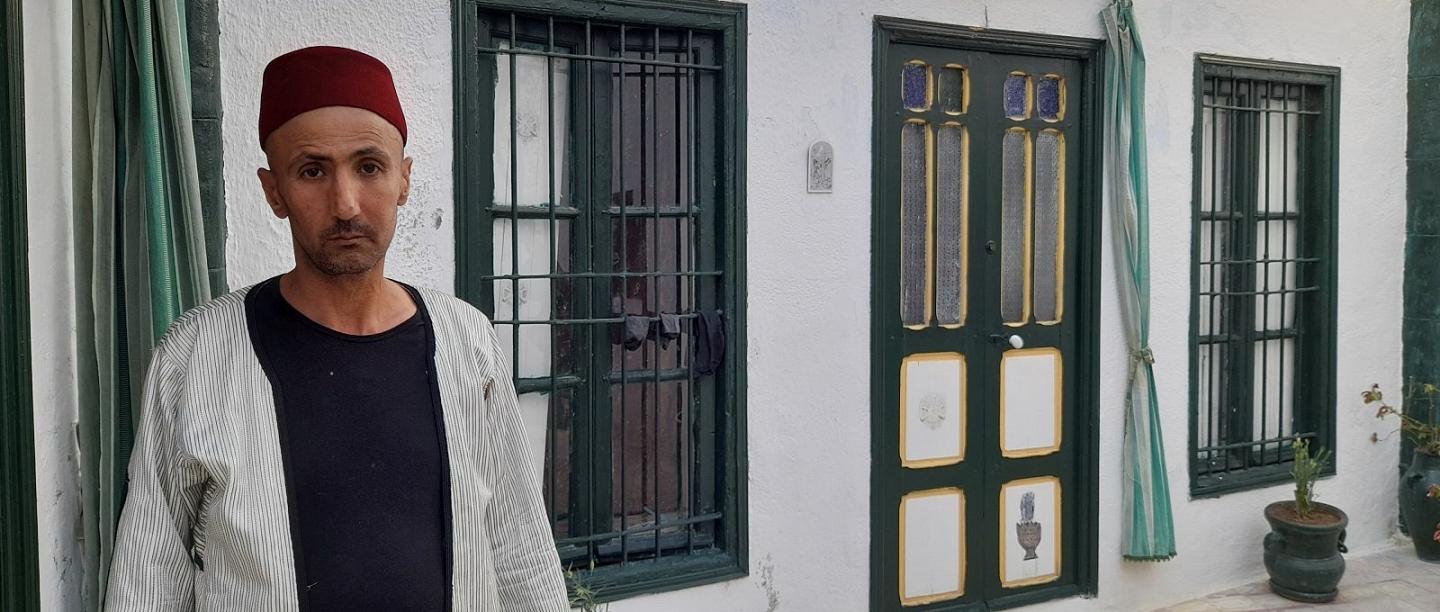
Stambeli's last dance in Tunis

Since the age of 12, Riadh Ezzawech has devoted his life to the practice and dissemination of stambeli, a musical genre that was born with the arrival in Tunisia of thousands of people who were enslaved and uprooted from Sub-Saharan Africa a few centuries ago. Over the past four decades, much has changed, and very little in favour of stambeli, which is now under serious threat of becoming extinct. Saving it from this fate has become the life mission of Ezzawech, a musician who has taken stambeli, which some liken to jazz for its African roots and hybrid character, to stages around the world, to make it known.
At first sight, Ezzawech’s passion for stambeli seemed like one of those fanciful and unlikely loves. There was no apparent reason for the son of a devout middle-class Muslim from Tunisia’s capital to veer towards the practice of an art associated with the descendants of slaves and their animist rituals. “My parents were beside themselves when I told them I wanted to be a stambeli musician. For them, it was a shameful thing to do. But they were not able to stop me,” he explains, with a worn smile. Although not from the Black community, the stambeli masters eventually adopted Ezzawech as a member and taught him all their secrets. For stambeli is, or has been, more than just a musical rhythm.
Aside from the master, who plays a stringed instrument called a gombri, a key figure is the arifa. “Not only did the arifas recite the songs, they also acted as mediators within the community. And when people had an ailment, they would consult the arifa, and stambeli sessions were often part of the cure,” explains Ezzawech, with an air of nostalgia. Modern medicine has put an end to the figure of the arifa, but not to the frenetic and repetitive movements of the dancers seeking to enter a state of trance and connect with a reality beyond the physical.
It is this spiritual dimension that has connected stambeli with Sufism, an iteration of Islam characterised by the worship of holy men as mediators between the faithful and God. The stambeli of today is, in fact, closely linked to Sufism, as the people brought as slaves and their animist rites were Islamised over the years. More than a transposition of a Central African art form to Tunisia, stambeli should, rather, be seen as the fruit of centuries of cultural fusion.
Gentrification and disaffection
This explains why the association that Ezzawech set up in 2016 for the teaching and dissemination of stambeli is in the zawiya – a small Sufi shrine – dedicated to the Sufi master Sidi Ali Lasmar. Sidi Ali Lasmar is laid to rest in one of the rooms of the zawiya, which is located near the ancient wall that surrounded the Medina of Tunis and is a place to which the faithful have turned for help for over five centuries. Yet, as with the musical genre, the existence of the shrine itself is threatened by the process of gentrification underway in part of the Medina.
Following independence, the building was taken over by the state, which went on to sell it to a private investor, despite its value as a cultural and religious heritage site. Since then, the community has religiously paid the monthly rent to the owner, but with his recent death, things have changed.
“His son intends to sell it to a Libyan developer who wants to build a multi-storey building. He is asking us for 120,000 dinars – about €40,000. If we don’t buy it first, he plans to sell it in November. Where can I get such an amount of money? The Ministry of Culture is ignoring us,” says an anguished Ezzawech, who, in addition to leading the Sidi Ali Lasmar musical troupe, is in charge of the zawiya’s maintenance and is battling against the clock to save it. In theory, the state should be responsible for preserving the shrine, but it has not shown any interest, nor has it ever shown any interest in stambeli. Read More…