Swedish museum offers a glimpse into the origins of modern tattooing
-
 Loading...
 - Gracie Johnson
- 07 Feb 2022
- 420 Views
- 0 Like
- 0 Comment
An artifact from the early days of tattooing in Philadelphia is included in a new exhibition at the Swedish American History Museum, in FDR Park.
Harry “Buckie” Buchanan’s name may not be widely known to tattoo enthusiasts, but in the late 19th and early 20th centuries he was considered the tattooist’s tattooist. Buckie influenced generations of tattoo artists, giving some of them ink into their own skins.
“He was part of this generation that really interests me: guys just started tattooing in the late 19th century right when electric tattoo machines were introduced,” said Derin Bray, an historian and collector of vintage tattoo artifacts. “He’s one of these early adopters of electric tattoo machines. As part of this generation that popularized and professionalized tattooing, he’s doing really important work.”
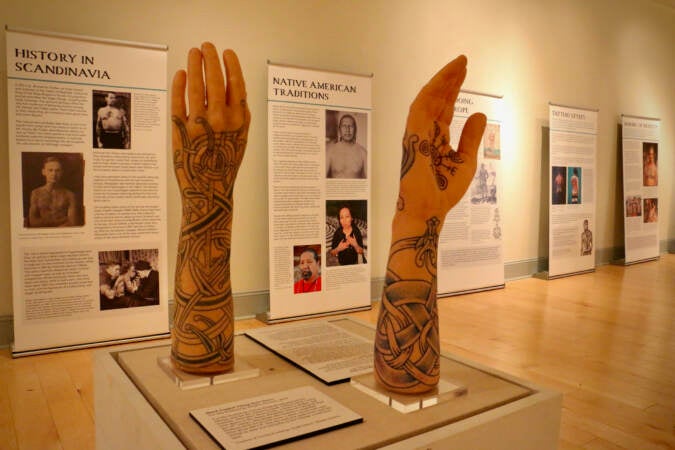
A rare panel of Buchanan’s flash art dating from the 1930s is included in “Tattoo: Identity Through Ink,” now on view at the Swedish museum. The show explains the history of tattoos, which goes back over 7,000 years. Egyptian mummies have been found with traces of ink in their preserved skin, and Japanese clay figurines dating to 5000 BCE have been found with what appear to be tattoo-like decorations.
The exhibition pays particular attention to the Nordic origins of tattoos. The Vikings had “green lines from head to foot,” according to early descriptions written in what is now Russia, although no drawings or physical evidence of Viking body art has been discovered.
If ancient Nordic tattoo style has been lost to time, modern “neo-Nordic” styles use symbolism associated with Vikings and the Norse mythology, such as runes and Thor’s hammer. The exhibition points out that much of the original meanings of those ancient symbols have been bastardized in recent years by neo-Nazi and white supremacist hate groups, which have co-opted those symbols for their own purposes.
“Tattoo” highlights one pioneering Norwegian tattoo artist, Amund Dietzel, who joined the Norwegian navy at 14 years old. He is believed to have gotten his first tattoo at age 15, ultimately most of his body became covered with ink.
He learned how to tattoo at sea as a teenager. When he was shipwrecked off the coast of Quebec in 1907, at just 16 years old, Dietzel made his way to America where he traveled throughout the country performing as the tattooed man in sideshow circus acts.

As with most tattooed circus performers, Dietzel’s body was a form of advertisement for his side hustle: giving viewers tattoos after the show.
“They would draw people in through the spectacle, and then behind the sideshow tent they have a little booth set up tattooing,” said Bray, who publishes books on tattoo history on his imprint Rake House. “They did that in carnival sideshows traveling across the country. It was really through the sideshow and circus that tattooing became popularized, and introduced to rural communities.”
Dietzel eventually settled in Milwaukee, where he ran storefront tattoo shops. He used what was then standard tattoo imagery of nautical themes, pretty women, and hearts with banners, and infused them with clean, bold lines, and modern Art Nouveau and Art Deco stylings.
He became a highly influential mid-century American tattoo artist, dubbed the “Master of Milwaukee” and the “Rembrandt of the rind.” He continued working in Milwaukee until 1967, when the city outlawed tattooing.
“At least it took the city 51 years to find out it doesn’t want me,” Dietzel was known to have said at that time. “Milwaukee used to be a very nice town.”