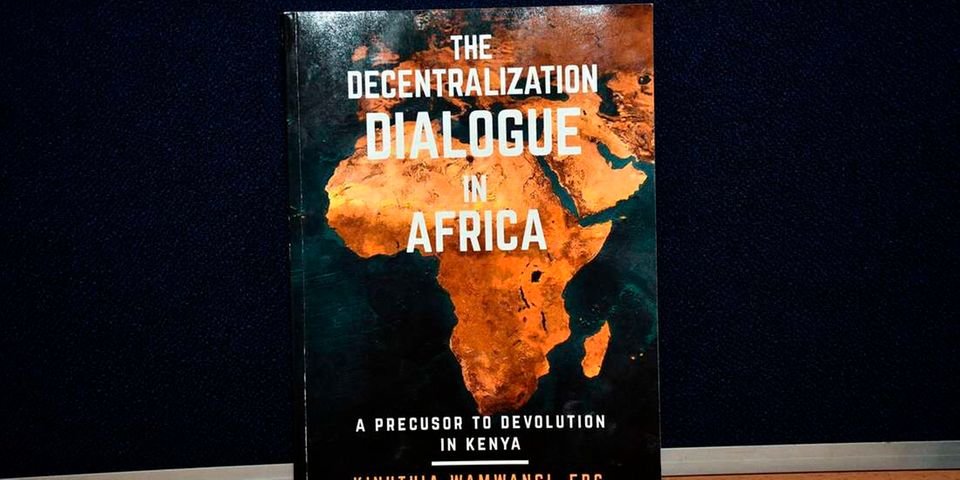
The book 'Decentralisation Dialogue in Africa' offers many lessons on devolution
-
 Loading...
 - David Kipruto
- 07 Jun 2022
- 283 Views
- 0 Like
- 0 Comment
Kinuthia Wamwangi is not just a distinguished local governance expert. The 71-year-old wears many hats.
The Nakuru-born former chairperson of the defunct Transition Authority (TA) is an advocate, a lecturer, human resource manager and a local government administrator.
However, what stands out is his many years of distinguished service during the era of local government system in Kenya having served in various positions in different municipalities.
The decades-long experience with the local authorities saw him being appointed as the pioneer chairperson of TA, a body that midwifed the transition to the current devolved units.
But his experience was not just limited to Kenya as he would also be tapped by Municipal Development Partnership for Eastern and Southern (MDPESA), a World Bank-supported decentralisation initiative covering 25 countries but based in Harare, Zimbabwe, where he served as senior programme officer.
With the vast local and international experience in local governance, Wamwangi has penned a book, The Decentralisation Dialogue in Africa: A Precursor to Devolution in Kenya.
The scholarly book, published by the Jomo Kenyatta Foundation (JKF) Educational Publishers, packs an in-depth analysis of African experience in embracing decentralisation, with Kenya featuring heavily.
Gained prominence
He traces the history, drivers, achievements, opportunities and challenges attendant to the new phenomenon that only gained prominence in the continent in the 1980s.
The author dips into his immense experience to take the reader through the decentralisation journey.
The book contains empirical illustrations and comparative analyses based on the author’s experience, observations, research, teaching and general public engagements as a practitioner, scholar, public administrator and consultant on local government.
Chapter one of the 187-page book opens with definition and concept analysis of decentralisation but also delves deeper into its various forms, motivation for devolution and attendant resistance.
The University of Nairobi alumnus goes on to examine the nexus between decentralisation and development, saying that empirical evidence points to achievements falling far short of stated objectives and aspirations, more so in sub-Saharan Africa. Read More…