The Czech Tiger King
-
 Loading...
 - Honza Kohout
- 18 May 2022
- 289 Views
- 0 Like
- 0 Comment
The US Netflix documentary series Tiger King was released in March 2020 just as most of us were entering Covid lockdown for the first time, and it kept many people happily glued to their TV screens in those first uncertain weeks. The show, with its eccentric characters and bizarre story, may have struck many Europeans as something that could only happen in America. The EU, with its strong rules and regulations, seemed like a world away – most of us, if asked, would probably assume that keeping a tiger as a pet in the EU is illegal. But the Czech Republic, an EU country since 2004, has a huge and roaring exotic animal trade, with a relatively large number of people keeping exotic animals as pets.
Radek was just two years old when his mother married his stepfather and he came face-to-face with his first wild animal. Actually, not just one – several.
“All kinds – from big cats like lions and pumas, and we also had a tiger for a while – and then also other animals like bears and a crocodile and kangaroos.”
Radek’s stepdad also got his introduction to imported species at a young age. His grandmother worked at Prague zoo when he was a child, and that was how he came into contact with the wild and wonderful world of exotic animals.
“He used to spend a lot of time there, like around the zoo, with the animals, and had friends who took care of the animals, like actual employees of the zoo, so I guess at the time when he was still a child, he thought, ok, when I grow up, I’m gonna have animals like these.”
As a result of these friends and contacts in the exotic animal trade, Radek’s stepdad was easily able to make this dream a reality when he got older, and as an adult he started keeping exotic animals at home; first in a cage outside the house, and later at a farmhouse about an hour away from Prague. Radek says he wasn’t very comfortable with the idea of the animals being caged, but they didn’t seem visibly distressed.

“Honestly, I wasn’t that happy about it – I kind of became conscious of them being locked up most of the time, and my stepdad didn’t really have that much time for them at the end. But I guess they could have lived in worse conditions.”
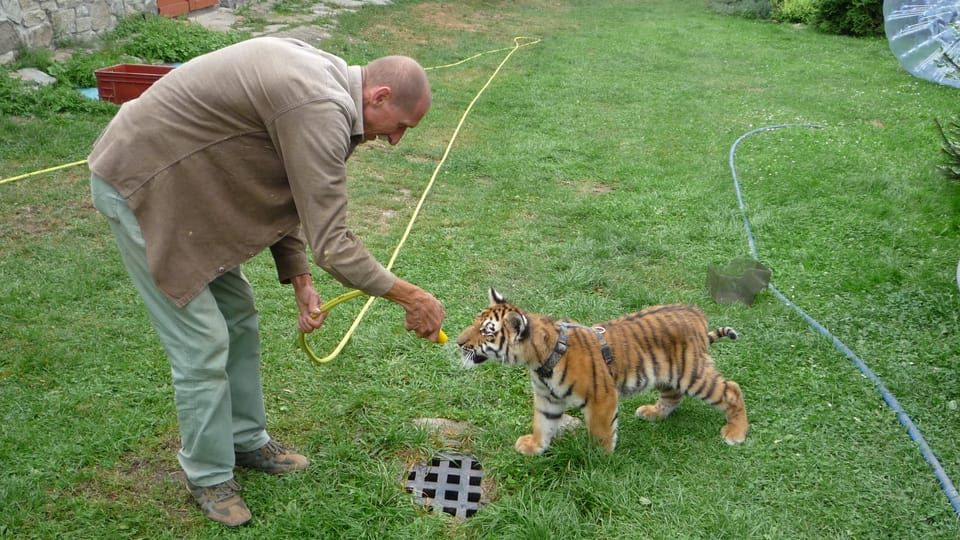
Despite the fact that the animals had a much smaller space to roam around in than they would have had in their natural habitats, somewhat remarkably, Radek’s stepfather did take them out for walks.
“He used to walk them on these iron leashes, like on chains – not that they would suffer or anything, it was just to use something that won’t break when you walk the animal. You can’t use a normal leash like for a dog.”
Occasionally, however, things did go wrong. One time a baby mountain lion escaped.
“There was even a report about it on the TV. They were looking for it all around the village and even in the fields and in the nearby forest and stuff. And then after a day or two somebody found it and brought it back home.”
But despite a few scratches and scrapes, no-one ever got seriously hurt. Radek says that the animals were surprisingly tame, which he explains by the fact that they were mostly raised by his family from birth.
“We got them from a very young age. Some we had our own to keep, but some we had only temporarily to basically raise, for them to get used to people, to be around people and to be nice to people, so they were just your friends, kind of. Of course, they had all these animalistic, wild instincts, but they were still kind of friendly.”

For some, trading in exotic animals is a way of making money, but for Radek’s stepdad, it was a hobby – he enjoyed taking care of them and kept them until the end of the animals’ lives. However, in a few rare cases he sold them, for example, when a pair of pumas had cubs, which happened every year or two, or when an animal grew to be too big to handle.
“Some of the tigers, they can get pretty big you know – several hundreds of kilos – and when they don’t have the best nature, some of them are not that easy to tame and then they can be quite dangerous, so it was probably the better decision to give them to a real professional.”
Sadly, Radek’s stepfather passed away a few years ago, so Radek and his mother had to decide what would happen to the animals once he was gone. Using his stepfather’s vast network of contacts, they gave the animals away for free to what they deemed to be the best homes for them, an offer that the recipients were only too happy to accept given that exotic animals usually come with a hefty price tag attached.
But Radek’s stepfather was not just one lone eccentric guy – there are tens or hundreds of thousands of such people in the Czech Republic, as Pavla Říhová from the Institute for Environmental Studies at Charles University‘s Faculty of Science tells me. Read More...


