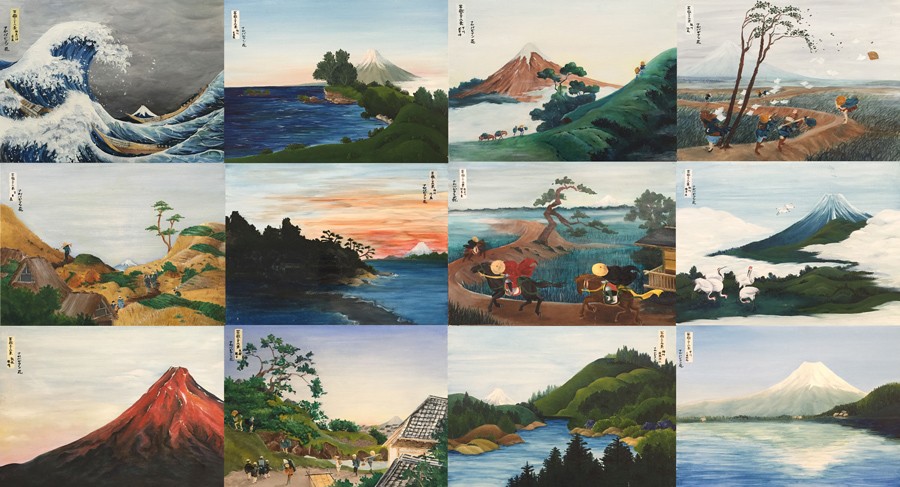
The Faces of Mt. Fuji Through Japanese Paintings
-
 Loading...
 - Akemi Ando
- 28 Apr 2023
- 75 Views
- 0 Like
- 0 Comment
Monochrome ink painting or Suiboku sansuniga was introduced to Japan during the mid-14th century. The early forms of this art were inspired by Chinese ink painting which uses a brush, ink, paper, and inkstone. Nature is the most common subject in these paintings, illustrating landscapes, plants, and animals in different strokes. If there are any humans in the painting, they are typically depicted as minor detail and not given much emphasis.
Over time, Japanese artists created their own distinct styles, leading to the development of paintings that show realistic landscapes known as Shinkeizu. The infamous Mt. Fuji has long been a favourite subject of painters in their work. As changes in artistic styles and techniques began to occur, the representations of this iconic landscape evolved as well. Know more about how realistic sceneries began to emerge in Japanese paintings, and see how this is reflected in Mt. Fuji landscape paintings.
Japan’s Shift From Imagined to Real Scenery Paintings

Around the middle of the 9th century (Heian period), the genre of landscape painting started to take on its Japanese character. Paintings during this time lacked the didacticism of Buddhist symbols and was more inclined to convey the Japanese people’s appreciation for the surrounding natural beauty. Thus, this period saw a widespread decline in the impact of earlier centuries’ Chinese aesthetics and creative models.
Since the 10th century, landscape painting has developed as a distinct genre with the theme of the four seasons (shiki), and, primarily, depictions of specific places famous for historical events, natural beauty, or as pilgrimage sites. Landscapes have continued to be used as a narrative compositional element, evolving from the Chinese concept of figurative scenes set against the local mountain landscape to truly Japanese sceneries.
The meishoe genre, known as “picture of famous places”, produced a number of well-known iconographical cycles that were incorporated in both the vibrant yamatoe style and the monochromatic suiboku sansuniga ink painting. Read More…