The Greek reading guide
-
 Loading...
 - Sadiki Omar
- 28 Feb 2023
- 55 Views
- 0 Like
- 0 Comment
Our selection of Greek books (in English) worth reading
We hope you enjoy this introductory reading guide to Greek books by Greek authors. With more and more translations of Greek literature becoming available and thanks to the modern digital age, accessing the works of modern Greek writers has never been easier. Here are a selection of titles we believe are worth sharing with all of you, wherever you are placed in the world. Happy reading.
Greek Books in English – our latest selection of good reading
The Notary

A wealthy count on his deathbed, his libertine nephew, an upstanding young clerk, and a scheming notary who stops at nothing to protect his daughter make The Notary an iconic tale of suspense and intrigue, love and murder. The classic work of Alexandros Rangavis, The Notary, a mystery set on the island of Cephalonia on the eve of the Greek Revolution of 1821, is Modern Greek literature’s contribution to the tradition of early crime fiction, alongside E.T.A. Hoffman, Edgar Allan Poe and Wilkie Collins.
About the author – Alexandros Rizos Rangavis was born in Constantinople in 1809. He was among many things a poet, author, translator and historian of literature. He was a prominent figure in Greece, serving as a professor of archaeology at the University of Athens, minister of Foreign Affairs and ambassador to Washington, Constantinople, Paris and Berlin. Scholars were interested in his various works including Hellenic Antiquities (1842-1855), Archaeologia (1865-1866) and the first History of Modern Greek Literature (1877). The Notary was among his collection of dramatic works. Although he spent a great part of his life abroad, he lived in Athens where he died in 1892.
The Odyssey – by Homer
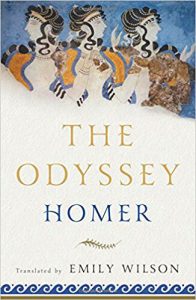
In this fresh and first English translation of The Odyssey by a woman, the stirring tale of shipwrecks, monsters, and magic comes alive in an entirely new way. Written in iambic pentameter verse and a vivid, contemporary idiom, this engrossing translation by Emily Wilson, matches the number of lines in the Greek original, thus striding at Homer’s sprightly pace and singing with a voice that echoes Homer’s music. The Odyssey is a poem about violence and the aftermath of war; about wealth, poverty, and power; about marriage and family; about travellers, hospitality, and the yearning for home.
Wilson’s Odyssey captures the beauty and enchantment of this ancient poem as well as the suspense and drama of its narrative. Its characters are unforgettable, from the cunning goddess Athena, whose interventions guide and protect the hero, to the awkward teenage son, Telemachus, who struggles to achieve adulthood and find his father; from the cautious, clever, and miserable Penelope, who somehow keeps clamouring suitors at bay during her husband’s long absence, to the “complicated” hero himself, a man of many disguises, many tricks, and many moods, who emerges in this translation as a more fully rounded human being than ever before.
A fascinating introduction provides an informative overview of the Bronze Age milieu that produced the epic, the major themes of the poem, the controversies about its origins, and the unparalleled scope of its impact and influence. Maps drawn especially for this volume, a pronunciation glossary, and extensive notes and summaries of each book make this an Odyssey that will be treasured by a new generation of scholars, students, and general readers alike. Read More…