The real story behind the Disney hit movie ‘Encanto'
-
 Loading...
 - Piers Howard
- 01 Mar 2022
- 421 Views
- 0 Like
- 0 Comment
When Alejandra Espinosa read the script for the first time her hands trembled when she saw her name written in a watermark. The plot told the story of a Colombian girl and her grandfather. “No,” she said to herself as she reading, “this story should be about women.” Espinosa was at the Walt Disney Studios in Los Angeles, sitting in front of Jared Bush, the co-director and writer of Disney hits Zootopia and Moana. Now Encanto, the latest production from the famous animation stable set in Colombia, is in theaters following its release last November. Alejandra’s say-so removed that awkward grandfather and gave life to Alma Madrigal, Mirabel’s grandmother and a key character in the movie. There would be many more differences of opinion, but let’s start at the beginning, where the story really began, in a Colombian village where the locals are known as “yellow feet” because of the hue the soil turns the soles of their feet. The story was born in Barichara.
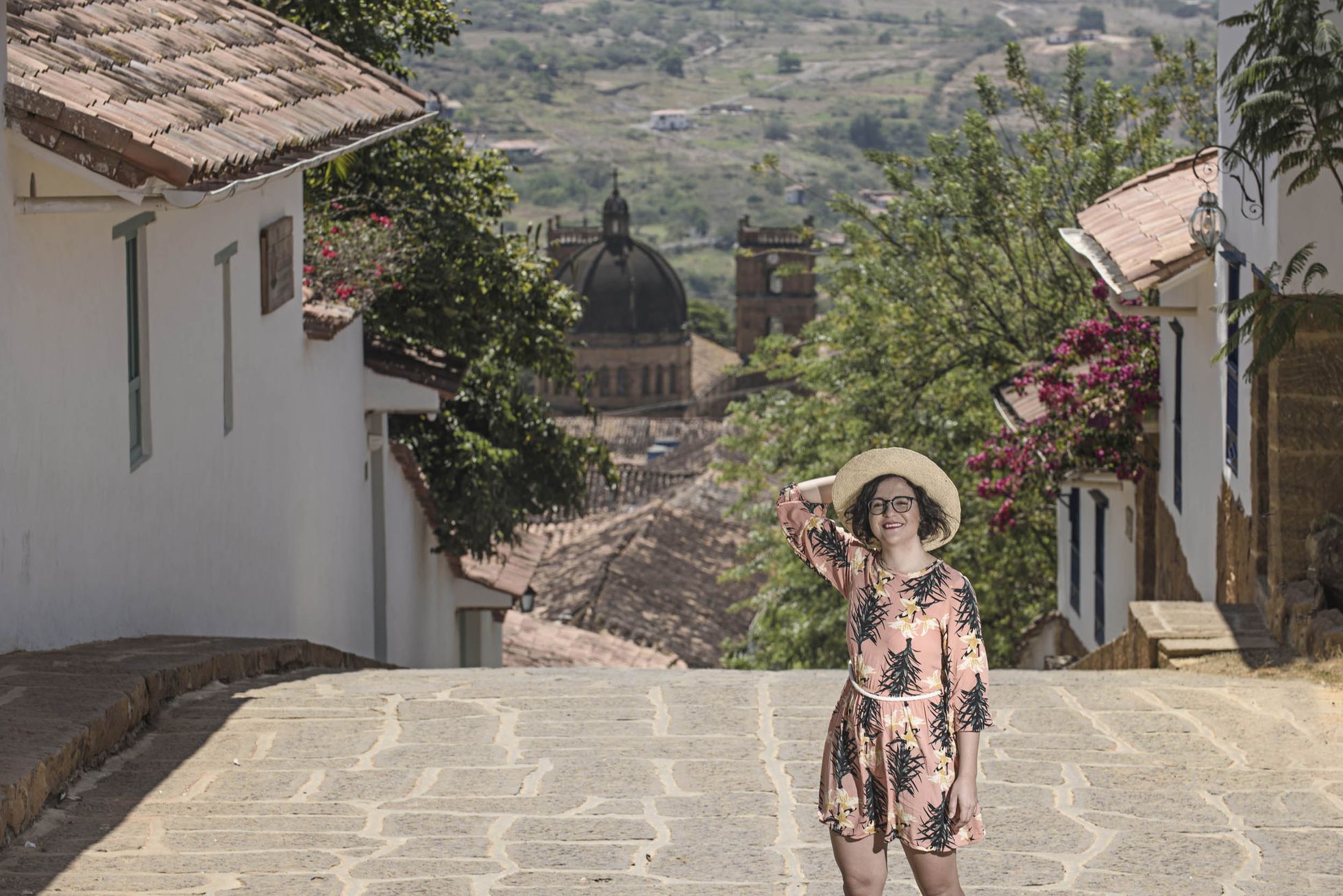
Espinosa was tired of Bogotá. It was 2016, she had recently finished a Literature degree and she wanted to write and paint watercolors far from the vast city in which she had grown up. A trip to Barichara, in Santander Department, seven hours from the capital, had been on her to-do list for several years. “I can paint and you can open a hostel,” she said to her partner at the time. A year later Espinosa, who was born in 1992, had made watercolors of all of the houses in Barichara, as well as every corner of this earth-colored, cobble-stoned town, which has escaped the advance of neon, cement and noise that covers much of the rest of Colombia’s urbanizations. Day trippers, lured by its tag of the “most beautiful town in Colombia,” can buy one of Espinosa’s postcards as a souvenir for a few pesos.
History runs through Espinosa’s veins. Daughter of the historian Diana Uribe, she decided to immerse herself in the culture and tradition of Barichara and Santander, from which she had gained so much. “I was quite shy, I had a kind of incapacity for social skills, and here I felt very confident. I blossomed when I arrived.” Soon she had become the most respected tour guide in the area. And that was what she was doing in 2017 when a phone call changed her life.
Several Disney employees wanted to do a four-day tour of Barichara and were looking for a local guide versed in history and culture. Espinosa signed a confidentiality agreement that said something along the lines of she should forget everything she heard during the visit. She didn’t even Google their names to keep her nerves under wraps and so as not to appear starstruck. But when they arrived, they were the ones who were blown away. There were five of them, among them Bush and Byron Howard, who directed Bolt and Tangled and worked alongside Bush on Zootopia. They asked Espinosa a thousand questions and an instant connection was forged. Her passion for the subject was overwhelming and she steeped them in the kitchens of the townsfolk’s houses, alongside the stonecutters who crafted the streets and among the women of Vélez who for six months of the year sew the colorful skirts whose “Made in China” replicas are now sold in toyshops across the world under the Disney trademark. It was love at first sight.
“I told them: ‘Don’t ruin all of this,’” says Espinosa. “It needed to be treated with a lot of respect, it’s very important because there is a huge stigma attached to Colombia, it is viewed as of little worth, like Mirabel [the movie’s hero]. We don’t know who we are, we are always looking for foreign cultural models to define ourselves. I always placed identity at the center of the debate.”
Espinosa also told them to forget it when they started talking about magical realism, asking them instead to consider Cuban author Alejo Carpentier’s lo real maravilloso (the wonderful real). “Magical realism does not consist of taking gratuitous magic and putting it in the context of a jungle,” she told them. As Colombian writer Gabriel García Márquez once said: “I don’t invent anything, I’ve seen it all or I’ve been told about it.” It is about understanding the cosmovision of the Afro and indigenous worlds. She told them water is sacred for indigenous people. She told them that the miracle that forms the basis of the movie should come from the river.
Espinosa took the Disney tour to a small forest enveloping a few houses, to see the bougainvillea on the balconies and to photograph the best view. When they left, she was exhausted. They promised they would speak to her again soon. She thought it was simply a nice way of saying goodbye. She went back to her happy life in Barichara, proud to have added a small contribution to what was about to be developed by the animation giant, which has given so many generations of children blond princesses to imitate.
Disney contract
A month later, a contract arrived in Barichara from Disney in Los Angeles, in which Espinosa was described as Encanto’s cultural consultant.
“Sometimes I was nervous after taking their calls, thinking to myself: ‘They’re not going to call me again.’ I think that was my value to them. I wasn’t afraid to tell them: I don’t like this, it doesn’t work, it has to be changed. It was important what message the movie was going to transmit to Colombians, which is to see yourself as you are. Mirabel’s search [in the movie] is our own search for self-worth and self-acceptance,” she says. Read More…