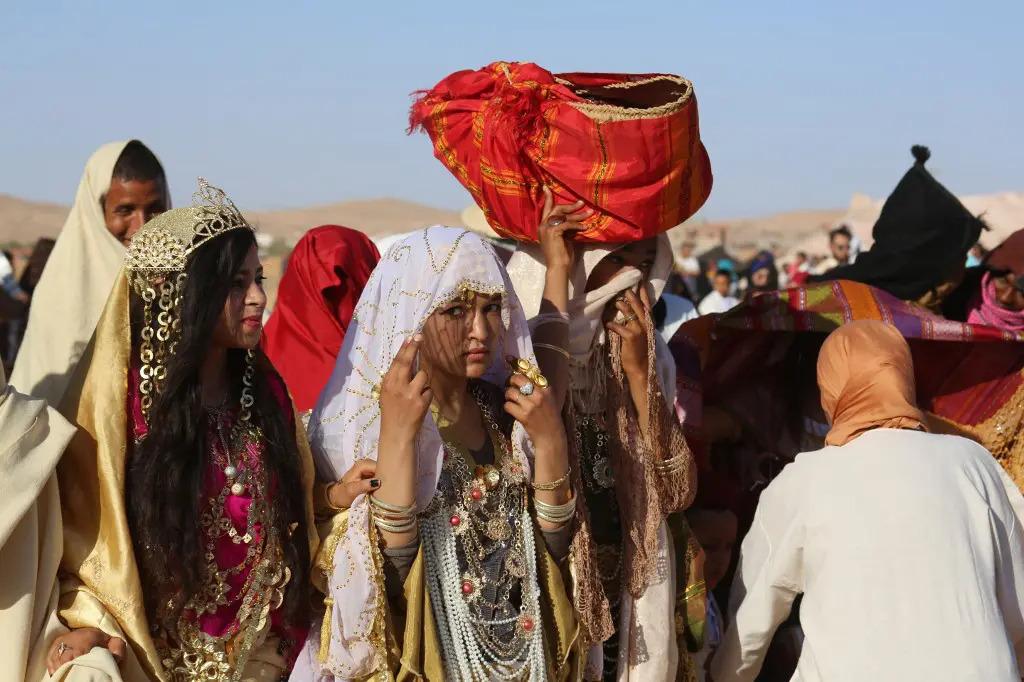
Tunisian Weddings: A Tale of Tradition and Modernity
-
 Loading...
 - Allen Anderson
- 07 Oct 2022
- 74 Views
- 0 Like
- 0 Comment
Halima Ettounsi always wished for a lavish traditional Tunisian wedding.
She describes it as one-of-a-kind and remarkable, “with memories that will last a lifetime.”
“It’s difficult to put into words how it feels. You have to be there to understand how unique it is,” Ettounsi, a social expert, told Fanack.
The North African country, located on the Mediterranean Sea’s coast, is rich in cultural diversity and distinct customs.
Traditional marriages differ by governorate and family, according to Ettounsi.
“Weddings are not standard,” she explained. “It is entirely up to the couple and their family. However, there is always a desire to add a traditional touch.”
Tunisia is rich in traditions passed down from generation to generation, whether it’s food, clothing, music, rituals, or gestures.
Wedding ceremonies in a nation where Islam is practiced by the majority of the population differ from those in other mostly Muslim Middle Eastern countries such as the Gulf and the Levant.
While wedding customs are still practiced across the country, social analysts observe that exorbitant costs, particularly in light of rising inflation rates, signal the beginning of more modest, less extravagant ceremonies.
A brief history
Nestled between Algeria and Libya, Tunisia played a central role in antiquity.
The Phoenicians, master traders and negotiators, chose Carthage in 1814 BCE to construct a great metropolis controlling commerce and extending their political authority.
The Romans then won the Punic Wars against the Carthaginians in 264 – 146 BCE and settled in Tunisia for six centuries where they developed the country’s economy by encouraging local production and exports.
When the Roman Empire fell, Tunisia was invaded by European tribes, most notably, the Vandals before falling under the rule of the Byzantine Empire, which in turn was conquered by the Arabs in 647 CE.
In the years that followed, waves of migration from the Arab and Ottoman worlds turned the population that was previously descended from indigenous tribes into a cultural composite.
Following the French invasion, Tunisia became a French protectorate in 1881. By 1884, the French had taken control of all administrative offices and fostered the installation of French settlements across the nation, increasing from 34,000 in 1906 to 144,000 colonists by 1945, occupying one-fifth of the cultivable land.
This French influence left substantial marks on the language, architecture, and culture, which was more prevalent in the north than in the south, where tradition still dominates till present, according to Tunisian Journalist Imen Bliwa.
“I’m originally from the south but now reside in the north, and the difference is noticeable. While all Tunisians follow the same traditions, northerners are more likely to have western-style weddings,” Bliwa said.
Step-by-step planning
In Tunisia, summer is the unofficial wedding season. Wedding ceremonies are typically three days long, but in other regions, the celebrations can go up to seven days, and in exceptional situations, even longer.
“More rituals entail more spending,” Bliwa explained, “which is why most people stick to 3-4 days instead of the usual 7.” Read More…


