Turkey takes action in bid to curb currency crisis
-
 Loading...
 - Angie.Morgan
- 13 Aug 2021
- 893 Views
- 0 Like
- 0 Comment
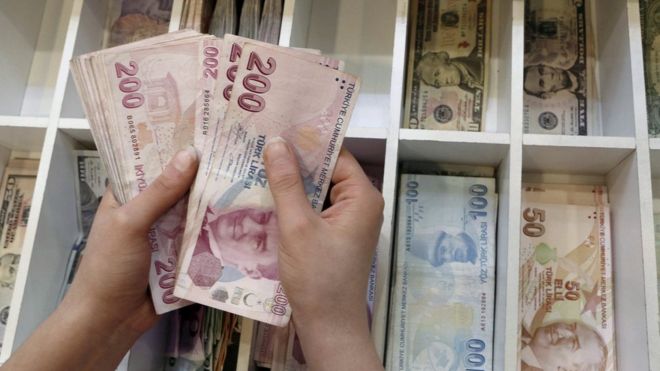
Turkey's central bank has said it is ready to take "all necessary measures" to ensure financial stability after the collapse of the lira.
It has vowed to provide banks with "all the liquidity the banks need".
The comments came after a widening diplomatic spat with the US prompted market turmoil in the country.
Investors were not reassured. Although the lira rose slightly, it still hit a new record low against the dollar and stock markets in Europe and Asia fell.
Before the announcement the lira was down 9% before recovering slightly to be 6% lower at 6.87 per dollar.
Turkey's interior ministry said it was taking legal action against 346 social media accounts it claimed had posted comments about the weakening lira "in a provocative way".
The slide had worsened on Friday, when US President Donald Trump approved the doubling of tariffs on Turkish steel and aluminium, following Turkey's refusal to free an American pastor who has been in detention in Turkey for nearly two years.
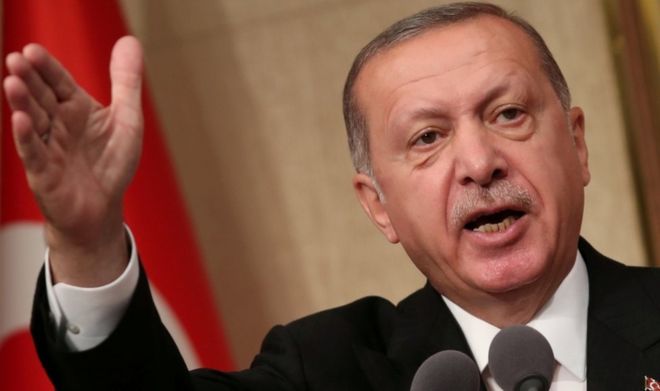
Turkish President Recep Tayyip Erdogan has vowed not to allow Turkey to be "brought to its knees" and has spoken of a plot against the country.
What is happening on the markets?
Before the new measures were announced, Japan's Nikkei 225 had already fallen almost 2% in late trading. News of the announcement did nothing to perk up share values there and it closed down that amount.
Hong Kong's Hang Seng index closed down 1.5%, but the Shanghai Composite recovered from a fall of 1.7% to trade with much smaller falls by the close.
In midday trading in Europe, London's 100-share index was down 0.6%, while the German and French share markets were down by 0.3% and 0.7%.
In Australia, the ASX 200 index lost 0.5%, while South Korea's Kospi index was down 1.8%.
Investors globally are worried about the damage spreading and have been prompted to sell riskier assets, including Asian stocks and emerging market currencies.
Analysts said investors were now looking for safe havens in the form of the yen, as well as the US dollar.
What is the cause of the lira slide?
Experts have blamed the drop in the Turkish lira on fears that the country is descending into an economic crisis.
Turkey's stock market has also fallen 17%, while government borrowing costs have risen to 18% a year. Meanwhile, inflation has hit 15%.
Investors are worried that Turkish companies that borrowed heavily to profit from a construction boom may struggle to repay loans in dollars and euros, since the weakened lira means there is now more to pay back.
Why are Turkey and the US at odds?
The dispute centres on Turkey's refusal to release American pastor Andrew Brunson.
Mr Brunson has been detained for nearly two years, accused of links to the outlawed Kurdistan Workers' Party and the Gulenist movement, which Turkey blames for a failed coup in 2016.
The Turkish president is angry that the US has not taken more action against the Gulenist movement and what he said was a failure "to unequivocally condemn" the 2016 coup attempt. The US has refused to extradite Fethullah Gulen, who lives in Pennsylvania.
US support for Kurdish rebel groups fighting Islamic State (IS) fighters in northern Syria is another major difficulty, given Turkey's battle against a Kurdish insurgency in its own country.
Mr Erdogan has also been getting closer to Russia. That creates an awkward triangle, given that Turkey is a Nato member, Russia is Nato's number one threat and the organisation is obliged to defend any member that is attacked.
Nato uses the Incirlik Air Base in Turkey to fight against IS and there has been some domestic pressure on Mr Erdogan to close it.
What are Turkish officials doing about it?
The Turkish Central Bank announced on Monday that banks would be given all the liquidity - help to keep money moving - they needed.
But the bank did not increase interest rates, which would help contain inflation while supporting the lira.
It is not clear if this comes after Mr Erdogan's pressure. The president is famously averse to interest rate rises.
He has dismissed the fall of the currency as "a storm in a tea cup" and urged Turks to sell dollars and buy lira to help boost the currency.
Why is there so much fear this will spread?
Investors are worried that Turkish companies could struggle to repay loans in dollars and euros - a debt pile that only grows as the lira falls.
More than a third of Turkish banks' lending is in foreign currencies, according to Reuters.
Worries that the falls in value would spread were recently underlined by a report in the Financial Times saying that the European Central Bank is concerned about the exposure of eurozone banks to Turkey.
In particular, the report points out that Spain's BBVA, Italy's UniCredit and France's BNP Paribas, all of which have significant operations in Turkey, are especially exposed.
Eight years ago, concerns about contagion during the eurozone debt crisis saw investors push up the borrowing costs of highly indebted eurozone countries, exacerbating their debt problems.
What do people in Turkey think about this?
Business executive Kemal, who lives in Istanbul, said: "It is not unusual or unexpected to see some companies go under when there is such a sudden devaluation of the currency. However, I do not believe it will crumble the economy."
British holidaymaker Paul Fothergill, who is staying in Dalyan, says he has been holidaying in Turkey for the last 30 years. He said: "Since we arrived on Thursday the Turkish lira has nosedived. It's very sad for locals and investors, but incredibly good for us, the Brits. You can imaging how cheap our evening meals and trips have been. The most expensive meal, including drinks and tip, so far was £12 for me and my wife."
Heather, a Briton who has lived in Turkey for 15 years with her family, said: "This last year has seen ridiculous price rises and price differences in shops and supermarkets. Prices of basics like butter, cheese, fruit and vegetables are so expensive that we think twice about putting them in our baskets. Petrol and utilities have also seen price rises. Wages have not gone up so we worry about where this will end. It may be beneficial for those with pounds, dollars or euros but rest of us are struggling."