Two New Species Of Glass Frogs Discovered In Ecuador
-
 Loading...
 - Willow Morrison
- 05 Apr 2022
- 324 Views
- 0 Like
- 0 Comment
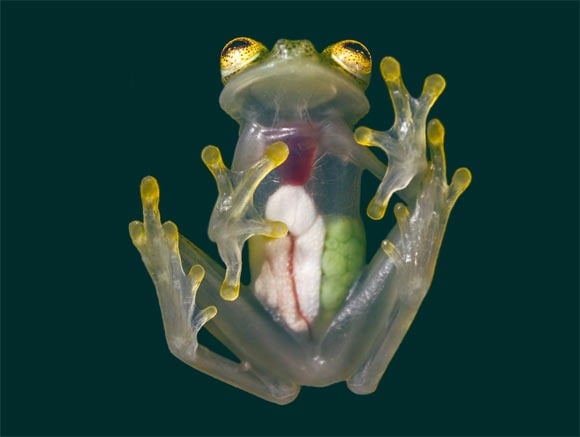
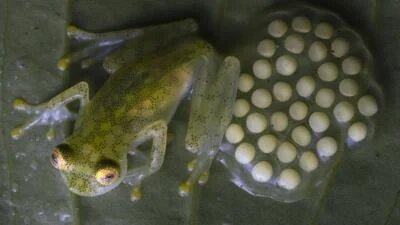
Endemic to southern Mexico, Central America, and South America, glass frogs are fascinating animals. The agile frogs can jump over ten feet at a time. Also, unlike other frog species, the males stand guard over their eggs until they hatch and the tadpoles fall into the water. But the frogs' most unique attribute is their appearance. While the front is typically bright green, the underside lacks color pigments and is translucent. As a result, the animal's internal organs — beating red heart, while liver and digestive system, and, in the case of females, a cluster of green eggs — are all clearly visible.

The new species dubbed Mashpi glass frog (Hyalinobatrachium mashpi) and the Nouns' glass frog (Hyalinobatrachium nouns), were found on the southern and northern sides of the Guayllabamba River in the Andes Valley, respectively. The specimens' identical appearance and size led the team to initially believe that the frogs were members of the same species. However, a DNA analysis of the amphibians revealed significant genetic differences.
Juan Manuel Guayasamin, an evolutionary biologist at Universidad San Francisco de Quito who led the study, says the frogs are an example of the region's "cryptic diversity" — different species that look identical. The researcher asserts that this is why it is hard to determine the exact number of unique species in the biodiverse region.
Guayasamin has a theory on what keeps the two species, which live 13 miles apart, distinct. "What we are thinking is that the valley has kept these frogs from mixing with each other," he says. "When you have populations separated by a geographic barrier, you start having an accumulation of mutations in each group, and in time, they become genetically different."