Type 3A Hair: What It Is and How to Care for It

Who runs the world? Curls. Just like people, curly hair comes in all different shapes, colors, and sizes, and it's important to tailor your routine and styling toward your curl pattern. Understanding curl patterns can be intimidating at first, but once you've figured it out, creating and following the routine that best serves your curls can make a world of difference.
So, what exactly defines the curls of type 3A hair? We turned to the experts—stylist Nubia Rëzo and trichologist Kerry Yates—to find out.
What Is Type 3A Hair?
Understanding your curl type can often be difficult. "Did you know that not every follicle is created equal, and each follicle works independently, meaning on one head you can have many different curl types ranging from type 2 and type 3 curls?" shares Yates. That being said, the experts have some tips on how to identify your curl type as 3A.
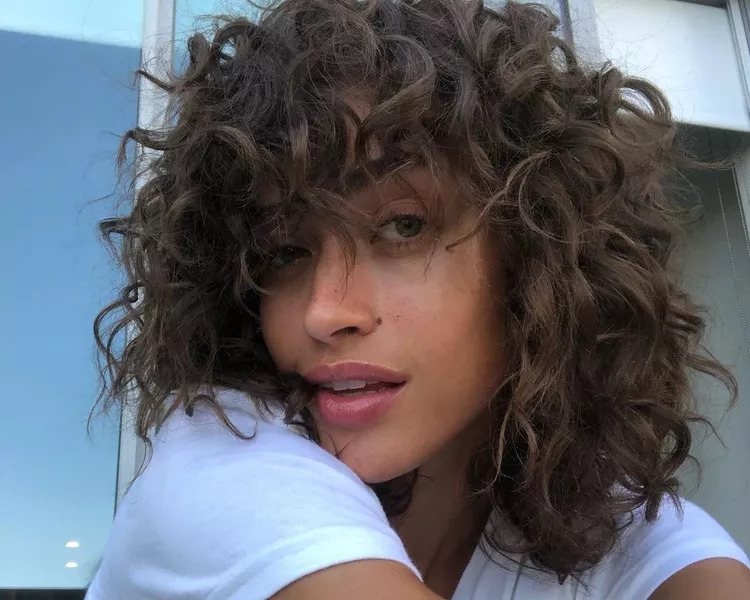
3A curls have a defined ringlet, as you'll see in the chart above. The curl itself is both wider and looser than other ringlet curls. "To understand what I mean by ringlets, visualize a corkscrew and when I speak of loose curls, think of that ringlet being wide enough to easily wrap around a small banana or a thick highlighter pen," notes Yates. "The diameter ranges from 1 inch to 1/2 inch."
And for a simpler way of putting it: "They are springy loopy curls," says Rëzo.
Differentiating Between Type 3A and Other Hair Types
Differentiating between curl patterns can sometimes be difficult as the curls get tighter, but there are some key notes to help clarify any lingering question marks.
"There are four basic curl types of texture types ranging from 1 to 4," shares Yates. "Type 2 denotes wavy hair with no discernible curl, and types 3 and 4 plus additional classifications define both the curl type and shape. If your curls are defined ringlets, think like the shape of a slinky or corkscrew, then you have class 3 curls. If your curls follow more of a 'z' pattern, then you have class 4 types of curls."
Deferring back to the curl pattern chart, the difference between 3A's neighboring pattern 2C is quite defined. Type 2C does not have a completely formed ringlet, whereas 3A does, making it a generally direct differentiation standpoint. The difference between 3A and 3B, however, can be a tad more difficult as both are defined ringlets and differ in curl tightness.
"3B curls are more spirally ringlets," Rëzo adds, "3A hair is often made up of strands that are 's' shaped."
How Should You Care for Type 3A Hair?
"Curly hair is more fragile, and the tighter the curl, the drier the strand," Yates notes right off the bat. "Type 3A curls can require some extra support based on the hair texture (fine, medium, coarse) and hair health." So, how do you narrow down the perfect routine that shows your hair love without causing distress? The experts have some tips.
Avoid Chemical Exposure
"Heavily highlighted curls will be dry and more prone to breakage," Yates says. "Exposure to heavy chemicals can negatively impact the curl shape and can cause some ringlets to be more wave-like and even appear frizzy."
Studies support this notion, showing that chemical treatments lead to a decrease in the lipid content of the cell surface in hair and change it from the state of hydrophobicity to a more hydrophilic state, meaning hair is no longer locked in moisture and can generally lead to what Yates noted as dry hair with more breakage.1
Deep Condition
Experts note that deep conditioners can be essential to helping repair damaged hair. "Since 3A is right in the middle, it is advised to show it some extra love, but not too much," says Rëzo. "You want to make sure to deep condition as part of your hair routine, especially with any texture tighter than a 3. Usually, the tighter the curl, the dryer the hair. This happens because the more textured the hair is, the harder it is for it to hold moisture."
Limit Silicone Products
"Choose formulas that limit their silicone usage," says Yates. "Silicones can enhance shine and flexibility in the short term but can exacerbate hair conditions and [compromise] overall health in the long term."
Typically, over time, a silicone buildup in hair can actually cause breakage, dehydration, and leave your hair generally weaker. Instead, look for products with emollients such as plant-based oils. "In addition, for curls with various ringlet shapes, choose styling products with natural resins that tout weightless styling," Yates notes. "The idea is to create a bouncy curl, not a heavy curl that will fall into a wave after styling."
"Since the type 3A curl is already naturally springy, you really don’t need much product to style," adds Rëzo. Read More...