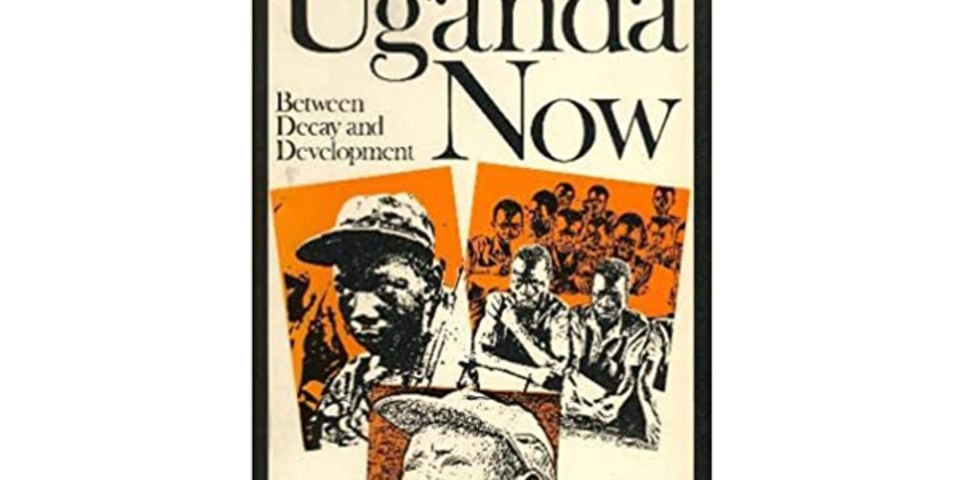
Uganda Now: Between decay and development
-
 Loading...
 - Abbo Asiimwe
- 20 Feb 2023
- 61 Views
- 0 Like
- 0 Comment
Divided into seven parts with at least four essays apiece, this scholarly work is enriched by intellectual assessments which the average Ugandan may use as loci placing today’s Uganda in context.
“Uganda Now: Between Decay and Development (Eastern African Studies)” has aged well and will someday be considered a modern-day classic.
Divided into seven parts with at least four essays apiece, this scholarly work is enriched by intellectual assessments which the average Ugandan may use as loci placing today’s Uganda in context.
The 22 contributors to this thought-provoking book assembled for a symposium in 1985 as Yoweri Museveni’s National Resistance Army unleashed its finishing blow on the Okello-Okello military junta.
Their deliberations were drawn out to the extent that they finalised their contributions in the cold light of Museveni’s initial period of power.
Colonialism, independence and post-independence considerations are examined with the fine toothed comb of intellectual enquiry and inquiry in the shape of detailed analyses of the politico-historical orthodoxies thereof.
Also, diagnostic analyses are made regarding the economic realities for the Ugandan government in the period of international debt.
Christopher Wrigley, in Chapter two, examines the Buganda Agreement of 1900 and reflects upon its significance in creating lopsided developments in Uganda.
These asymmetries served as one of four tragic ‘steps towards disaster’, nullifying the viability of an otherwise worthwhile flag independence in Uganda.
In discussing Uganda’s ‘dislocated polity’ in chapter 3, D.A. Low views the country through a kaleidoscope of a ‘thousand or so actual or latent political systems’ extant during the nineteenth century Scramble and Partition of Africa.
The multiplicity of these systems, he argues, faced ‘profound social and political difficulties as many new aggregations…found themselves ensconced in an arbitrary concocted new state.’
This led Ugandan leaders to the marketplace of ideas on how to compose governing majorities.
We saw this with the Uganda People’s Congress and Kabaka Yekka alliance, which soon went belly up on the high seas of political compromise.
In Chapter eleven, Nelson Kasfir looks at the splash, in socioeconomic terms, which Idi Amin’s rule made. He also delves into the question of land tenure in Uganda. Read More…