Vertical Knee Raises Are Perfect for Upping Your Ab Routine
-
 Loading...
 - Anna Pedersen
- 29 Jul 2022
- 91 Views
- 0 Like
- 0 Comment
By now you probably have a go-to ab workout; sit-ups, crunches, planks, or something else that requires most of your body to be on or near the ground. But you don't need to be horizontal to get your core working—that's where vertical knee raises come in. This challenging exercise targets your ab muscles by keeping your upper body stable and leveraging up and down movement in your legs and hips (with the help of gravity).
Vertical knee raises require a little more involvement than ab workouts on a mat, as you need equipment in the form of a machine or bars. And while they’re not beginner exercises, that doesn’t mean you can’t build up the strength to do them or vary the difficulty level to your needs. Ahead, fitness trainers Danica Osborn and Eric Potter explain what makes vertical knee raises a great addition to your workout, and how to do them properly.
What Are Vertical Knee Raises?
Vertical knee raises are an advanced movement that targets your core, specifically the rectus abdominus and the hip flexors. Your abs stabilize your body, while your hip flexors bring your knees up and down, says Potter.
They’re also called “captain’s chairs" according to Osborn, who adds that they’re a great way to challenge your core.
What Are the Benefits of Vertical Knee Raises?
Vertical knee raises are one way to increase core strength, and a strong core helps with everyday movement both inside and outside the gym, from getting out of bed in the morning to lifting a barbell, says Osborn. A strong core also helps with form, increases athleticism, improves posture, protects organs, and reduces your risk of injury.
And if you’re looking for a way to mix up your current core training, vertical knee raises can do just that, says Potter, who notes that they're more a challenging (and fun) alternative to traditional sit-ups and planks.
Vertical Knee Raises vs. Other Ab Exercises
While most ab exercises are done on the floor (think sit-ups, crunches, planks, etc.), vertical knee raises are done, well, vertically, which means you have to stabilize the top half of your body and exclusively use your core, says Potter. Osborn notes that when you do ab work on a mat, your thigh muscles try to step in and help. But with vertical knee raises your quad activation is reduced, allowing you to really target the ab muscles.
Vertical knee raises also require using equipment like two parallel bars or a dip/raise machine, so you do have to plan ahead; they’re not an exercise you can just decide to do a few reps of if you have the time and extra floor space.
Proper Vertical Knee Raise Form
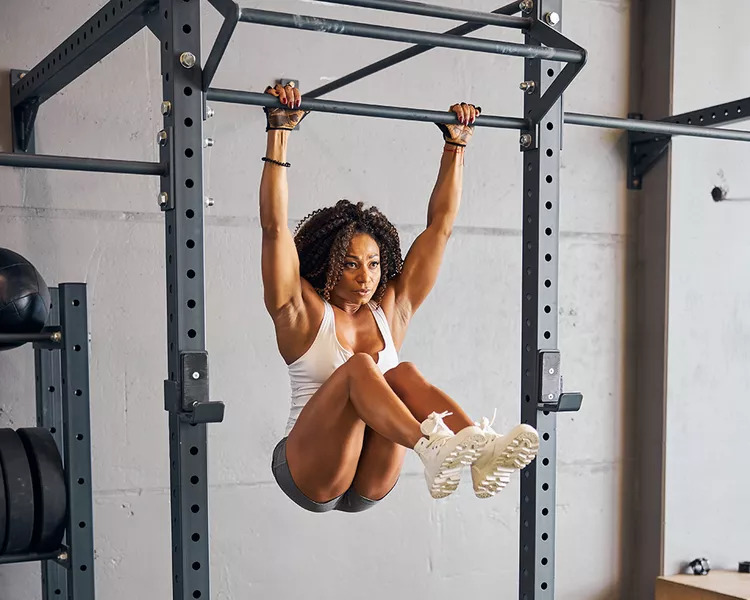
Osborn and Potter explain how to do vertical knee raises with proper form. They can be performed on a pull-up bar, dip/raise machine, or parallel bars.
1. Position your back firmly against the support (if using a dip/raise machine).
2. Place your hands on the handles or bars, and allow the bars to support your weight while letting your legs and feet dangle below you. Get your body under control without any swinging.
3. Exhale and bend your knees, then draw them up towards your chest while keeping your head up. The closer your knees come toward your chest, the more core engagement you’ll achieve. Try to get your knees at least parallel to the ground.
4. Once your knees are comfortably up, inhale and slowly lower your legs back to the vertical position.
5. Try to do six to 12 flawless reps, increasing as you get more comfortable. Form is more important than reps, so focus on deliberate controlled movements, even if that means fewer reps.
Keep your core engaged, and try to avoid pushing your navel outwards (also called “doming”), says Osborn. Additionally, avoid swinging your legs, as relying on momentum reduces the effectiveness of the exercise.
Safety Considerations
Because they are a relatively challenging exercise, vertical knee raises might not be appropriate for everyone’s workout routine. For example, anyone who has chronic lower back pain or issues should be cautious because this exercise requires a lot of hip flexor and abdominal recruitment, which may cause stress in the lower back, says Potter.
In addition, if you’re in the latter half of your pregnancy, recovering from childbirth, healing from abdominal surgery, or battling diastasis recti, you should also avoid vertical leg raises, Osborn says.
As always, if you have any concerns, consult a doctor or trainer before trying a new exercise. And if you have any pain while performing vertical knee raises, return to standing right away.
Vertical Knee Raise Variations
Where you do your vertical knee raises can increase or decrease the level of difficulty. A pull-up bar will be the most challenging, while a dip/raise machine will be the least challenging as it provides upper body support and can help reduce swaying (if you’re a beginner, start with the dip/raise machine). You can also vary your leg positions and holds. Read More...