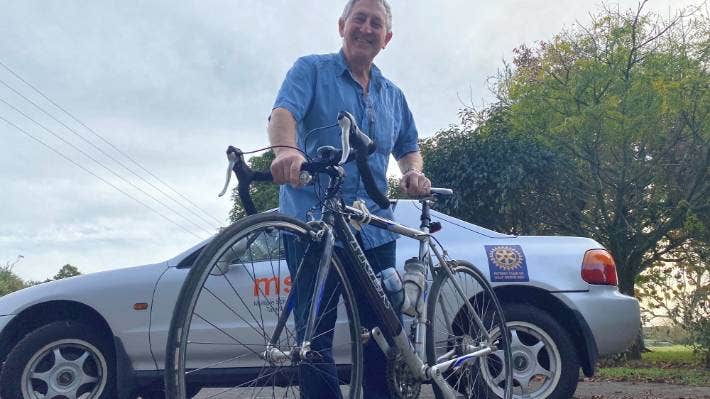
Walker's keeping his mind, body and smile busy on World Multiple Sclerosis Day
-
 Loading...
 - Ella Murph
- 31 May 2022
- 274 Views
- 0 Like
- 0 Comment
With the exercise equipment strategically placed around Graham Walker’s rural Taranaki house, it would be easy to mistake him for a professional athlete.
While Walker was once a competitive cyclist, he is now exercising for something much more important than a trophy or jersey – he’s exercising for his health and quality of life.
Ten years ago, Walker was diagnosed with multiple sclerosis (MS), a disease in which the immune system eats away at the protective covering of nerves to affect movement, sensation and body functions.
Monday is World MS Day, and people around the world will be raising awareness of the condition.
MS affects about 4300 New Zealanders, and three times as many women as men. It is often seen in younger people, and the average age of diagnosis is 32.
“When somebody is diagnosed at the mid-30s, they’re probably having families about them, and everything changes,” said Walker, himself a family man.
“It's very hard on a relationship, counselling is really important, not just for the person with MS, but often their family as well.”
Walker was 55 when he first became aware that something was wrong when he had “a bit of a limp” and struggled to hit a few notes on his saxophone with his left hand.
“When you're diagnosed, the doctors that diagnose you, the neurologists, all they do is tell you your diagnosis. They don't tell you what's going to happen next because, really, they don't know.
“The disease is known as the snowflake disease, which alludes to the fact that no two people are identical with the symptoms. There are 50 or 60 or more different symptoms, and no two people are the same.”
This year’s theme for World MS Day is ‘connections’ and Walker, president of MS Taranaki, and vice president of MS New Zealand, urged newly diagnosed people to join their local MS society.
“The MS societies have knowledge that's the lived experience and they have all sorts of strategies to help.
“They employ a field officer. I met her for a coffee and we got to know each other. And she was able to point me in the direction of a lot of things that I needed to know, and one of those is exercise.”
Walker, who lives near Lepperton, tries to ride his bike four or five days a week.
“I was aiming at 200 kilometres, but I mean, it's probably down about 150 kilometres,” he said.
“Muscle fatigue is quite an issue and fatigue, full stop, is a big issue.
“Exercise has kept me mobile in lots of ways because you know, you just use it or lose it. It's really important for people with the MS that they understand exercise is medicine.”
Physical exercise is just one part of living with the disease, good sleep, socialising and small diet changes such as eating more salad all help.
Walker rattles off a list of committees he’s on – mostly to do with health and cycling – he says it’s part of keeping the mind busy.
MS New Zealand has been petitioning Pharmac and the government to improve treatment for people with MS, and has secured one big change.
From July 1, people who have had one attack of MS symptoms will be eligible to access medications.
“Currently you need to have two attacks of MS before they start giving you drugs. Read More...