Water's mysterious phase transitions
-
 Loading...
 - Ken Ma
- 13 Mar 2021
- 1064 Views
- 0 Like
- 0 Comment
Water, always important, always controversial, always fascinating, remains surprising. For a substance that is ubiquitous on Earth, three quarters of our planet is covered with it, researchers can still be surprised by some of its properties, according to Arizona State University chemist C. Austen Angell.
Angell, a Regents Professor in ASU's School of Molecular Sciences, has spent a good portion of his distinguished career tracking down some of water's more curious physical properties. In a new piece of research just published in Science (March 9), Angell and colleagues from the University of Amsterdam have, for the first time, observed one of the more intriguing properties predicted by water theoreticians -- that, on sufficient super-cooling and under specific conditions it will suddenly change from one liquid to a different one. The new liquid is still water but now it is of lower density and with a different arrangement of the hydrogen bonded molecules with stronger bonding that makes it a more viscous liquid.
"It has nothing to do with 'poly-water,'" Angell adds recalling a scientific fiasco of many decades ago. The new phenomenon is a liquid-liquid phase transition, and until now it had only been seen in computer simulations of water models.
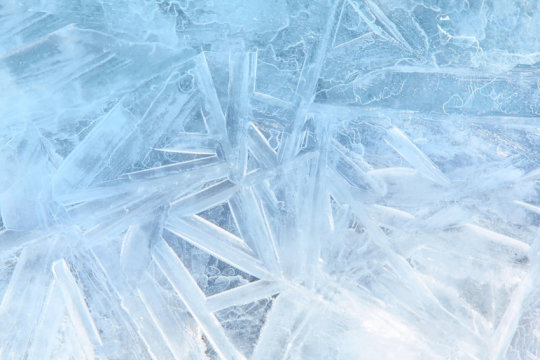
The problem with observing this phenomenon directly in real water is that, shortly before the theory says it should happen, the real water suddenly crystallizes to ice. This has been called the "crystallization curtain" and it held up progress in understanding water physics and water in biology for decades.
"The domain between this crystallization temperature and the much lower temperature at which glassy water (formed by deposition of water molecules from the vapor) crystallizes during heating has been known as a 'no-man's land,'" Angell said. "We found a way to pull aside the 'crystallization curtain' just enough to see what happens behind -- or more correctly, below -- it," Angell said.
Phase transitions of water are important to understand for a multitude of applications. For example, the well-known and destructive heaving of concrete roads and footpaths in winter is due to the phase transition from water to ice under the concrete. The phase transition between liquid states, described in the current work, has much in common with the transition to ice but it occurs at a much lower temperature, about -90 C (-130 F), and only under super-cooled conditions so it is likely to remain mostly a scientific curiosity for the foreseeable future.
Angell explained that a couple of years ago he and his research associate Zuofeng Zhao, were studying the thermal behavior of a special type of "ideal" aqueous solution they had been using to explore the folding and unfolding of globular proteins. They wanted to observe these solutions' ability to supercool and then vitrify. Seeking the limit to the glassy domain, they added extra water to enhance the probability of ice crystallization and found that instead of finally evolving heat as ice crystallized (leaving a residual unfrozen solution) as is normally found when cooling saline solutions, it actually gave off heat to form a new liquid phase.
The new liquid was much more viscous, maybe even glassy. Furthermore, by reversing the direction of the temperature change, Angell and Zhao found that they could transform the new phase back into the original solution before any ice would start to crystallize.
"This observation, published in Angewandte Chemie, raised considerable interest but there was no structural information to explain what was happening," Angell said. That changed when Angell visited the University of Amsterdam two summers ago, and met Sander Woutersen, a specialist in infrared spectroscopy who became very interested in the structural aspects of the phenomenon.
In the Science paper, the team with Woutersen, his student Michiel Hilbers and his computational colleague Bernd Ensing has now shown that the structures involved in the liquid-liquid transition have the same spectroscopic signatures -- and the same hydrogen bonding patterns -- as are seen in the two known glassy forms of ice produced by laborious alternative processes (high- and low-density amorphous solid phases of water).
"The liquid-liquid transition we had found was now seen to be the 'living analog' of the change between two glassy states of pure water that had been reported in 1994, using pure pressure as the driving force," Angell explained.
The results would seem to "provide direct evidence for the existence of a liquid-liquid transition behind the 'crystallization curtain' in pure water," Woutersen said, adding that the findings offer a general explanation for the thermodynamic anomalies of liquid water, and a validation for the "second critical point theory" put forward by Gene Stanley's group to explain those anomalies.
"This behavior is almost unique among the myriad of known molecular liquids," Angell added. "Only a few other substances are thought to exhibit it, but none have been proven to date."