Weaving an Altar to Guatemala's Pre-Hispanic Glory
-
 Loading...
 - Hannele Kivi
- 13 May 2022
- 308 Views
- 0 Like
- 0 Comment
Altar para pájaros (Altar for birds) on view at Instituto de Visión, is Sandra Monterroso’s first exhibition in New York, showcasing a series of works that speak to her Mayan heritage while referring also to migration through the metaphor of birds. For the last 20 years, the Guatemalan artist has produced a body of work that includes tapestry, installation, video, and performance focusing on issues such as modernity and coloniality, patriarchy and gender.
Monterroso’s use of traditional techniques in a contemporary context becomes a powerful cultural signifier in her work. A women’s güipil (Mayan blouse woven on a backstrap loom) connected to a common men’s “I Love NY” t-shirt, most likely manufactured in a maquiladora, is the first artwork visitors encounter when entering the exhibition (“Aj Camisel/Matador,” 2009). This piece is part of the artist’s ongoing research on gender hierarchies and the role of ruling women in the pre-Hispanic period. The güipil, woven by women in workshops in the Verapaces region of Guatemala, also includes quotes from an ambiguous romantic and philosophical conversation between a man and a woman. The contrast of materials and texts, and the placing of the torso mannequins, which prioritizes the female gown, reveal many layers of the existing local tensions produced by gender discrimination, colonialism, migration, and lost traditions due to globalization.

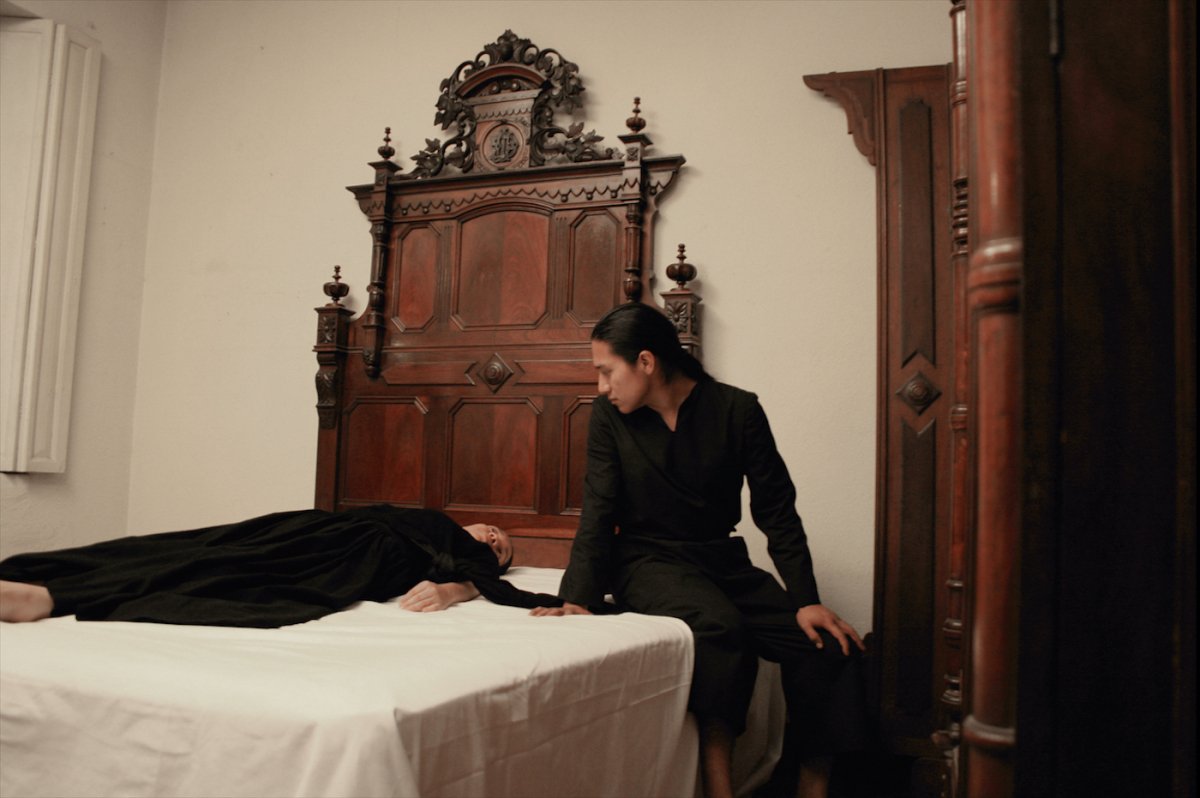
As with most of Monterroso’s works, this piece also functions as a performance prop since the artist often uses her body to speak about territories and Indigenous communities. An example is the recorded performance in the video “Meditando el error” (2008) in which she and an unknown indigenous man converse in different colonial settings (for example, in a bedroom and an orange grove) while wearing connected traditional gowns. The piece points to the importance of preserving traditions and the fear of abandoning ties with the spouse, family, and community.
The artist’s interest in the symbolic and sociopolitical significance of textiles and weaving extends to the technique of spinning fibers. Monterroso refers to the organic yarn as the common thread that connects the colonial past to the modern world, while the acts of dying, weaving, knotting, and embroidering function as a narrative device. With the piece “Nudo en Resitencia, en Contaminación” (Knott in resistance, polluted, 2011), which consists of dyed natural fibers knotted with a contrasting plastic tube, the artist symbolically invites viewers to untie colonial issues that remain from the past and also reflect on today’s ecological concerns — the latter more pointedly addressed in “Volcano” (2022), a textile woven in a women’s workshop, dyed with turmeric and achiote and embroidered with volcanic stones that refer to the 37 volcanos defining the Guatemalan landscape.

According to Monterroso, her textile pieces are inspired by weaverbirds, who build nests by weaving fine strands of fiber from leaves, branches, and other found objects. Obvious hints to this idea are “Nido”(The nest, 2021), as well as “La Otra Línea Histórica, Cara o Cruz” (The other historic line, Face or Cross, 2017-21), composed of black feathers, annatto pigment, linen, watercolor, and copper coins. One side of the coins shows the face of colonizer Fray Bartolomé de las Casas, while the other side portrays Guatemala’s coat of arm presented as a symbol of independence. The artist seems to question whether or not Guatemala has achieved colonial independence after all.
Altar para pájaros is a sincere endeavor by a Mayan artist to give voice to her community using traditional techniques, and to invite us to learn from the past in order to understand the present. Through migration and weaving she confronts the knots that tie together the inequalities, violence, discrimination, racism, and patriarchy in Guatemala.