Win for science as BP pressured into cleaning up offshore gas plans
-
 Loading...
 - Rohkhaya Cisse
- 05 Apr 2023
- 60 Views
- 0 Like
- 0 Comment
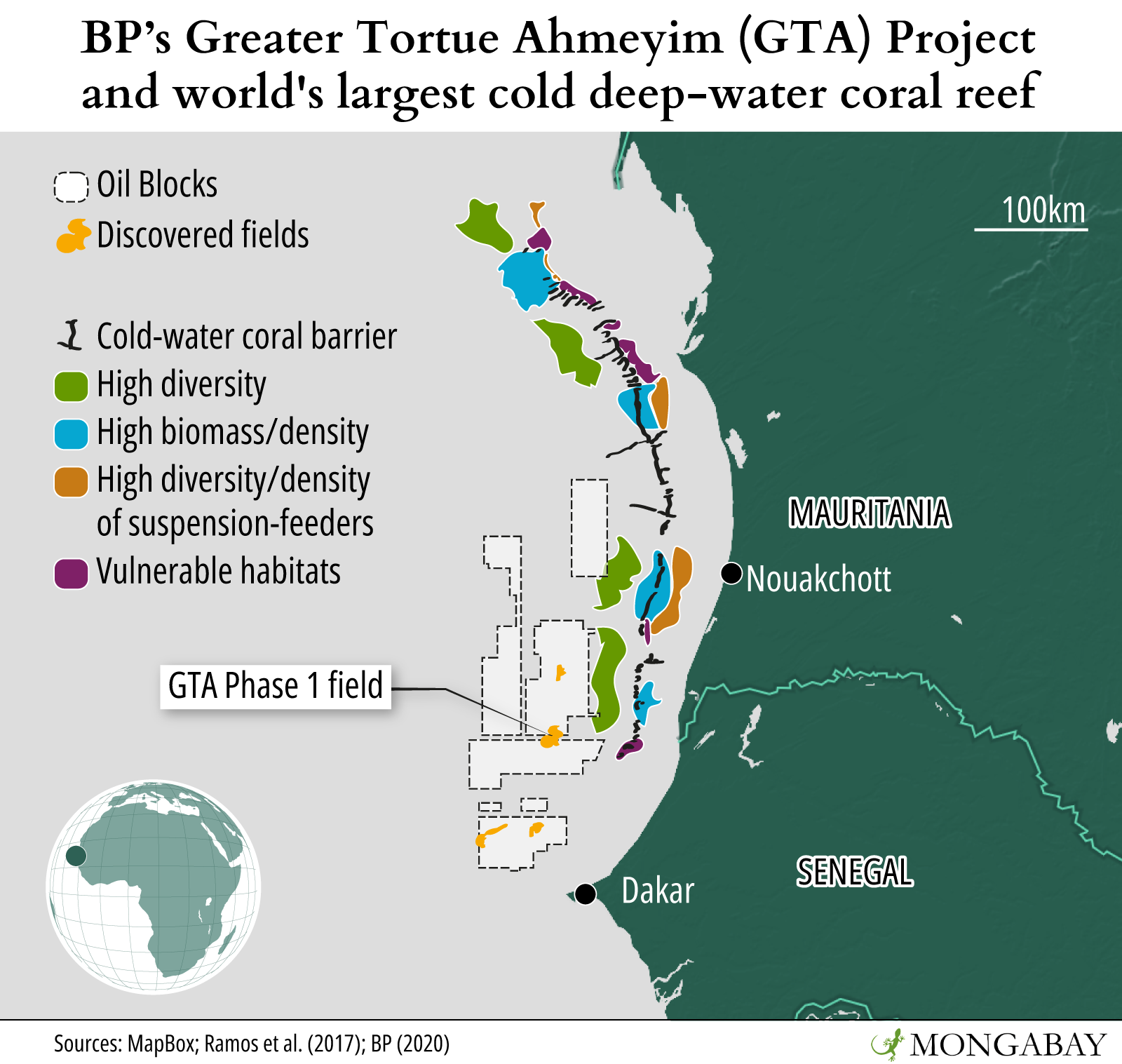
BP is launching an offshore gas platform with a pipeline through the world’s largest cold deep-water coral reef off the coast of Senegal and Mauritania.
The project’s environmental impact assessment has been described as “nonsense” by a group of marine biologists
A group of scientists has been fighting for four years to change this. Their proposals are currently being studied.
Scientists warning of a “potential ecological disaster” from gas drilling off West Africa have won a small victory after convincing U.K. oil major BP to review the project’s impact assessment. BP has already secured permission from the governments of Senegal and Mauritania to build offshore gas infrastructure for the Greater Tortue Ahmeyim (GTA) project, but scientists warned the activity would pierce the largest cold-water coral barrier in the world.
After four years of petitioning BP to amend the project, the group of 10 marine biologists has finally gotten the company to commit to ad review of its environmental and social impact assessment (ESIA).
“It was very long and tiring, but I’m glad we convinced BP to redo the analysis,” Sandra Kloff, an independent marine biologist based in Spain and spokesperson for the group, told Mongabay. Kloff has worked in the region for nearly 20 years, and in 2009 published a report on the impact of offshore extraction on the marine biology of Mauritania.
“But we’ll see what happens, we still don’t know which recommendation BP will listen to,” she said. An impact assessment full of ‘nonsense’. It all began in 2018, when Senegal’s environment ministry called on the Netherlands Commission for Environmental Evaluation (CNEE), an environmental auditing organization, to conduct an independent review of the ESIA provided by BP. This original ESIA has been written by four different environmental consulting agencies.
Kloff was part of the CNEE expert panel. “I saw a lot of flaws in the ESIA so I decided to contact all the scientific experts I knew and sent them extracts from the ESIA,” she said. “They were flabbergasted.” Read More…