Women's football in Argentina: feminism takes to the field
-
 Loading...
 - Maria Acosta
- 18 Mar 2022
- 398 Views
- 0 Like
- 0 Comment
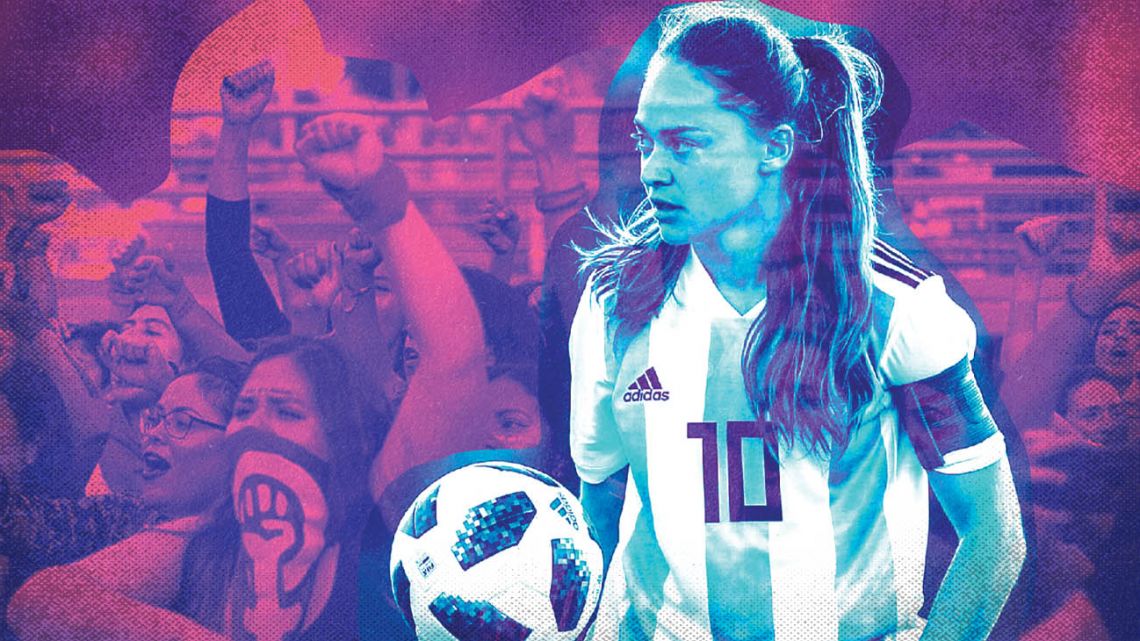
Women’s football keeps marching on. With slow yet firm steps, year after year it grows in popularity and presence. The 2021 Argentine Football Association (AFA) tournament was arranged to be broadcast on national public television, and thus Argentina became the first country in South America to televise all matches live.
March 2019 finally saw women’s football become professional in this country, thus establishing a minimum of eight football players under contract, with the same pay as a male ‘Primera C’ player (Argentina’s fourth tier). Today, all 21 clubs taking part in the first division tournament must have at least 12 professional players under a contract registered by AFA.
“I can sense progress. Nowadays we can play professionally, which we didn’t use to be able to do a while ago, we were just amateurs. It’s becoming a lot more important, with more vision and opportunities,” says Delfina Lombardi, the Bahía Blanca-born forward.
Clad in her light-blue-and-white jersey, Lombardi will represent her country at the CONMEBOL Sub 17 Women’s Tournament in Uruguay in 2022 with a view to qualifying for the FIFA U-17 Women’s World Cup.
“I’ve experienced the times since we practically started those AFA tournaments, from 1998 to 2012 when I retired, though I’m still involved. I’ve witnessed the change from nothing to watching matches on television. Seeing sponsors pop up. Although we still have to improve the product, as long as sponsors keep showing up, we can have consistent rather than temporary growth,” remarks Rosana Gómez, formerly of the Argentine national team, with World Cup experience and currently a coach.
“Leftie,” as Gómez is nicknamed, put her coaching gear back on after working at CONMEBOL’s Development and Evolution department. She started playing for Rosario Central and then Boca Juniors, where she won 12 tournaments.
“We have to strengthen all the people involved in women’s football. We need all the components of the football ecosystem to let women in,” she comments.
The women’s football first division tournament was first televised in 2021 on Public Television and DeporTV. During a presentation at AFA’s headquarters in Ezeiza, Women, Gender and Diversity Minister Elizabeth Gómez Alcorta stated: “It seems incredible for this day to have come, but here we are. This tournament will be broadcast to thousands of girls who will see that their dream is possible.”
“Broadcasting matches on public television is great progress. Women’s football has plenty of impact and we have to continue giving it more opportunities,” Gómez agrees.
“Having a chance to watch matches on television helps growth, and more girls and parents approach football, so we can see this sport differently, with more development,” the former player and current coach adds.
State oil company YPF is the official sponsor of the professional tournament, which has been sponsored by Rexona, Flybondi and Sara, the women’s safe transport app.
“There’s more interest by brands and sponsors, given the crowds drawn by women’s football. The number of girl players is increasing at higher levels, which creates more interest in the sport by people as well as brands,” says Lombardi, who got her start at Bella Vista and currently plays for River Plate.
The road to equality
In the first year of the pandemic, 2020, the local tournament was suspended after AFA decided to conclude it without a champion or any team facing relegation. Later that year, the ‘Transición’ Championship, which started and was completed in 2021, featured a historic event: Mara Gómez became the first trans player in the first division.
“I never thought I would play professional football, I never saw it happening”, the 24-year-old La Plata-born player says.
“Football was a turning-point in my life. It came during one of the most difficult times of my life, when I was discriminated against and excluded. I started playing during those hard times, it was a means of containment, it dulled the pain,” the forward, who started her career in a local neighbourhood league at 15, tells us.
Gómez has managed to break the barriers of discrimination and exclusion to realise her dreams. When she was 18, La Plata already had a women’s league and she tried her luck at Toronto City, an amateur league club. She currently plays for Estudiantes de La Plata and counts Villa San Carlos as her first AFA experience.
“Every step of the way I had to pay my dues for being a trans girl, that’s why I say it’s always been difficult to do something as basic as sport,” she assures us.
Global struggle
The year 2022 started with a momentous event: the US women’s football team reached an agreement with the United States Soccer Federation (USSF) to end the six-year battle on equal pay. The USSF thus agreed to pay US$24 million in bonuses to match men’s salaries. It was a triumph which paved the road for other female players.
It is a different story in Argentina, though.
“Girls can’t live on football, they have to get a day job. Those who can make it go to other leagues and it’s our local league’s loss,” explains Julia Paz Dupuy, a player at the Futsal Argentine team currently competing in Spain’s first division. She moved when only 22 to play for Poio Pescamar FS, because “you can’t live on women’s football in our country,” as she explained.
“In Argentina you need policies which help players grow as athletes and elite footballers,” she adds.
“Football is very time-consuming, you have to train every day. To make ends meet, players can’t compete at 100 percent because some of them have to work and study,” says Mara Gómez, who during her university years had to juggle her studies and football.
“I couldn’t make a choice whether to work, study or play sports. I wanted to do all three because each one of them is a part of my life. If we had other conditions, we wouldn’t actually feel pressured by personal matters,” she adds. Read More...