Your next smart lock could ditch the battery by harvesting energy from your phone
-
 Loading...
 - Nessa Smith
- 22 Jul 2022
- 107 Views
- 0 Like
- 0 Comment
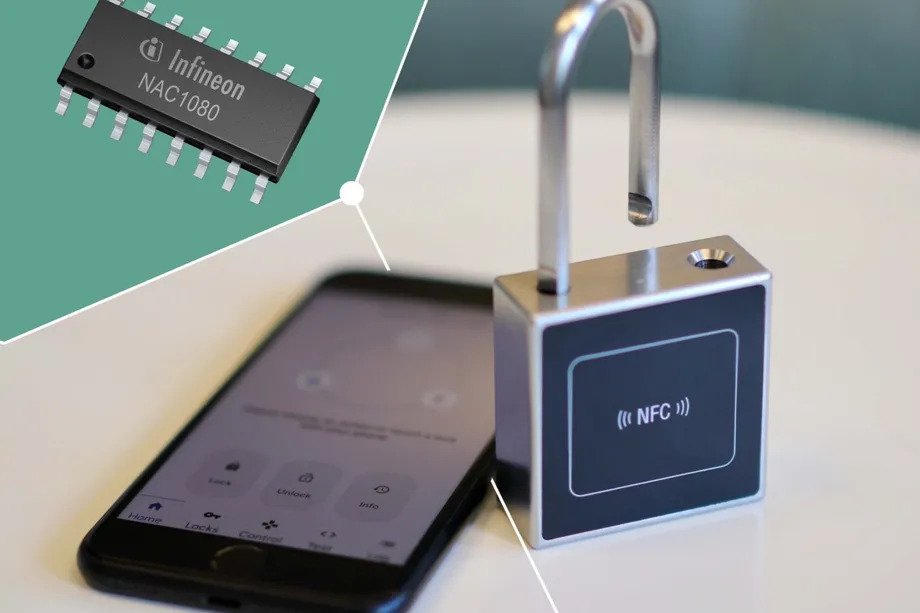
One of the magical things about near-field communication technology (NFC) is that tags don’t need a battery to communicate — you’ll never need to buy a new coin cell for your employee badge, because the badge scanner wirelessly beams enough power to the badge to verify it’s legit. Now, chipmaker Infineon wants to make the same thing happen with smart locks — ones that can be entirely powered by your phone.
You can already buy fancy door locks in Europe and basic padlocks in China that do the trick, with Finland’s iLOQ claiming to have been the first to do it back in 2016. But today, Infineon is selling a new chip and offering full detailed instructions (PDF) to anyone who wants in on the idea.
It’s called the NAC1080, and it’s designed to be a single chip that does practically the whole thing. It’s got circuits to recognize your NFC phone, harvest its power, and drive the smart lock’s motor. And it’s got both embedded security features and a 32-bit ARM Cortex M0 CPU to verify that you and your phone are allowed to open and close the lock in question. All of that while running on the teensy charge your phone can provide.
/cdn.vox-cdn.com/uploads/chorus_asset/file/23892513/smart_lock_nfc_2.gif)
Manufacturers will have to supply the antenna, 3V mini-motor and capacitors that take the place of a battery. Locks like this need to build up a small charge before they can power a motor, but it looks like we’re talking about a few seconds based on the example unlocking you can see above.
Don’t expect this feature to crop in other smart locks, though, like the deadbolts you’d typically mount on the doors in your home. “The key is the smart mechanical latch design which can be opened and closed with very small energy use,” Qi Zhu, an Infineon marketing and business development director, tells The Verge. While Infineon says it could be used in a front door lock, it admits that “the response time for more complex doors is longer.”
The motors are generally expected to turn the lock’s “secret” — not move large portions of the lock itself. In Infineon’s padlock example, for instance, the lock shackle springs open after the small piece that keeps it locked moves out of the way. A video from iLOQ shows the energy moving a pair of tiny pins, with your fingers doing the rest. Read More...