20 Insanely Delicious Korean Soup Recipes You Must Try 2022
-
 Loading...
 - Qian Huang
- 02 May 2022
- 314 Views
- 0 Like
- 0 Comment
In Korea, people usually refer to any variety of soup as Guk. It’s a tradition in many Korean households to include a flavorful Guk along with their main dishes. Sometimes, the Guk itself can be considered as a main dish as well.
But that’s enough with the introduction about Korean Guk. Let’s jump in to see what Korean cuisine has to offer.
Top-Notch Korean Soup For Your Homemade Asian Meal
If you’re relatively new to Asian cuisine, then Korean soup is the perfect dish to practice your taste buds. These recipes are super simple to follow. It’s just a matter of time before you start serving your family with fantastic soup.
1. Samgyetang (Korean Ginseng Chicken)
In Korean, Samgyetang means “ginseng”, a type of plant that has roots with high medicinal values. Locals combine this pricy herb with warm chicken soup to optimize its nutrient content. Samgyetang often appears during summer as a custom for locals to cool themselves.
The hot chicken soup is believed to make people produce more sweat. Therefore, when evaporation kicks in, it takes away the heat from the body.
Although it is unclear when Koreans invented Samgyetang, the modern version was first recorded in a cookbook (Joseon Yorijaebeop) in 1917. The ginseng chicken soup began its commercial path to the world’s cuisine as a dish in many Korean restaurants in the 1940s.
Samgyetang is a reliable protein source thanks to the flavorful chicken meat. The broth provides an incredible array of valuable minerals and vitamins. The incorporation of ginseng helps the soup have signature bitter and earthy flavors.
Interestingly, the Korean locals either cook the chicken whole or only cut it in half. By doing this, the chicken doesn’t become too tenderized from the cooking process.
2. Naengguk (Chilled Soup)

To my surprise, Naengguk refers to any type of cold soup in Korean cuisine instead of being just a dish. Like Samgeyetang, Korean residents often consume Naengguk to beat the heat during the summer.
Most often, people categorize Naengguk into 2 types, depending on the ingredients and seasoning. The first type of Naengguk only has a broth made with vinegar and water, while the second variety utilizes high protein ingredients like chicken, sesame seeds, or beans.
Therefore, the latter variation of Naengguk has more nutrients and flavors in the broth. The recipe I’m telling you about falls under this category.
You can use shredded cucumbers to mix with some finely chopped garlic. The broth concoction is a mixture of cool water with Joseon Ganjang (Korean soy sauce) and Yangjo (Korean vinegar).
A small tip: You should add ice to your Naengguk if extra coolness is what you’re looking for. Naengguk is relatively easy to make as all you have to do is combine the ingredients. Remember, you can always store Naengguk in the fridge for later consumption.
Cool yourself down in the summer heat with an amazing bowl of Naengguk.
3. Kongnamul Guk (Soybean Sprout Soup)

Kongnamul Guk doesn’t possess a bold flavor or vivid color like other Korean dishes. Instead, the dish is warm and light in flavor that will heal your soul. If you’re having a hard time getting over your cold, then Kongnamul Guk is perfect for aiding you through the recovery process.
However, Korean locals usually consume the dish as a way to cure hangovers. I guess it’s mostly because of the high amount of Amino acid asparagine in the soybean sprouts that helps reduce the ethanol level in your liver.
In Korea, people use anchovies to set the tone for the stock. Then, the addition of dried kelp provides an extra layer of flavor for the Kongnamul Guk. Cooking the soybean sprouts is simple as you only need to keep them for around 8 minutes in the boiling stock.
However, you should wait for the sprouts to cook fully before opening the lid. This is to prevent the stock from having any fishy flavor. Finally, you can sprinkle some chili powder and serve the dish along with rice.
4. Dduk Guk (Korean Rice Cake Soup)

Dduk Guk, most often known as Tteokguk by Koreans, is a traditional dish that is often featured during the New Year celebration in Korea. Although no one knows the origin of Dduk Guk’s consumption on New Year, people usually have it to celebrate gaining a year of age.
The highlight of Dduk Guk is the delicious rice cakes, usually a simple blend of tapioca starch and rice flour. To accompany the rice cakes, I suggest adding some proteins by using ground beef. In addition, you can use nori seaweed to deepen the flavor of the Dduk Guk broth.
Before serving the dish, make sure you whip up some beaten eggs to drizzle over the soup mixture. Remember, you need to be careful not to drizzle the egg over the cooked rice cakes.
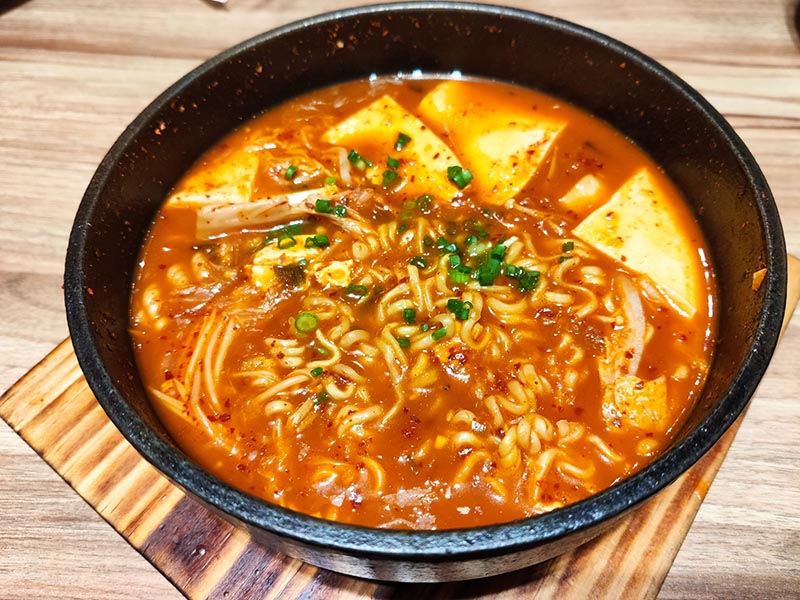
5. Spicy Beef Ramen Soup

Don’t let yourself mix up the word ramen here as a traditional noodle of Japanese cuisine, instead, the recipe calls for instant Korean ramen. The spicy and hot ramen soup is perfect for anyone with an empty stomach for a late-night snack.
The recipe is super simple as you can utilize the soup package of the instant ramen to set the tone for the broth. However, to make it more flavorful, my suggestion is to combine Gochugaru (Korean pepper flakes), soy sauce, and finely chopped garlic into the broth mixture.
Normally, locals often have spicy ramen at night. To accompany the ramen, people often have it with some tasty side dishes in Korea to diversify the overall taste.
Don’t forget the sliced beef for additional proteins to your night meal. In addition, Shiitake mushroom is a fine inclusion to the dish, which helps enhance the rich, buttery, and meaty flavors when cooked. Read More…