6 amazing creatures that seem to have arrived from another planet
-
 Loading...
 - paula summer
- 19 Jul 2022
- 90 Views
- 0 Like
- 0 Comment
1. Crab Yeti
Kiwa hirsuta
This interesting crustacean about 15 cm long lives in hydrothermal vents near Antarctica. There, at a depth of two kilometers in the Pacific Ocean, the water is hot (380 ° C) and toxic: there is too much sulfur. But the crab is fine.
The long hair on his paws is a real garden in which he lives ( AR Thurber. Dancing for Food in the Deep Sea: Bacterial Farming by a New Species of Yeti Crab / PLOS One ) lives an entire ecosystem of many different bacteria. Some serve the crab as food, while others help filter out poisonous substances, making the environment around their host tolerable.
2. Tahitian Warty Clownfish
Antennarius striatus
A fish belonging to the order of anglerfish, which are sometimes also succinctly called monkfish. This species is also called hairy frogfish. Its representatives reach ( Antennarius striatus, Striated frogfish / Aquarium ) reach 25 cm in length and are covered with long dermal spines resembling wool.
These predators prefer ( T, W. Pietsch, DB Grobecker. Frogfishes of the World: Systematics, Zoogeography, and Behavioral Ecology ) do not swim, but walk along the bottom on their powerful fins. When the hairy frog is hungry, it sets up an ambush and waits until some prey swims by. Then she puffs out her cheeks, sucking in water like a vacuum cleaner, and the prey itself flies into her mouth.
The defense mechanism of the frog fish is also peculiar. At the sight of the enemy, it swells so that it becomes physically impossible to swallow - it gets stuck in the throat.
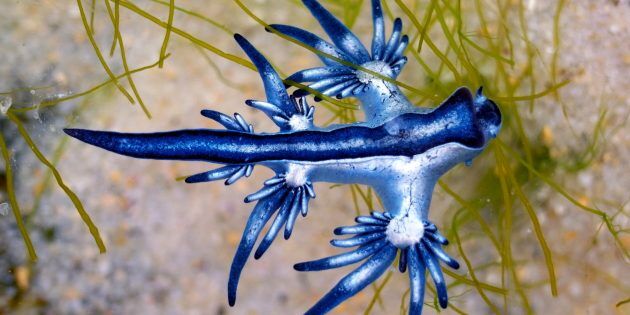
3. Blue dragon
Glaucus atlanticus
The gastropod uses ( TE Thompson. Observations on a collection of Glaucus from the Gulf of Aden with a critical review of published records of Glaucidae (Gastropoda, Opisthobranchia) / Oxford Academic ) the effect of surface tension to crawl across the water surface of the Indian and Pacific oceans. That is, he literally walks through the liquid like a messiah. Only he does it not from above, but from below, skillfully using his outgrowths throughout his body to increase buoyancy.
The blue dragon is very tiny, only 3 centimeters long, but it preys on formidable opponents - extremely poisonous jellyfish of the "Portuguese boat" type. His jaws deftly gnaw ( B. Srinivasulu. First record of the blue sea slug (Glaucus atlanticus) from Andhra Pradesh / The Journal of Asian Biodiversity ) not only them, but also other blue dragons, if they fall under a hot hand. Read More…


