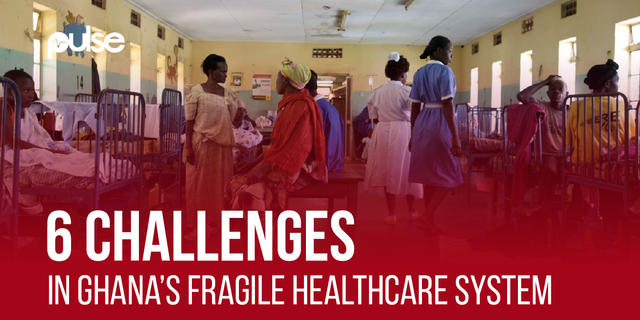
6 Challenges in Ghana's fragile healthcare system
-
 Loading...
 - Stephen Amponsah
- 09 May 2022
- 306 Views
- 0 Like
- 0 Comment
Ironically, poor healthcare systems count as one of the key contributors to this shorter life span in Africa.
And in Ghana, this has been a bane that has plagued the country since the declaration of independence in 1957.
Despite the efforts of successive governments over the years to improve the healthcare infrastructure across the country, the challenges still persist.
Below are some 6 challenges;
No bed syndrome
This unfortunate phenomenon has been the cause of thousands of deaths of Ghanaians across the various health facilities in the country over the years. Coined in 2018, the ‘no bed syndrome’ is a long-standing problem very well known in the Greater Accra and other regional health facilities.
According to the World Health Organisation (WHO), the standard indicator of hospital beds per population ratio for each country is estimated at 5 beds per 1,000 population.
In the publication of the WHO in 2014 on “World Health Statistics”, Ghana scored 0.9 beds per 1,000 population. This statistic means that Ghana has only 18% of the desired bed complement in its health facilities
In June 2018, there were widespread reports of the death of a 70-year old man due to the ‘no bed syndrome’.
The 70-year-old man, Anthony Opoku-Acheampong, died after seven hospitals in Accra turned him away over claims that there were no beds.
The deceased's family started searching for a hospital for him at 11:00 pm on June 2, travelling for about 46 kilometres in total, across the seven hospitals, till he eventually died at around 3:30 am.
Though a total of 10,000 hospital beds were distributed to all public health facilities across the country by the government in 2020 to help curb this menace, the problem still mounts.
Medical negligence
Another canker that has gained popularity in Ghana in recent years is medical negligence. Many people across the country have lost loved ones at health facilities due to this phenomenon.
Medical negligence has been defined by case law as “the omission to do something which a reasonable man would do or doing something which a reasonable man would not do”
There are increasing reports of medical negligence cases in Ghana by both public and private health facilities.
A patient visiting a doctor/hospital expects medical treatment, with all the knowledge and expertise of the doctor, to help mitigate or completely eradicate his medical problem. Thus, a doctor/hospital owes certain duties to their patient and a breach of any of these duties could constitute negligence on the part of the doctor/hospital.
In November 2015, the 37 Military Hospital became the first medical facility in Ghana to be slapped with GHS1,075,000 in damages for the negligent death of a 27-year-old woman during childbirth.
This landmark judgement spiralled a number of cases by patients who lost loved ones to medical negligence across the country.
Doctor/Patient ratio
According to Statista, as of 2019, Ghana had a total of 3,236 doctors, increasing from 2,857 in the previous year.
The density of medical doctors in Ghana stood at 1.4 per 10,000 inhabitants as of 2020. Though the ratio has been steadily improving in the urban areas over the years, it is increasingly becoming in the hinterlands.
Statistics from the Ghana Health Service (GHS) show that the doctor-patient ratio in the Northern Region, for example, had increased from 1:8,859 in 2020 to 1:10,901 in 2021.
This results in the deaths of patients across the numerous health facilities in Ghana daily. And in the words of General Secretary of the Ghana Medical Association, Dr. Justice Yankson, “it’s getting worse by the day”.
“The key thing is that we have not invested enough in healthcare generally, so in emergency health care services, we haven’t invested at all. We have a huge population, but how many emergency care services exist in the system? What is the level of resources that can handle emergency cases properly?”.
“Clearly, our population has outstripped the health system capacity, and we need to quickly invest in there and have a short to medium-term plan to address the systemic challenges as we prepare for the long term,'' he said.
Motivation for health workers
It is common knowledge in Ghana that motivation for workers across the different sectors of the economy is inadequate. Most especially, those in the health sector have always complained of insufficient motivation by the government in their line of duty.
Agyepong et al. in “Health worker (internal customer) satisfaction and motivation in the public sector in Ghana” (2004) mentioned low salaries of health workers as a major contributory factor for poor service quality especially in terms of staff attitudes towards patients, informal fee charges and lateness to work.
Staff dissatisfaction with working conditions has necessitated engagement in part-time income-generating jobs to supplement regular employment incomes. This practice has been found to have a negative influence on quality service delivery.
Bad Infrastructure
The infrastructural deficit in the Ghanaian health sector has been a major concern to successive governments. Its gravity has led to major policy decisions in constructing different regional and district health facilities across the country.
However, most of these projects have stalled over the past decade and this has contributed to the incessant deaths of patients in dilapidated health facilities across the country.
It, therefore, came as no surprise that during the height of the COVID-19 pandemic in 2020, Ghanaian President Nana Addo Dankwa Akufo-Addo pledged to construct 101 district hospitals, six regional hospitals in the newly created regions, two specialised hospitals in the middle and northern belts, as well as a regional hospital in the Western Region and renovation of the Effia-Nkwanta Regional Hospital. Read More...