7 Useful Tips for Photographing Summer
-
 Loading...
 - katie georgia
- 25 Jul 2022
- 97 Views
- 0 Like
- 0 Comment
I often receive a strange look when I mention that summer is my least favorite season. Sure, some relaxing days in the sun are great for the body and spirit (especially for a northerner who doesn’t get a whole lot of sun) but the long summer days will for most involve long periods of cloudless days.
This isn’t ideal for landscape photography.
Don’t get me wrong; there are just as many beautiful sceneries waiting to be photographed during summer as it is during the rest of the year, so there’s no need to pack away the camera for the season. It’s just a matter of finding the right subjects and the best light.

But how do you best photograph summer? How do you come home from your vacation with images that you’re excited to share with friends and family, perhaps even sell as prints?
Here are some summer photography tips and ideas to help you get started:
#1 Use a Polarizer
A polarizer is an essential filter for summer photography. It’s a filter that serves multiple purposes but the two main ones during summer are adding contrast to the sky and removing unwanted glare from wet surfaces.
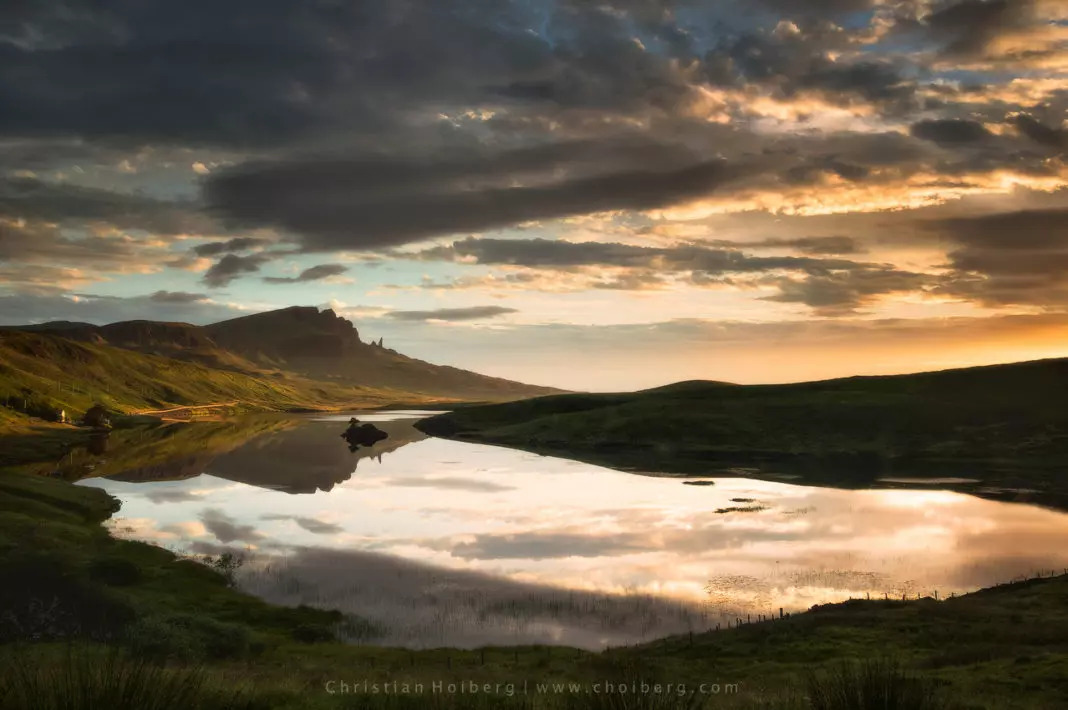
This filter is particularly useful when photographing on partly cloudy days, such as in the image below:

During those conditions, a polarizer does a great job increasing the contrast in the sky and making it ‘pop’.
Just keep in mind that a polarizer increases the overall saturation and slightly darkens the image by 1.5-2 stops. That means you’ll need to make adjustments to your shutter speed, aperture, and/or ISO (known as The Exposure Triangle)
#2 Avoid Photographing Rivers and Water During Daytime
The second tip is one that should be taken into consideration all year but it’s especially important on a sunny summer day; avoid photographing rivers and wet surfaces during the daytime.
Rivers, streams, lakes, and other wet surfaces have a strong glare when the sun is high in the sky and there are no clouds to block it. This can be quite distracting in an image and it is hard to correct in post-processing.
For that reason, it’s better to plan your visit to such locations on overcast days or when the sun is at a lower position.
If you’re not able to visit at another time of the day you should at least use a polarizer. As mentioned in the previous tip, the polarizer removes glare from wet surfaces. It won’t remove everything but it will reduce it significantly. Read More...