Artificial Photosynthesis Can Produce Food in Complete Darkness
-
 Loading...
 - Sophie Hoedemaker
- 27 Jun 2022
- 133 Views
- 0 Like
- 0 Comment
Artificial photosynthesis is being developed by researchers to help make food production more energy-efficient on Earth, and maybe one day on Mars.
For millions of years, photosynthesis has evolved in plants to turn water, carbon dioxide, and the energy from sunlight into plant biomass and the foods we eat. However, this process is very inefficient, with only around 1% of the energy found in sunlight ending up in the plant. Researchers have found a way to bypass the need for biological photosynthesis altogether and create food independent of sunlight by using artificial photosynthesis.
The new research, published on June 23, 2022, in the journal Nature Food, uses a two-step electrocatalytic process to convert carbon dioxide, electricity, and water into acetate, the form of the main component of vinegar. Food-producing organisms then consume acetate in the dark to grow. Combined with solar panels to generate electricity to power the electrocatalysis, this hybrid organic-inorganic system could increase the conversion efficiency of sunlight into food, up to 18 times more efficient for some foods.
“With our approach we sought to identify a new way of producing food that could break through the limits normally imposed by biological photosynthesis,” said corresponding author Robert Jinkerson, an assistant professor of chemical and environmental engineering.
In order to integrate all the components of the system together, the output of the electrolyzer was optimized to support the growth of food-producing organisms. Electrolyzers are devices that use electricity to convert raw materials like carbon dioxide into useful molecules and products. The amount of acetate produced was increased while the amount of salt used was decreased, resulting in the highest levels of acetate ever produced in an electrolyzer to date.
“Using a state-of-the-art two-step tandem CO2 electrolysis setup developed in our laboratory, we were able to achieve a high selectivity towards acetate that cannot be accessed through conventional CO2 electrolysis routes,” said corresponding author Feng Jiao.
Experiments showed that a wide range of food-producing organisms can be grown in the dark directly on the acetate-rich electrolyzer output, including green algae, yeast, and fungal mycelium that produce mushrooms. Producing algae with this technology is approximately fourfold more energy efficient than growing it photosynthetically. Yeast production is about 18-fold more energy efficient than how it is typically cultivated using sugar extracted from corn.
“We were able to grow food-producing organisms without any contributions from biological photosynthesis. Typically, these organisms are cultivated on sugars derived from plants or inputs derived from petroleum—which is a product of biological photosynthesis that took place millions of years ago. This technology is a more efficient method of turning solar energy into food, as compared to food production that relies on biological photosynthesis,” said Elizabeth Hann, a doctoral candidate in the Jinkerson Lab and co-lead author of the study.
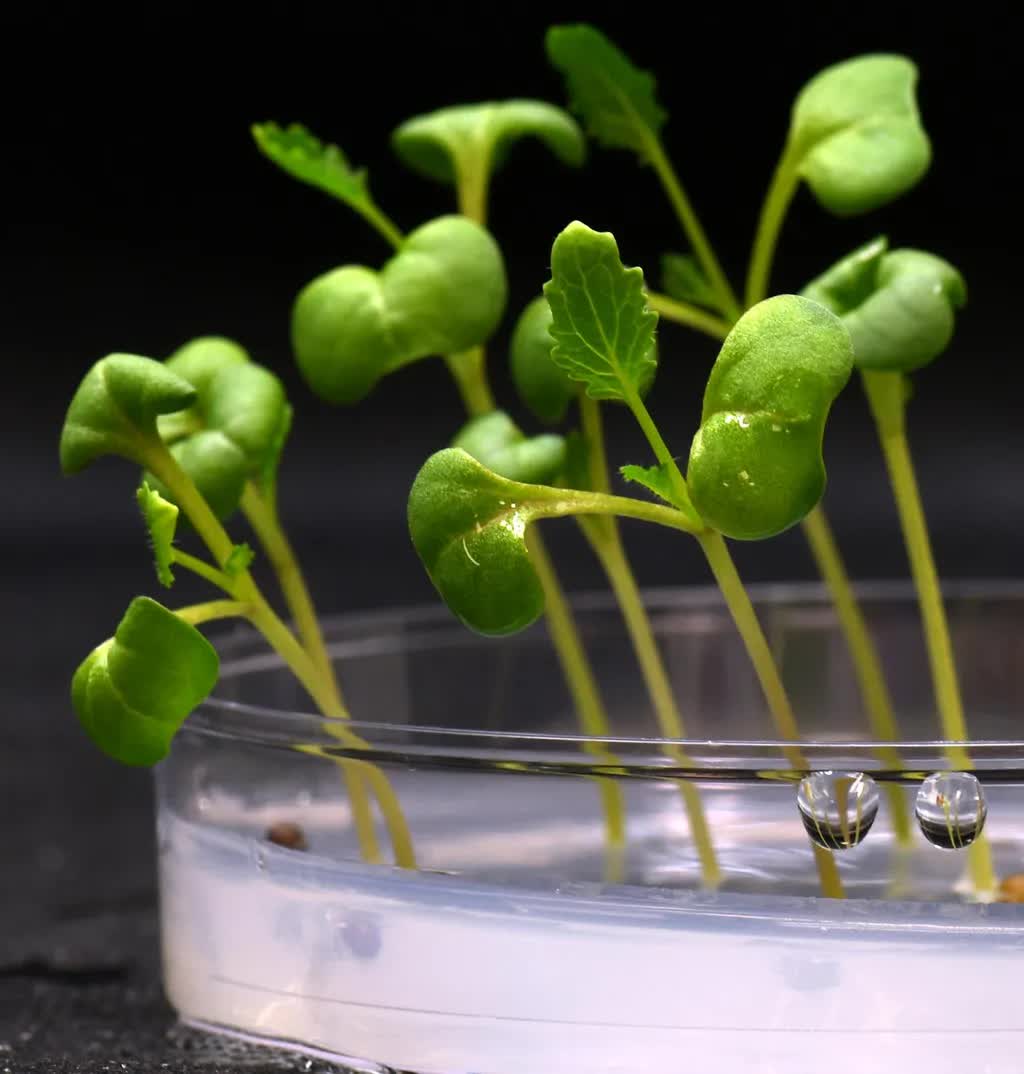
The potential for employing this technology to grow crop plants was also investigated. Cowpea, tomato, tobacco, rice, canola, and green pea were all able to utilize carbon from acetate when cultivated in the dark.
“We found that a wide range of crops could take the acetate we provided and build it into the major molecular building blocks an organism needs to grow and thrive. With some breeding and engineering that we are currently working on we might be able to grow crops with acetate as an extra energy source to boost crop yields,” said Marcus Harland-Dunaway, a doctoral candidate in the Jinkerson Lab and co-lead author of the study.
By liberating agriculture from complete dependence on the sun, artificial photosynthesis opens the door to countless possibilities for growing food under the increasingly difficult conditions imposed by anthropogenic climate change. Drought, floods, and reduced land availability would be less of a threat to global food security if crops for humans and animals grew in less resource-intensive, controlled environments. Crops could also be grown in cities and other areas currently unsuitable for agriculture, and even provide food for future space explorers.
“Using artificial photosynthesis approaches to produce food could be a paradigm shift for how we feed people. By increasing the efficiency of food production, less land is needed, lessening the impact agriculture has on the environment. And for agriculture in non-traditional environments, like outer space, the increased energy efficiency could help feed more crew members with less inputs,” said Jinkerson.
This approach to food production was submitted to NASA’s Deep Space Food Challenge where it was a Phase I winner. The Deep Space Food Challenge is an international competition where prizes are awarded to teams to create novel and game-changing food technologies that require minimal inputs and maximize safe, nutritious, and palatable food outputs for long-duration space missions.
“Imagine someday giant vessels growing tomato plants in the dark and on Mars—how much easier would that be for future Martians?” said co-author Martha Orozco-Cárdenas, director of the Plant Transformation Research Center. Read More...