Astronomers find first compelling evidence for a moon outside our solar system
-
 Loading...
 - Courtney Trump
- 04 Oct 2021
- 872 Views
- 0 Like
- 0 Comment
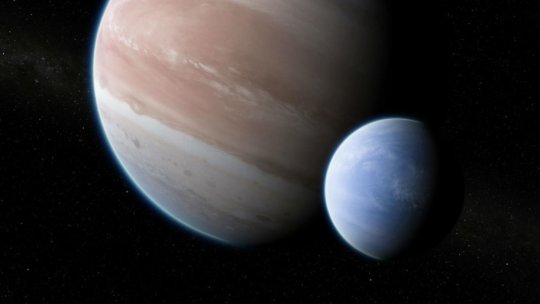
A pair of Columbia University astronomers using NASA's Hubble Space Telescope and Kepler Space Telescope have assembled compelling evidence for the existence of a moon orbiting a gas-giant planet 8,000 light-years away.
In a paper published Oct. 3 in the journal Science Advances, Alex Teachey and David Kipping report that the detection of a candidate exomoon -- that is, moons orbiting planets in other star systems -- is unusual because of its large size, comparable to the diameter of Neptune. Such gargantuan moons do not exist in our own solar system, where nearly 200 natural satellites have been cataloged.
"This would be the first case of detecting a moon outside our solar system," said Kipping, an assistant professor of astronomy at Columbia. "If confirmed by follow-up Hubble observations, the finding could provide vital clues about the development of planetary systems and may cause experts to revisit theories of how moons form around planets."
In looking for exomoons, the researchers analyzed data from 284 Kepler-discovered planets that were in comparatively wide orbits, with periods greater than 30 days, around their host star. The observations measured the momentary dimming of starlight as a planet passed in front of its star, called a transit. The researchers found one instance, in Kepler 1625b, that had intriguing anomalies.
"We saw little deviations and wobbles in the light curve that caught our attention," Kipping said.
The Kepler results were enough for the team to get 40 hours of time with Hubble to intensively study the planet, obtaining data four times more precise than that of Kepler. The researchers monitored the planet before and during its 19-hour-long transit across the face of the star. After it ended, Hubble detected a second and much smaller decrease in the star's brightness 3.5 hours later, consistent with "a moon trailing the planet like a dog following its owner on a leash," Kipping said. "Unfortunately, the scheduled Hubble observations ended before the complete transit of the moon could be measured."
In addition to this dip in light, Hubble provided supporting evidence for the moon hypothesis by measuring that the planet began its transit 1.25 hours earlier than predicted. This is consistent with the planet and moon orbiting a common center of gravity (barycenter) that would cause the planet to wobble from its predicted location.
"An extraterrestrial civilization watching the Earth and Moon transit the Sun would note similar anomalies in the timing of Earth's transit," Kipping said.
The researchers note that in principle this anomaly could be caused by the gravitational pull of a hypothetical second planet in the system, although Kepler found no evidence for additional planets around the star during its four-year mission.
"A companion moon is the simplest and most natural explanation for the second dip in the light curve and the orbit-timing deviation," said lead author Teachey, NSF Graduate Fellow in astronomy at Columbia. "It was a shocking moment to see that light curve, my heart started beating a little faster and I just kept looking at that signature. But we knew our job was to keep a level head testing every conceivable way in which the data could be tricking us until we were left with no other explanation."
The moon is estimated to be only 1.5 percent the mass of its companion planet, which itself estimated to be several times the mass of Jupiter. This value is close to the mass-ratio between the Earth and its moon. But in the case of the Earth-Moon system and the Pluto-Charon system -- the largest of the five known natural satellites of the dwarf planet Pluto -- an early collision with a larger body is hypothesized to have blasted off material that later coalesced into a moon. Kepler 1625b and its satellite, however, are gaseous, not rocky, and, therefore, such a collision may not lead to the condensation of a satellite.
Exomoons are difficult to find because they are smaller than their companion planet and so their transit signal is weak; they also shift position with each transit because the moon is orbiting the planet. In addition, the ideal candidate planets hosting moons are in large orbits, with long and infrequent transit times. In this search, the Neptune-sized moon would have been among the easiest to first detect because of its large size.
The host planet and its moon lie within the solar mass star's (Kepler 1625) habitable zone, where moderate temperatures allow for the existence of liquid water on any solid planetary surface. "Both bodies, however, are considered to be gaseous and therefore unsuitable for life as we know it," Kipping said.
Future searches will target Jupiter-sized planets that are farther from their star than Earth is from the Sun. There are just a handful of these in the Kepler database. NASA's upcoming James Webb Space Telescope could really "clean-up" in the satellite search, Kipping said. "We can expect to see really tiny moons."