Astronomers May Have Discovered the Youngest Planet Ever Detected in Our Galaxy
-
 Loading...
 - Fanya Yougouda
- 15 Aug 2022
- 81 Views
- 0 Like
- 0 Comment
ALMA Makes First-Ever Detection of Gas in a Circumplanetary Disk
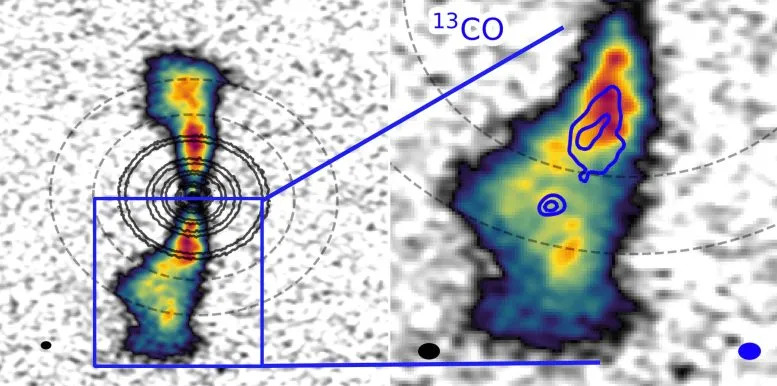
Astronomers using the Atacama Large Millimeter/submillimeter Array (ALMA) to study planet formation have made the first-ever detection of gas in a circumplanetary disk. What’s more, the detection also suggests the presence of a very young exoplanet. The results of the research were published in The Astrophysical Journal Letters.
Circumplanetary disks are an accumulation of gas, dust, and debris around young planets. These disks contain the material that may form moons and other small, rocky objects, and control the growth of young, giant planets. Analyzing these disks in their earliest stages may help shed light on the formation of our own Solar System, including that of Jupiter’s Galilean moons, which scientists believe formed in a circumplanetary disk of Jupiter around 4.5 billion years ago.
While studying AS 209 — a young star located approximately 395 light-years from Earth in the constellation Ophiuchus — astronomers observed a blob of emitted light in the middle of an otherwise empty gap in the gas surrounding the star. That led to the detection of the circumplanetary disk surrounding a potential Jupiter-mass planet.
Researchers are closely watching the system, both because of the planet’s distance from its star and the star’s age. The exoplanet is located more than 200 astronomical units (an astronomical unit is the distance between the Earth and the Sun), or 18.59 billion miles, away from the host star. This vast distance challenges currently accepted theories of planet formation. And if the host star’s estimated age of just 1.6 million years holds true, this exoplanet could be one of the youngest ever detected. Further research is needed, and astrophysicists hope that upcoming observations with the James Webb Space Telescope will confirm the planet’s presence.
“The best way to study planet formation is to observe planets while they’re forming. We are living in a very exciting time when this happens thanks to powerful telescopes, such as ALMA and JWST,” said Jaehan Bae, a professor of astronomy and the lead author of the paper. Read More...