Best in glass – can the return of the milkround help squash our plastic problem?
-
 Loading...
 - Siomi Kennedy
- 09 Feb 2021
- 1257 Views
- 0 Like
- 0 Comment
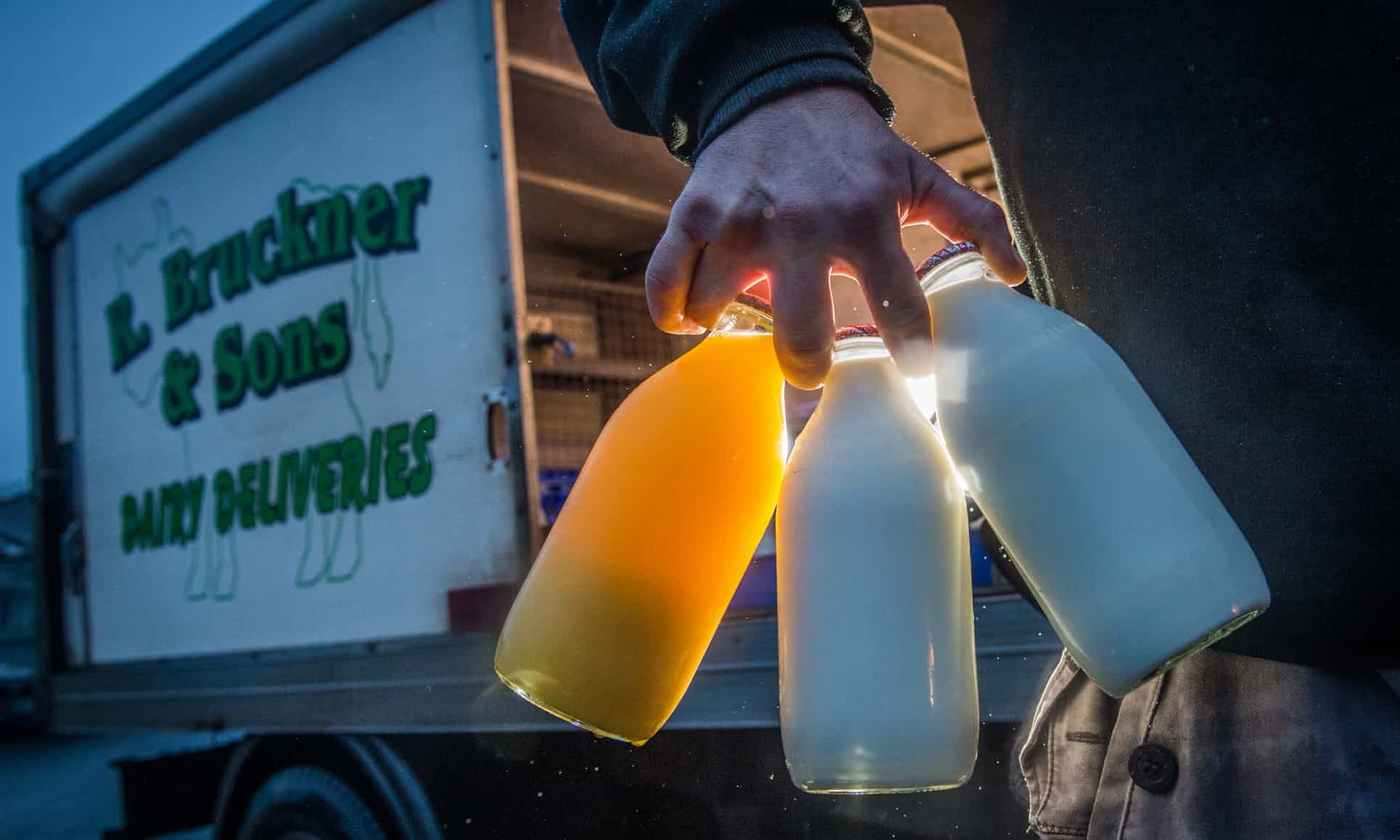
Just before dawn breaks, as a blackbird sings in the drizzle, I join third-generation milkman, Stuart Bruckner, 42, on the last leg of his Devon milkround. I have never met him before, but three times a week he delivers my four pints of red-top semi-skimmed under the cover of darkness in time for my breakfast. It gives me great joy to pop my empty glass bottles back on the doorstep to be used again. Since the recent increased public dismay about plastic pollution, more people have signed up to doorstep deliveries to get plastic-free milk, although share of the sector around the country remains steady at around 3%, according to Dairy UK.
“Business has gone crazy these last couple of weeks,” says Bruckner, who believes BBC’s Blue Planet II has helped spark a revival. “On average, nine new customers are signing up daily,” he adds. “Interestingly, it’s a younger demographic of customers calling up. More families and couples in their 30s and 40s are putting orders in specifically for milk in glass.”
So, should we all cut out the plastic two-pinter out from the weekly shop and give the local milkman a call?
Milk doorstep deliveries have been in steady decline over the past 20 years. Back in 1975, 94% UK milk was delivered in glass bottles, but by 2016 that had decreased to just 3%. Bruckner admits that he and his brother, Sam, who run Dartmouth Dairy with their mother, Joy, have often wondered whether to continue using glass. “We can’t compete with supermarkets, but we have always just stuck with what we know,” he says. “Now, we’re so glad we did. Hopefully, this is a real opportunity for traditional milkmen to make a comeback. We’re looking at putting on extra delivery days and, if business continues like this, we will need to employ new milkmen.”
Bruckner began his shift at 11pm. “I started doing milkrounds with my dad when I was 10 and he gave us a strong work ethic,” he tells me. “It’s a weird and wonderful job – it can be awkward, unsociable and tiring. We’ve witnessed crimes, been the first to discover car accidents, and I found a customer lying injured from a fall when I noticed his milk hadn’t moved since my previous delivery.”
As the clink-clink of bottles resonates down empty streets, Bruckner explains how business has changed since the business was established in 1955 by his grandfather, Robert. He keeps track of every order and payment electronically. Wholesale is important, too, with deliveries to hotels, schools and hospitals. We’re in one of the company’s 12 vans, but, as recently as 2011, they still used two electric floats to deliver over short distances around Dartmouth. However, he says: “We sell 1,000 lines, including heavy compost bags and sacks of potatoes – electric floats loaded up with heavy goods become dangerous on steep hills.”
Bruckner remembers when small dairies were thriving: “There were 12 dairies in south Devon when we were growing up. Ten years ago, the big Dairy Crest plant in Totnes closed and now there are no big milk producers left in the county.” Today, Dartmouth Dairy buys milk from another independent family-run company, Cotteswold Dairy, which sources English milk from 37 farmers within a 35-mile radius and has produced milk in glass bottles since 1938.
It takes approximately two and a half days for milk from the parlour to reach Dartmouth ready for distribution. “The provenance of our milk is so important – we trust our suppliers and we keep food miles down to a minimum,” Bruckner says. He explains that supermarket milk involves longer supply chains, since their milk travels further to be processed and bottled, but their cheap prices don’t represent the milk market. “The problem we have is that supermarket milk is so cheap that it’s not representative of the industry as a whole – and that devalues the price of milk.” In most supermarkets, a four-pint plastic bottle of semi-skimmed costs just £1.10 but in glass bottles from the milkman, the equivalent sets consumers back £2.72. Customers are paying for its traceability and Stuart explains that the price is all in the milk: “We’ve got to pay a fair price to our farmers. We don’t charge for delivery – our price is all in the milk. We haven’t put our prices up in four years, but you’re paying more for a sustainable product.”
Glass bottles make up just 2.6% of liquid milk sales in the UK, according to Dairy UK, and that includes shops, supermarkets and doorstep deliveries. That is a tiny proportion of the 5.5bn litres produced annually in the UK. Glass bottles can be washed and reused up to 25 times, although they eventually wear due to heat extremes and are then recycled. At first glance the sustainability credentials of glass bottles far outweigh those of plastic bottles, but the argument isn’t that clear cut. The industry needs an accurate life cycle assessment to compare the environmental footprint of efficiently recycling lighter, cheaper plastic bottles with the multiple reuse of heavier, more expensive glass bottles that require more fuel for transportation back to depots, as well as sterilisation at very high temperatures.
Some operations much bigger than the Bruckners’ still use glass. In 2016, dairy giant Müller bought Hanworth Dairy in London, pledging to keep its glass bottling plant and delivery service, which had been earmarked for closure. The company has since created milk&more – a national workforce of 1,200 milkmen and women delivering more than 100m pints of milk in glass bottles every year. The company’s CEO, Patrick Müller, expects that figure to rise significantly: “We’ve seen a surge of people interested in having their milk delivered in glass bottles.” The company says it has attracted 2,000 new customers in the past two weeks, 90% of whom are ordering glass bottles.
Bruckner believes there is still a big need for doorstep deliveries: “We’re the original home delivery service – milk deliveries date back to the late 1700s, so it’s nothing new. A customer can call us at 10pm and milk reaches their doorstep by 2am – you can’t beat that. And we sell much more than milk – from fruit and veg to bread and bacon, eggs, toilet roll. Here in Devon, many of our customers are elderly and so the convenience element is fundamental.”
It’s not just individual households that are starting to think more responsibly about single-use plastic. Fox primary school in Notting Hill, London, recently made the switch to glass milk bottles to cut down its plastic footprint and Nigel’s Dairy in Carmarthen has seen a surge in demand from retailers as a result of Aberporth’s recent successful campaign to become the first plastic-free town in Wales. The owner, Nigel Dragone, has extended his glass bottle range to include orange, apple, cranberry and grapefruit juices. “We’re busier than we’ve ever been – all people want is glass, glass, glass. We’ve taken on 30 new home deliveries in the last two weeks, plus lots of shops are switching to glass, so it has massively escalated,” he says.
It may not be practical for everyone to go back to glass bottles from suppliers such as Dragone, but I’m determined to continue supporting our local dairy industry. Once our shift is over, I head home for breakfast with a new appreciation for that glug-glug sound as I pour cold red top on to my cereal, and Bruckner goes back to the depot for a strong coffee.
Got craft milk?
Direct dairy-to-door deliveries in the UK
A handful of microdairies produce milk on site in foil-topped glass bottles and sell to customers direct.
The Calf at Foot Dairy in Suffolk is an ethical microdairy producing raw, unadulterated milk from 16 cows without weaning calves until they are ready. Local customers bring their own glass bottles to fill directly.
Taw River Dairy in North Devon allows its 20-strong Jersey herd to rear its own calves and milk just once daily.
North Aston Dairy in Oxfordshire produces 1,000 litres of milk every week from 17 cows. Members of the community have invested in “cow bonds” to finance the purchase of milking cows.