Black Spider: horror made in Switzerland
-
 Loading...
 - Nicolas Stewart
- 19 Apr 2022
- 323 Views
- 0 Like
- 0 Comment
Did you know that Switzerland is the birthplace of the horror genre as we know it today? It may have come by this honour somewhat passively, in part through climatological happenstance, but it is a story worth telling. It was here, on the shores of Lake Geneva, that a young MaryExternal link and Percy ShelleyExternal link spent the summer months of 1816, hosted by the poet Lord ByronExternal link and his friend John Polidori.
Kept from outdoor activities by bad weather – the result of a volcanic winter caused by the eruption of Mount Tambora the year before – the quartet took to telling ghost stories: Mary Shelley presented the rudiments of her seminal science-fiction novel Frankenstein, while Byron’s musings about vampires would later serve as inspiration for Polidori’s 1819 story The Vampyre, itself a future touchstone of 19th-century vampire lore, including Bram Stoker’s 1897 masterpiece Dracula.
Much of Switzerland’s place in the annals of horror, then, is owed to the fact that both Count Dracula and Frankenstein’s monster are Swiss-born, so to speak. Horrific writing, meanwhile, was done elsewhere, at least in the popular consciousness – by Shelley and Ann RadcliffeExternal link in England, by Edgar Allan PoeExternal link in the United States, by E. T. A. HoffmannExternal link in the German lands, by the Marquis de SadeExternal link in France, among other 19th-century so-called gothic and horror writers.
Swiss literature in the 19th century, by contrast, was dominated by the more sober realist mode; by the slice-of-life tales of Gottfried KellerExternal link and the historical narratives of Conrad Ferdinand MeyerExternal link. But just as Switzerland seems an unlikely place of origin for two staples of Halloween iconography, there is a Gothic underbelly to that supposedly quaint Swiss-German realism – one that is rarely appreciated beyond the borders of German-speaking Europe.

A warning against evil
Enter author and Protestant pastor Albert Bitzius, better known under his pseudonym as Jeremias Gotthelf. Born in 1797, he is generally considered, along with his juniors Keller and Meyer, to be Switzerland’s major literary figure in the 1800s, specialising in realist accounts of rural life in his native Bernese Emmental, written in a playful mélange of German grammar and vocabulary borrowed from the regional dialect.
And it is maybe his most enduring work, the 1842 novella Die schwarze Spinne (The Black Spider), which provides us with a rare example of Gothic horror made in Switzerland.
However, much like calling Switzerland the birthplace of modern horror comes with a few qualifiers, so does calling The Black Spider a horror story.
For one, it’s debatable whether Gotthelf himself would agree with this assessment. Framed by a comical bit of rural realism, detailing the logistical challenges of an 1840s baptism in the Emmental town of Sumiswald, the novella has the didactical structure and the stern moralism of an allegorical Christian sermon: it is, in essence, pastoral propaganda – a warning against evil temptation and an illustration of the transcendental power of godly devotion.
Yet the methods of Gotthelf’s religious instruction are steeped in Gothic sensibilities, with the main story, set 600 years earlier, featuring unnerving medieval architecture, demonic apparitions, a Faustian pact, and an infernal supernatural infestation.
Ordered by their liege lord, a capricious knight of the Teutonic Order, to construct a shaded avenue leading to his castle, the people of 13th-century Sumiswald are accosted by the devil, who promises to do the gruelling, near-impossible work for them, if they yield unto him an unbaptised child.
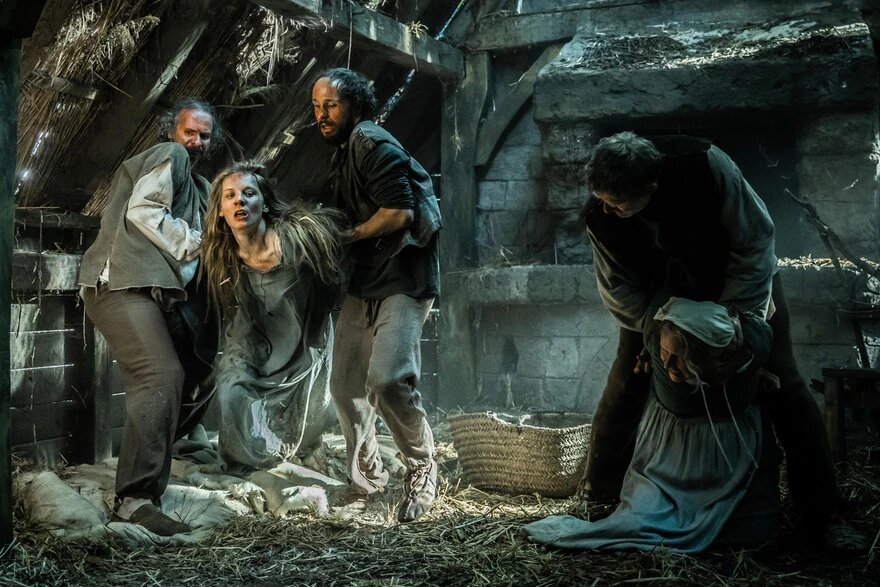
While the village men are too afraid to agree to the bargain, Christine, a German immigrant, takes it upon herself to keep Sumiswald safe from the knight’s wrath, sealing the deal with a kiss. The devil keeps his word, but the villagers promptly attempt to double-cross him, resolving to henceforth baptise every new-born child instantaneously. Read More…