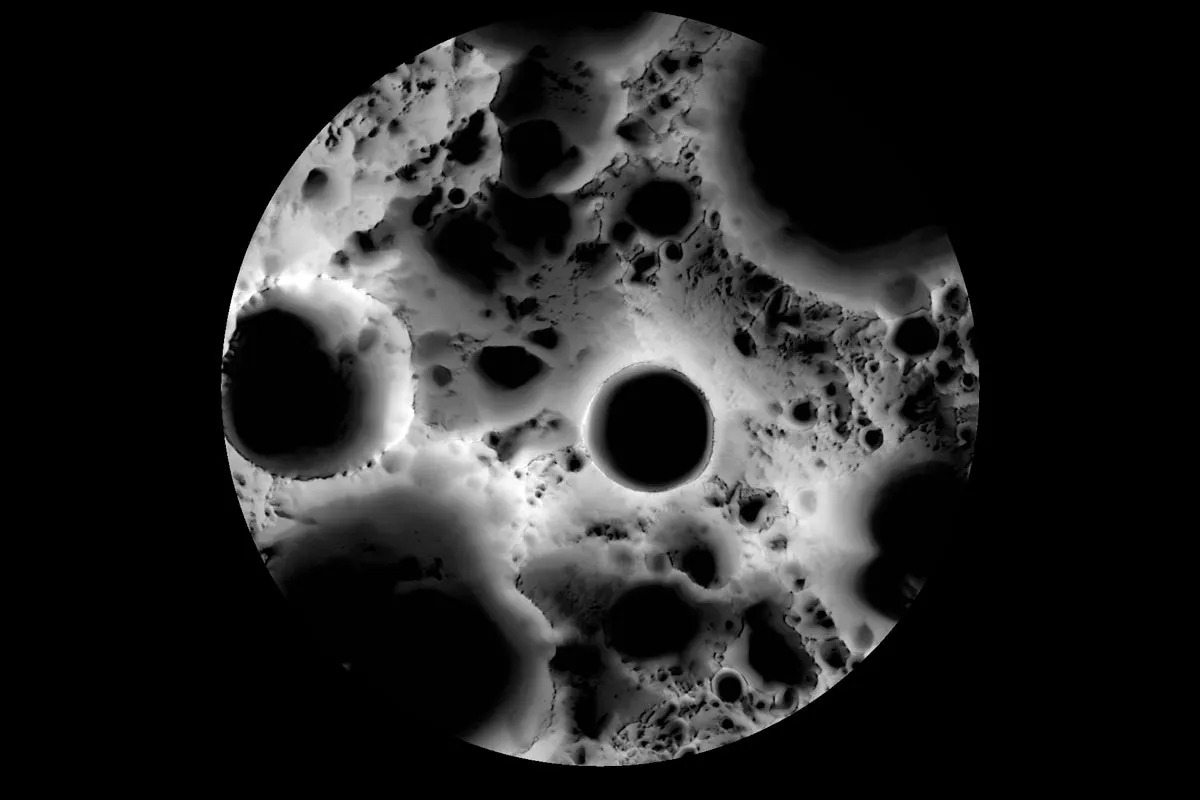
Bombardment History Revealed: The Moon Sustained Twice As Many Impacts As Can Be Seen on Its Surface
-
 Loading...
 - Carlos Costa
- 19 Jul 2022
- 102 Views
- 0 Like
- 0 Comment
Scientists have found that the porosity of the moon’s crust reveals its bombardment history. Furthermore, the moon has sustained twice as many impacts as can be seen on its surface.
The early solar system resembled a game of space rock dodgeball, some 4.4 billion years ago, when giant asteroids and comets, and, subsequently, smaller rocks and galactic debris pummeled the moon and other infant terrestrial bodies. This period ended approximately 3.8 billion years ago. This tumultuous time left behind a heavily cratered face on the moon, and a cracked and porous crust.
Now MIT scientists have discovered that the porosity of the moon’s crust, which extends deep beneath the surface, can reveal a great deal about the moon’s history of bombardment.
In a study published in the journal Nature Geoscience, the research team has shown through simulations that, early on in the bombardment period, the moon was highly porous — almost one-third as porous as pumice. Early, massive impacts that shattered much of the crust were the likely cause of this high porosity.
Scientists have assumed that a continuous barrage of impacts would slowly build up porosity. But surprisingly, the team found that nearly all of the moon’s porosity formed rapidly with these initial massive impacts, and that the continued onslaught by smaller impactors actually compacted its surface. These later, smaller impacts acted instead to compact and squeeze some of the moon’s existing cracks and faults.
From their simulations, the scientists also estimated that the moon experienced double the number of impacts as can be seen on the surface. This estimate is lower than what others have assumed in the past.
“Previous estimates put that number much higher, as many as 10 times the impacts as we see on the surface, and we’re predicting there were fewer impacts,” says study co-author Jason Soderblom, a research scientist in MIT’s Department of Earth, Atmospheric and Planetary Sciences (EAPS). “That matters because that limits the total material that impactors like asteroids and comets brought to the moon and terrestrial bodies, and gives constraints on the formation and evolution of planets throughout the solar system.”
A porous record
In the researchers’ new study, the team looked to trace the moon’s changing porosity and use those changes below the surface to estimate the number of impacts that occurred on its surface.
“We know the moon was so bombarded that what we see on the surface is no longer a record of every impact the moon has ever had, because at some point, impacts were erasing previous impacts,” Soderblom says. “What we’re finding is that the way impacts created porosity in the crust is not destroyed, and that can give us a better constraint on the total number of impacts that the moon was subject to.”
To trace the evolution of the moon’s porosity, the scientists looked to measurements taken by NASA’s Gravity Recovery and Interior Laboratory, or GRAIL, an MIT-designed mission that launched twin spacecraft around the moon to precisely map the surface gravity.
Researchers have converted the mission’s gravity maps into detailed maps of the density of the moon’s underlying crust. From these density maps, scientists have also been able to map the current-day porosity throughout the lunar crust. These maps show that regions surrounding the youngest craters are highly porous, while less porous regions surround older craters.
Crater chronology
In their new study, Huang, Soderblom, and their colleagues looked to simulate how the moon’s porosity changed as it was bombarded with first large and then subsequently smaller impacts. They included in their simulation the age, size, and location of the 77 largest craters on the moon’s surface, along with GRAIL-derived estimates of each crater’s current-day porosity. The simulation includes all known basins, from the oldest to the youngest impact basins on the moon, and span ages between 4.3 billion and 3.8 billion years old. Read More...