NASA telescope reveals never-before-seen details, heralding new era of astronomy
-
 Loading...
 - Fernanda Barbosa
- 20 Jul 2022
- 102 Views
- 0 Like
- 0 Comment
The cosmic cliffs of a stellar nursery and a quintet of galaxies bound in a celestial dance: NASA released the next wave of images from the James Webb Space Telescope this week, heralding a new era of astronomy.
"Every image is a new discovery," said NASA administrator Bill Nelson. "Each will give humanity a view of the universe that we've never seen before."
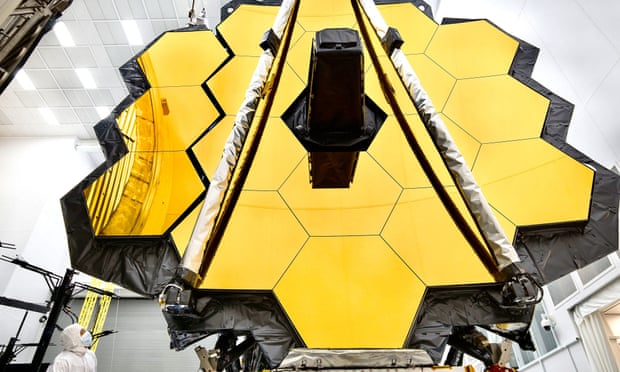
Released in a drip feed from the Goddard Space Flight Center, the new images demonstrated the full power of the 10-billion observatory, which uses infrared cameras to gaze into the distant universe with unprecedented clarity.
"They're beautiful and they're full of wonderful discoveries and science, and lots of things we haven't identified are in there," said Nobel-winning cosmologist and Webb senior project scientist John Mather, reacting to the images.
On Monday, Webb revealed the sharpest image to date of the early universe, teeming with thousands of galaxies going back more than 13 billion years.
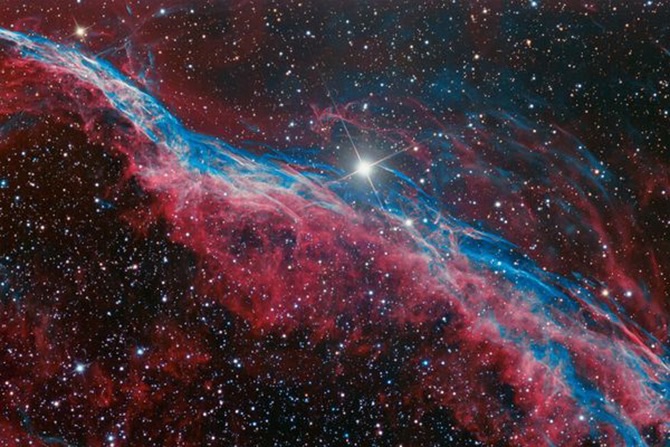
The latest tranche included the "mountains" and "valleys" of a star-forming region called NGC 3324 in the Carina Nebula, dubbed the "Cosmic Cliffs," 7,600 light years away.
"For the first time we're seeing brand new stars that were previously completely hidden from our view," said NASA astrophysicist Amber Straughn.
Scientists expect a torrent of knowledge from the telescope, which scans infrared frequencies that aren’t visible to the human eye, but are rich in information about the building blocks of the universe.
“I’m very excited,” said Christopher Johns-Krull, a professor of physics and astronomy at Rice University who studies planets outside Earth’s solar system. “The James Webb is going to reveal a lot, and truly move the field forward.”
The telescope “is going to be particularly powerful for looking at planets around other stars,” he said. Possibilities include finding a planet that supports life, and knowledge about how galaxies are formed.
Stellar nurseries and graveyards
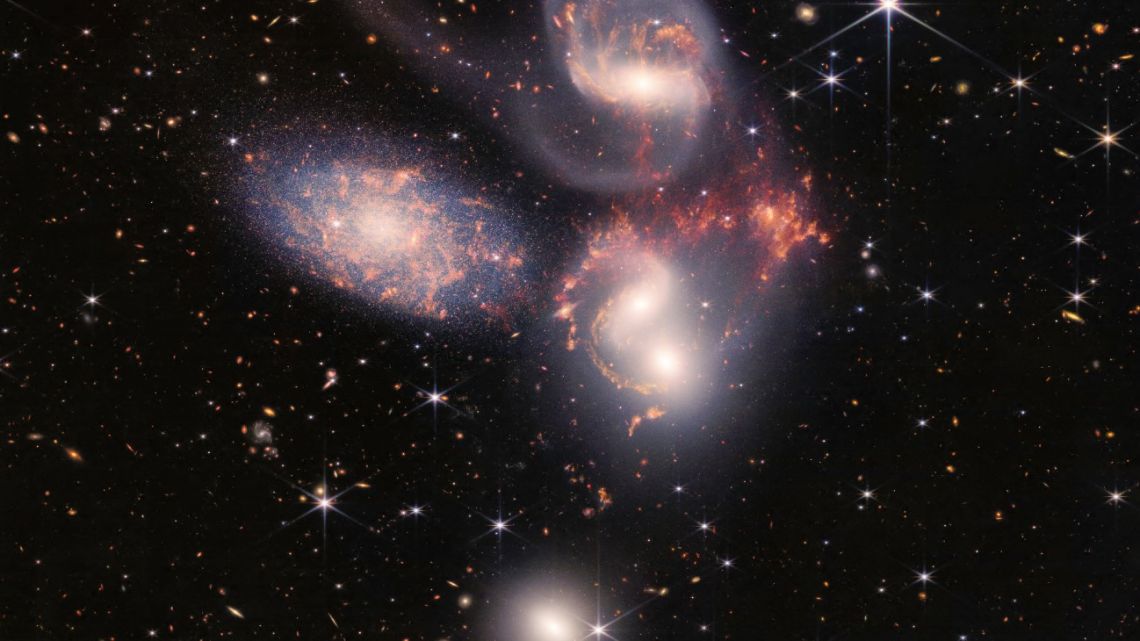
Webb also revealed never-before-seen details of Stephan's Quintet, a grouping of five galaxies including four that experience repeated close encounters, which provide insights into how early galaxies formed at the start of the universe.
At the centre of the cluster is a black hole called an active galactic nucleus, "which means stuff is flowing in, it gets cooked to high temperatures, and some of it gets spit back out again," explained Mather.
Studying the black hole will allow scientists to better understand the one at the centre of our own Milky Way, called Sagittarius A*.
A dim star at the centre of the Southern Ring Nebula was found for the first time to be cloaked in dust, as it spews out rings of gas and dust in its death throes.
Understanding the molecules present in such stellar graveyards can help scientists learn more about the process of stellar death.
The telescope also detailed water vapour in the atmosphere of a faraway giant gas planet.
The spectroscopy – an analysis of light that reveals detailed information – was of planet WASP-96 b, which was discovered in 2014.
Scientists will next hope to train the spectrographic instruments on small rocky worlds such as our own, to search for signs of habitability. Read More...