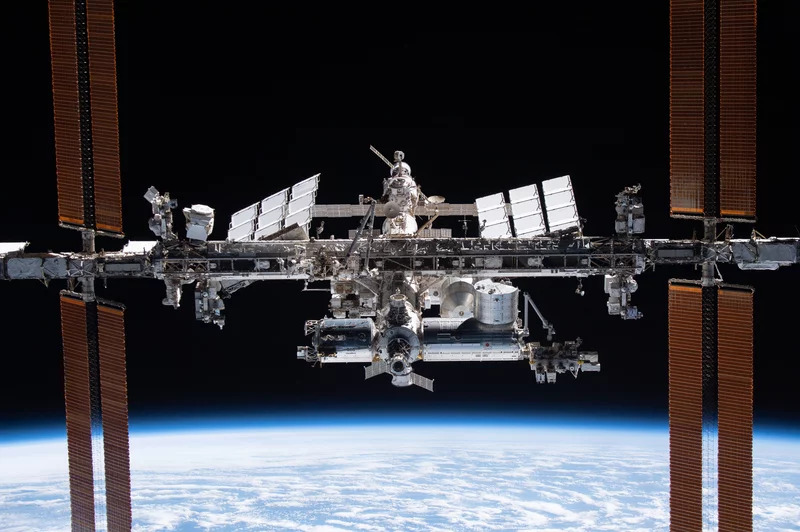
The International Space Station had to move to dodge space junk
-
 Loading...
 - Scarlett Lawrence
- 28 Oct 2022
- 73 Views
- 0 Like
- 0 Comment
The International Space Station had to fire its thrusters this week to make sure it avoided space junk in orbit around Earth.
The station fired its thrusters for 5 minutes and 5 seconds in what NASA called a "Pre-Determined Debris Avoidance Maneuver" at 8:25 p.m. ET Monday to increase its distance from a piece of what used to be a Russian satellite.
NASA says the maneuver increased the ISS' altitude between 0.2 and 0.8 of a mile. Without the move, the satellite debris would have come within about 3 miles of the space station.
The fragment in question was from Russia's Cosmos 1408 satellite. Russia destroyed it with a missile in November 2021, creating 1,500 pieces of debris, according to NASA. U.S. officials condemned the anti-satellite missile test, saying it would create hundreds of thousands more pieces of debris in the coming years.
Space junk is a major problem: There are millions of pieces of debris circling Earth, most of it originating from satellite explosions and collisions. And when objects collide with each other, they can create even smaller pieces of debris.
Pieces larger than a millimeter number about 100 million, while objects between 1 cm and 10 cm in diameter number about 500,000, and 25,000 pieces of debris larger than 10 cm are known to exist, NASA says.
Space junk can threaten weather forecasting and GPS
Space junk poses a special threat to satellites, and in turn, services satellites provide such as weather forecasting and GPS.
"It is of particular risk to the United States because the United States is probably the most space-dependent power around," said Saadia Pekkanen, director of the Space Law, Data and Policy program at the University of Washington, in an interview with NPR earlier this year. "Relative to other powers, if anything happens to those satellites, it does affect the civilian, commercial and military capabilities of the United States."
Even very small pieces can be dangerous because of the speeds at which objects are traveling in orbit. Average impact speed is usually 22,000 mph, but can be as high as 33,000 mph. Read More…