Butterflies may lose their ‘tails' like lizards

On some butterfly wings, “tails” may be more than just elegant adornments. They’re survival tools too, a study suggests.
The tails seem to attract the attention of attacking birds, keeping them away from a butterfly’s more vital body parts, researchers report May 25 in the Proceedings of the Royal Society B. The finding could help explain why wing tails have independently evolved multiple times across different moth and butterfly groups.
Evolutionary biologist Ariane Chotard studies the wings of swallowtail butterflies, which make up the hundreds of species in the family Papilionidae. “A lot of these butterflies display tails,” Chotard says. “And we don’t really know why.”
Some butterfly species with false head or eyespot patterns on their wings are known to receive more attacks from predators in those regions. And Chotard and her colleagues wondered if tails were also a target.
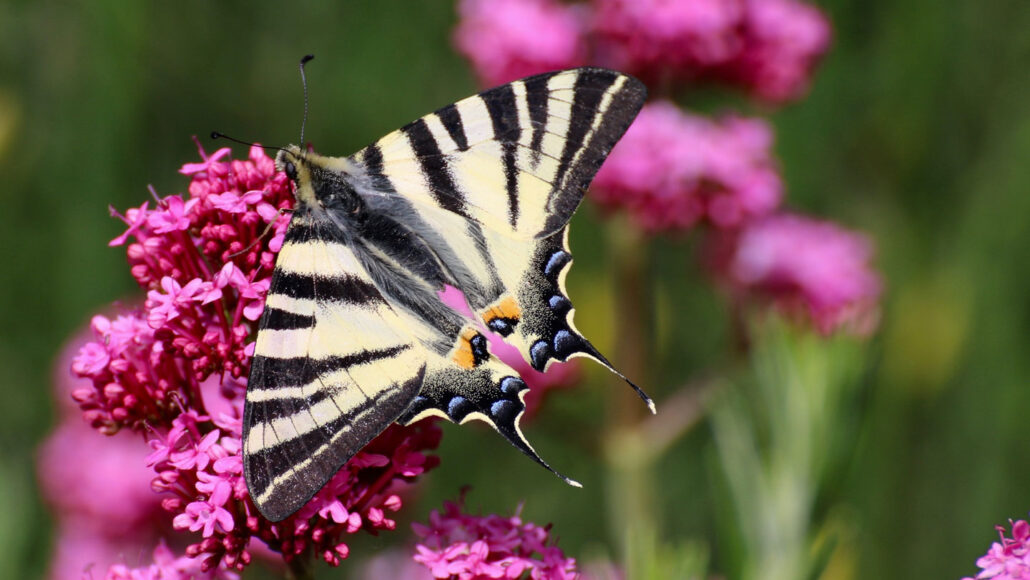
So in the summer of 2020, the researchers collected 138 sail swallowtail butterflies (Iphiclides podalirius) from the wild in Ariege, France. Sail swallowtails — found throughout Eurasia — sport two, conspicuous black tails on hind wings with some blue and orange spotting, contrasting greatly with the rest of the insects’ yellow, striped coloration.
Among the collected swallowtails, 65, or 41 percent, had damaged wings, all of which had at least one tail damaged. When all 130 wings in this group of damaged butterflies were counted, more than 82 percent of the wings had damaged tails, suggesting that predators may be targeting the spindly parts.
To test that idea, the team kept wild-caught songbirds called great tits (Parus major) in cages. The researchers then showed the birds dummy butterflies made from gluing real swallowtail wings to a fake body made of small pieces of black cardboard, and filmed the birds’ attacks on the faux insects.
Forty-three out of 59 beak strikes, or nearly 73 percent, were on the hind wings. Twenty-three, or 39 percent, of the strikes touched both a tail and colored areas on the upper part of a hind wing simultaneously, more than any other body area on the dummies.
Taken together, the findings suggest that swallowtail tails deflect attacks away from the butterfly’s vulnerable body to brittle extensions that easily tear off, allowing the insect to escape, the researchers say. This may be similar to the strategy some lizards use when sacrificing their detachable tails to hungry predators. Read More...