World Bee Day - Opportunity to Discuss the Challenges of Bee Preservation and Activities for their Survival
-
 Loading...
 - Mariana Vargas
- 15 Jun 2022
- 222 Views
- 0 Like
- 0 Comment
On 20 May, Slovenia and the rest of the world will celebrate World Bee Day for the fifth time. The UN General Assembly proclaimed World Bee Day on 20 December 2017. Since 2022 is the European Year of Youth, the main topic of this year's celebration are young people and beekeeping. The main purpose of World Bee Day is to raise awareness among the international public about the importance of bees and other pollinators for humanity in the light of food security, the global elimination of hunger and care for the environment and biodiversity.
World Bee Day highlights the importance of bees and other pollinators for sustainable agriculture, global food supply and hunger elimination. Every third spoonful of food depends on pollination. By pollinating crops, bees are an important source of jobs and farmers' income, in particular as regards small and family farms in developing countries. They also play an important role in preserving nature and biodiversity. It is vital to protect pollinators, which are threatened by human activities, in particular intensive farming, the wide use of pesticides and pollution caused by waste. Bees are exposed to new diseases and pests. The bees' habitat is shrinking due to the growing world population. Their survival and development are increasingly threatened by climate change.
In 2016, after disseminating information to countries, institutions and the general public for one year, Slovenia – on the initiative of the Slovenian Beekeepers’ Association – initiated procedures in the UN to declare World Bee Day. The first phase of official procedures took place in the working bodies of the UN Food and Agriculture Organization (FAO) in Rome, while the final phase took place in the competent committee at the UN General Assembly in New York. Both institutions adopted a resolution, which received the general support of participating countries, emphasising the importance of bees and other pollinators for sustainable development and the preservation of the planet for future generations. The aim of the initiative is to draw the attention of the international public to the importance of bee and pollinator conservation, highlight the importance of bees for agriculture, the environment and the entire humanity, and call for specific activities for their preservation.
Slovenia proposed the celebration of World Bee Day in the month of May for a number of reasons. It is when bees in the northern hemisphere are most active and begin to reproduce. This is also the period in which the need for pollination is greatest. In the southern hemisphere it is autumn, a time for harvesting bee products, marking the days and weeks of honey. In addition, 20 May is the birth date of Anton Janša, who is considered a pioneer of modern beekeeping and one of the greatest experts in this field of his time.
The promotion of World Bee Day contributes to the global visibility of Slovenia and Slovenian beekeeping. This provides opportunities for further development and expansion to international markets in numerous fields. One of them is definitely to market beekeeping knowledge and skills. Further development is possible as regards the offer of Slovenian beekeeping equipment, the export of bee products with a higher added value and the like. World Bee Day is also an opportunity for other branches of the economy, including tourism, trade and the hospitality industry, and for the general promotion of Slovenia globally.
Beekeeping in Slovenia
We are fortunate in Slovenia to have suitable natural conditions and a very rich knowledge, tradition and experience passed on by our beekeepers, enabling everybody to get familiar with bees and become beekeepers.
Not only that Slovenia initiated World Bee Day, it has also long been recognised as a country of beekeeping. Anton Janša (1734–1773), the first teacher of beekeeping in imperial Vienna, spread the knowledge of small Slovenian farmers and beekeepers across the world already 230 years ago. Hundred of years later, the area became famous for its Apis mellifera carnica honeybee, which soon became known throughout the world.
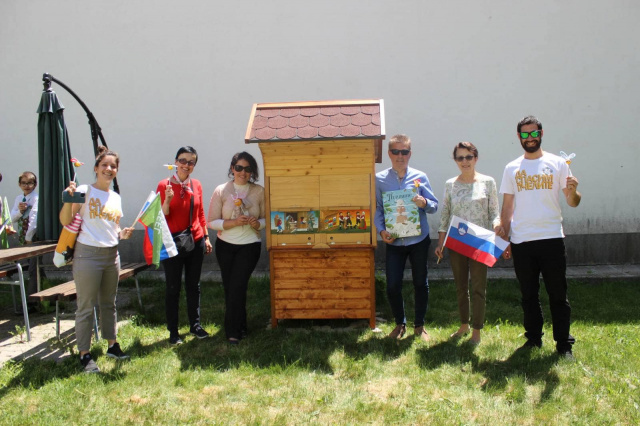
Beekeeping also left its mark in folk art. Painted beehive panels are part of the Slovenian cultural heritage. As one of the chapters of folk art, which was mostly created by and for representatives of lower social strata or peasants, painted beehive panels appeared in the Slovenian ethnic area in the second half of the 18th century. The most common beehive in Slovenia is the AŽ hive named after beekeepers Alberti and ŽnideršiÄ. Bee houses characterise the architecture of rural built heritage in Slovenia and enrich the cultural image of the Slovenian landscape even today. Read More...