Common goals ensure forest restoration success in northern Thailand
-
 Loading...
 - Chang Chen
- 10 Aug 2022
- 78 Views
- 0 Like
- 0 Comment
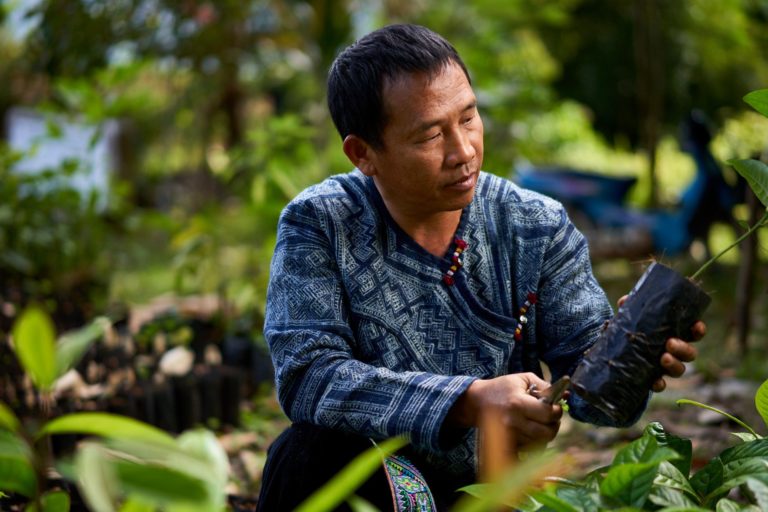
Chotgun Prapatsit takes a handful of topsoil and deftly sprinkles it into a small cylindrical potting bag containing a tiny tree seedling. The spindly stem sports its first set of fresh green leaves, which bob merrily as he tucks the soil in around its base, as if settling it down for a cozy night’s sleep.
“In the tree nursery, we live with our hearts,” Chotgun tells Mongabay during a visit to the Ban Mae Sa native tree nursery in Chiang Mai province, northern Thailand. As co-manager, he nurtures roughly 20,000 tree saplings each year for planting in local forest restoration projects. He says he feels connected to each individual specimen, watching them develop from seed to seedling in the nursery, and then from sapling to tree in the forest. “Each tree is different,” he says, “so if one is lost, we know.”
He nestles the newly prepared seedling into a tray amid a dozen others. At first glance, the young trees seem to be nothing more than a haphazard tangle of wispy stems and outsized leaves, but closer inspection reveals them to be a carefully curated assortment of 20 to 30 species native to the region’s biodiverse upland evergreen forests.
The tree nursery, on the outskirts of the Hmong village of Ban Mae Sa Mai, was established in 1997 as part of the community’s effort to avoid resettlement after their ancestral land was designated a protected area. By restoring areas of watershed forest that had been cleared for agriculture, the community hoped to demonstrate good faith with park authorities and simultaneously address problems with their water supply.
Over the next 16 years, the Hmong villagers restored 33 hectares (82 acres) of upland evergreen tropical forest within the upper Mae Sa valley in collaboration with national park authorities and researchers from Chiang Mai University’s Forest Restoration Research Unit (CMU-FORRU) who were beginning to experiment with methods of assisted regeneration at the time.

The reforestation project now serves as a research and demonstration site, where university students monitor biodiversity recovery and carbon sequestration, and local, regional and international delegates train in reforestation methods and community-led ecosystem restoration. Meanwhile, the nursery supplies tree-planting initiatives around the Mae Sa valley with locally grown saplings that are equipped to cope with the region’s soils and conditions. Read More…