Conservation study uses tiny treadmills to test sea turtle hatchling stamina
-
 Loading...
 - Ivana Lucija
- 20 Dec 2020
- 1491 Views
- 0 Like
- 0 Comment
If everything goes as planned, a newly hatched sea turtle should be able to crawl from its nest to the ocean in a couple of minutes. This trek happens in the first 24 hours when they emerge from their nests and is referred to as the "frenzy" period. Just like biathletes, these hatchlings sprint from the beach to the surf and then swim a long distance to reach their home. Unfortunately, things don't always go as nature planned.
Scientists believe that sea turtle hatchlings have an innate instinct that guides them toward the brightest low horizon and away from tall dark silhouettes, which orients them toward the ocean's surf. However, excess lighting from the nearshore buildings and streets draw hatchlings toward land, where they may be eaten by predators, run over by roadway traffic, or drown in swimming pools. Baby sea turtles have about a 50 percent chance of getting to their destination in urban settings where there is this disorientation or misorientation from artificial lighting. Because the "frenzy" period is a group activity and there is safety in numbers, being separated from the crowd also puts them at further risk.
Disoriented hatchlings who eventually make it to the ocean expend massive amounts of energy because what was supposed to take a couple of minutes now takes hours to accomplish. Speed is key and their survival depends heavily on their ability to swim. In an effort to conserve these endangered sea turtles, researchers from Florida Atlantic University's Charles E. Schmidt College of Science conducted the first study on disorientation to examine the physiological effects of extended crawling and swimming performance. The study, published in the Journal of Experimental Biology, has some surprising results.
"What prompted our study was the desire to understand what happens to these hatchlings after they spend hours crawling on the beach because they are disoriented," said Sarah L. Milton, Ph.D., lead author and associate professor of biological sciences in FAU's College of Science, who conducted the study with her graduate student Karen Pankaew. "We wanted to know if they would even be able to swim after crawling 500 meters or more, which could take them as long as seven hours to complete."
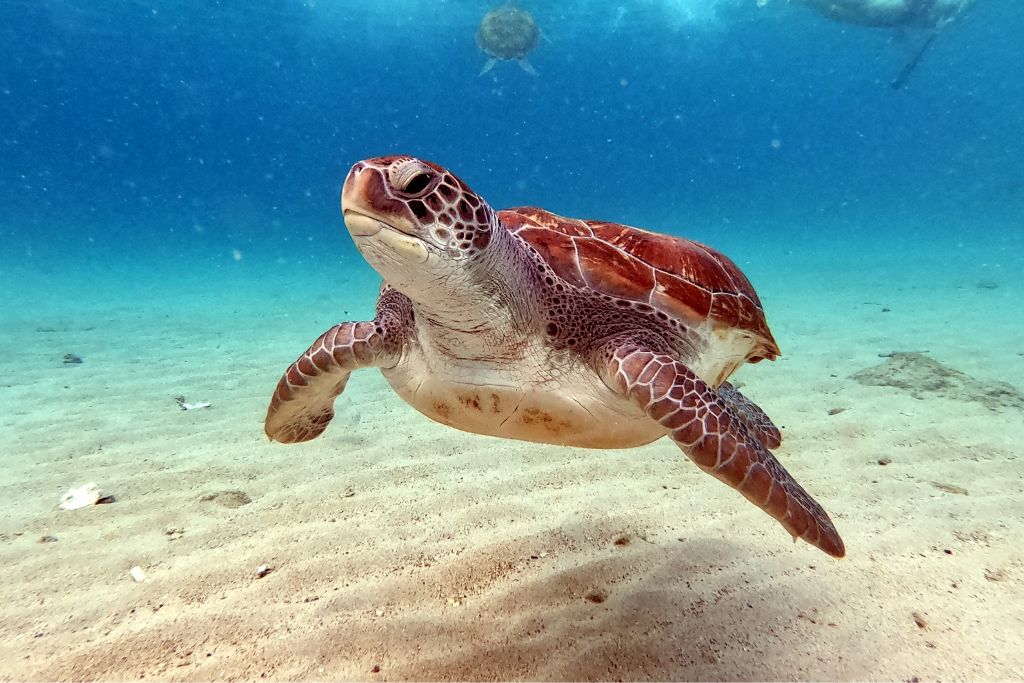
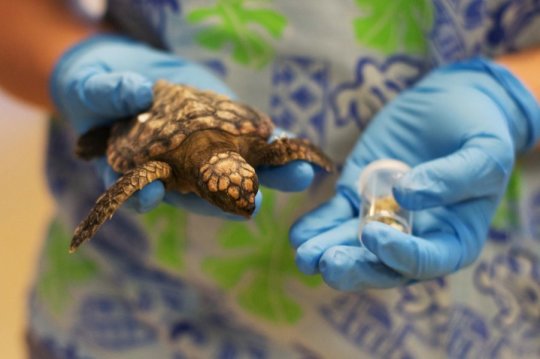
The study involved 150 hatchlings collected just as they emerged from 27 loggerhead turtle and 18 green turtle nests on beaches in Palm Beach County. The hatchlings were released back into the ocean in their natural habitats soon after they were collected from their nests. The objectives of the study were to characterize the energetics of extended crawl distances on the hatchlings and determine whether crawl distances impacted their initial dispersal swim performance.
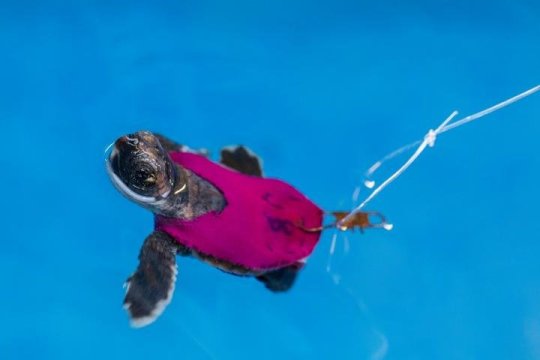
In the laboratory setting, Milton and Pankaew used tiny enclosed treadmills with simulated lighting, which the hatchlings followed while on the treadmill. To determine how well they could perform after their walk on the treadmill, the hatchlings swam in a small tank using a specially designed swimsuit. The researchers measured oxygen consumption and lactate accumulation during the hatchlings' high energy intensive frenzy crawls and frenzy swimming periods. When they were swimming, the researchers also measured the hatchlings' breathing rates and stroke rates -- that is how fast they were paddling their flippers.
To verify that the laboratory simulations on the treadmills were a good representation for actual disorientation, the researchers also conducted field studies. They observed normal and disorientated hatchling behavior and physiology on the beach to see how far the hatchlings crawled, how long it took them, and how often and how long they rested. The researchers compared behavior and metabolic markers in the field with those from laboratory experiments. Results from the laboratory and field studies matched.
"We were completely surprised by the results of this study," said Milton. "We were expecting that the hatchlings would be really tired from the extended crawling and that they would not be able to swim well. It turned out not to be the case and that they are in fact crawling machines. They crawl and rest, crawl and rest and that's why they weren't too tired to swim."
While this is good news, Milton and Pankaew caution that even though the hatchlings have incredible physical prowess that enables them to crawl for hours when they are disoriented, they wind up spending more time on the beach, which increases their chances of being eaten or harmed in other ways.
"One of the goals of the Florida Fish and Wildlife Conservation Commission is to reduce hatchling disorientation and our study provides the scientific basis to support lighting ordinances during turtle hatching season," said Milton. "We all need to do our part in helping to conserve these incredible animals."