Don't cause Zambian wildlife loss, British govt told
-
 Loading...
 - Victor Kinyanjui
- 10 Jan 2022
- 425 Views
- 0 Like
- 0 Comment
The president of the Zambia National Community Resources Board Association (ZNCRBA), George Tembo, said the British government’s recent announcement to ban international trophy-hunting imports from Africa would inevitably cause a loss of Zambia’s wildlife.
Therefore, Tembo said the Boris Johnson administration should not proceed with a Bill that would cause Zambian wildlife loss.
According to the British government’s environment secretary George Eustice, the ban will apply to imports of hunting trophies from endangered and threatened animals worldwide, including Africa’s big five (lion, leopard, rhino, elephant and buffalo).
The ZNCRBA president described the ban as “not fair enough for us African hunting communities because international hunting revenue is adding value to wildlife and habitat conservation and socio-economic development.”
“If today we ban hunting, we will become poorer, and lose both wildlife and its habitat,” he said, urging the British government to discontinue the bill that prohibits trophy-hunting imports. “The more we give people benefits from international hunting revenue, the more we can fight and reduce poaching.”
To prove this, Tembo said Zambia’s Sandwe Chiefdom “is a good example” to demonstrate negative impacts of banning hunting.
“I can give you a practical example of our West Betauke Game Management Area under the Sandwe Chiefdom, located 500 kilometres from the country’s capital city Lusaka, where government banned hunting for five years. What happened is that we lost more and more wildlife and resources (natural resources) to poachers,” he stated.
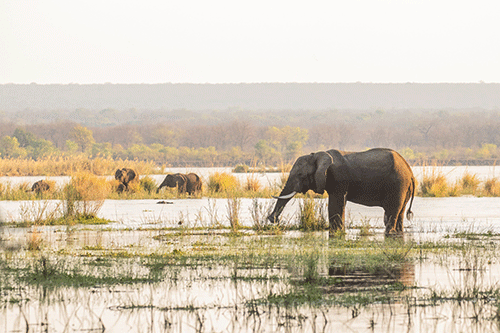
“We had no resources to pay community game scouts to fight against poachers. We said this hunting ban is getting us nowhere. We must bring back hunting (which funds salaries for game scouts). Then, we negotiated with the government for the return to international hunting in our area. With hunting back, wildlife populations are increasing. We have elephant, antelope, kudu, crocodiles and hippos.”
Tembo said throughout Zambia’s hunting communities, international hunting revenue is significantly supporting wildlife and habitat conservation, including socio-economic development.
“International hunting revenue is improving community livelihoods,” he noted. “In the Sandwe community where I come from, it has supported about 17 community public infrastructure since 2016. We have built and improved health facilities, schools, community houses and paid cash directly to vulnerable communities.”
The safari operators whom they work with have also improved and built different types of community infrastructure, including the construction of community game scouts’ houses.
Tembo added that Zambian communities are also using international hunting revenue to reduce hunger by procuring agricultural production equipment and inputs.
“Agricultural inputs have been bought, and people are having bumper harvests. The inputs are drought-resistant, and help vulnerable people to do farming. We also are coming up with lodges and fish farming, using international hunting revenue as a way of improving community livelihoods. I absolutely want international hunting to continue because it really adds value to socioe-conomic development.”
The British government is an active supporter of the United Nations’ Sustainable Development Goals (SDGs) that, among others, seek to eradicate poverty, poor health and achieve environment and wildlife conservation in the next eight years by 2030. Ironically, its Bill to ban trophy hunting imports which include Africa’s big five works against the key UN SDGs such as poverty eradication and environmental conservation in Africa’ hunting communities.
“Before being employed as a driver in Zambia’s Mulobeza Game Management Area in the elephant over-populated Kavango-Zambezi Transfrontier Area where Namibia, Angola, Botswana, Zambia and Zimbabwe share the same borders, I could not provide for my family needs,” said Reuben Shamabi. “However, from the time I started this job, it has really improved my life. All my family’s socio-economic conditions have improved. Read More...