Wild release marks return of giant forest tortoises to Bangladesh hills
-
 Loading...
 - Dilip Sinha
- 11 Jan 2022
- 412 Views
- 0 Like
- 0 Comment
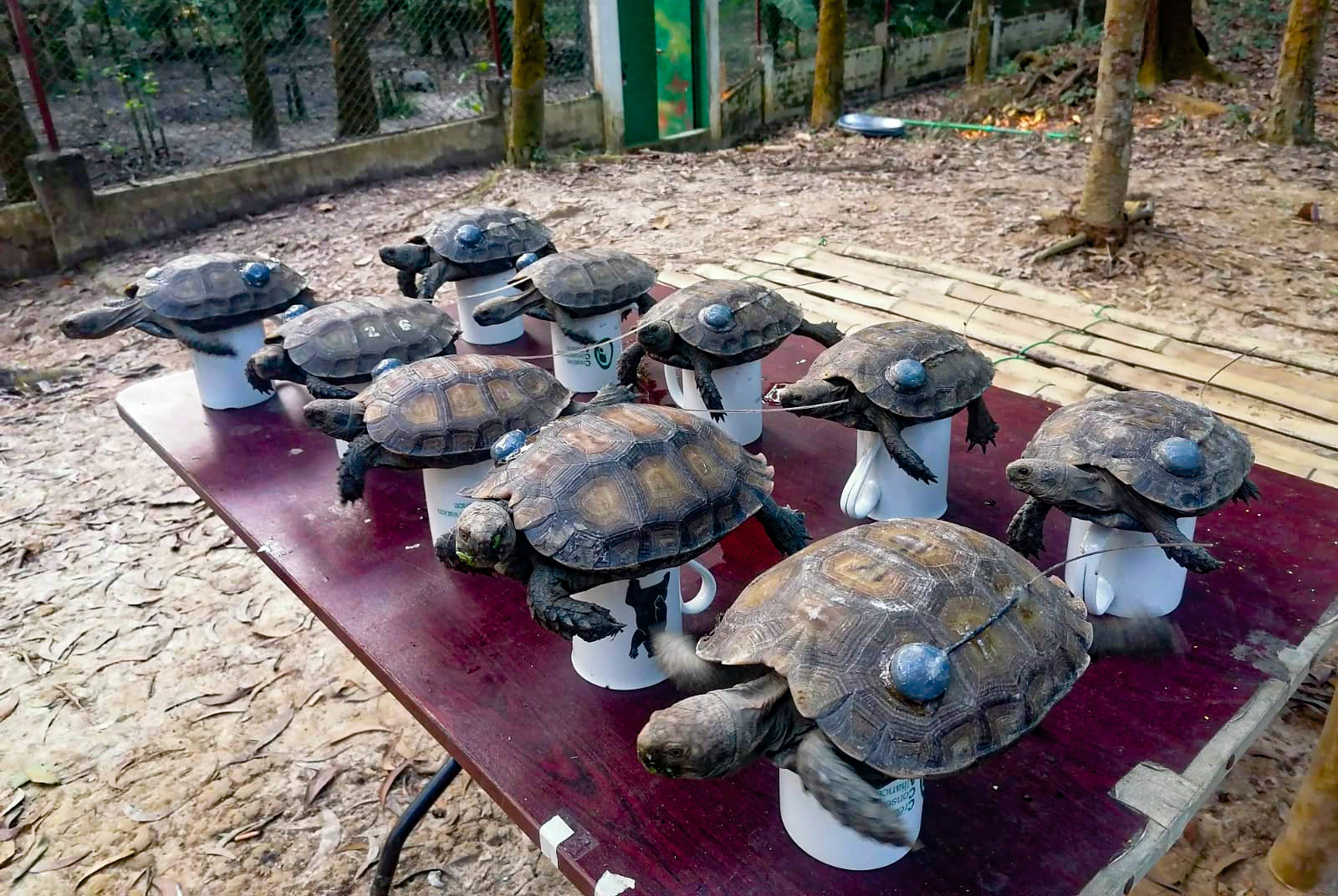
Bangladesh’s population of one of the world’s largest tortoise species received a boost last month when researchers and villagers released 10 captive-bred juveniles into the evergreen forests of the Chattogram Hill Tracts. This initiative, in the rugged mountain range in the extreme southeast of the country bordering Myanmar and India, was the first rewilding of the Asian giant tortoise in the country.
The species, Manouria emys, is critically endangered due to heavy hunting pressure and habitat destruction throughout its range across South and Southeast Asia. Tipping the scales at 35 kilograms (77 pounds), it’s the fourth-largest tortoise in the world and highly prized by subsistence hunters for its meat. Scientists had thought the species was extinct in Bangladesh until 2011, when new hope was triggered by the discovery of a shell in a remote corner of the Chattogram Hills.
“This confirmed that they still occur in that tiny pocket,” Shahriar Caesar Rahman, co-founder and CEO of the Creative Conservation Alliance (CCA), a Bangladesh-based nonprofit, told Mongabay. Without any action, he said, the species would likely be completely lost within the next decade. “What we needed to do was to increase their population size in captivity.”
Over the next few years, local hunters relinquished several of the rare tortoises to conservationists, and in 2017 CCA established a captive-breeding center to help secure the reptile’s future in collaboration with local communities, the Bangladesh Forest Department, and U.S.-based nonprofit Turtle Survival Alliance.
Today, the Turtle Conservation Center (TCC) in Bhawal National Park houses Bangladesh’s first conservation breeding colonies of not just Asian giant tortoises, but also critically endangered Arakan forest turtles (Heosemys depressa) and elongated tortoises (Indotestudo elongata), and endangered keeled box turtles (Cuora mouhotii).

Slow but steady progress
The 10 newly released Asian giant tortoises hatched in 2019 and are the offspring of parents rescued from slaughter. At the age of 2.5 years, they are large enough to evade natural predators, but they will not begin breeding until they are 15-20 years old.
As with so much in tortoise lives, Rahman said he anticipates slow but steady progress in recovering numbers in the wild. Although it took several years to begin breeding the tortoises, they are now breeding with regularity. Still, he reports that sudden cold snaps of weather during the monsoon season can catch them off guard leading to the loss of eggs and hatchlings.
“We are still trying to figure out how to increase the breeding success,” Rahman said, adding he hopes they can produce 100-200 hatchlings per year to keep boosting wild numbers. It’s a realistic target, he said, since high losses during egg incubation and hatchling stages are somewhat offset by the species’ extraordinary fecundity — female Asian giant tortoises typically lay up to 50 eggs in a clutch.
The release is a big initial step toward rewilding the species not just in Bangladesh, but also in Myanmar and India, where captive breeding “assurance colonies” for the species have also been established and are anticipating their first releases into the wild, said Rick Hudson, president of the Turtle Survival Alliance.
“It’s been really rewarding to take animals that were kind of doomed and be able to put them into a conservation program,” Hudson said. “They’re heavily hunted … it’s only in remote tracts of undisturbed forest where they are still found. So it was important to develop breeding colonies for this species throughout their range to give us options for restoring them to some of these habitats.” Read More…