Green light for return of red-footed tortoises to Argentina
-
 Loading...
 - Santos Lima
- 21 Jul 2022
- 123 Views
- 0 Like
- 0 Comment
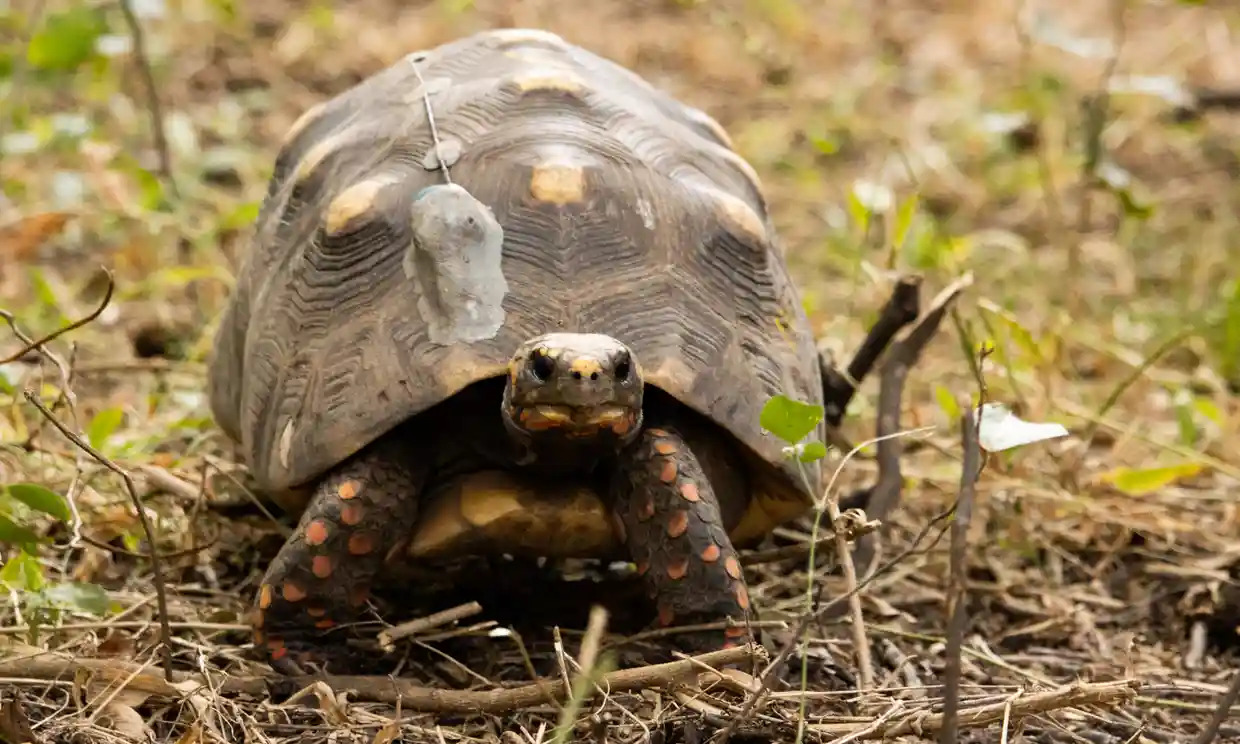
It may be one of the slowest-moving conservation projects in history, not just because of the red tape, but due to the animals themselves: 40 red-footed tortoises are being released into El Impenetrable national park in Argentina in the coming weeks after being rescued from the illegal pet trade in Paraguay and transported to Argentina.
One of the larger tortoises in South America, the red-footed tortoise (Chelonoidis carbonarius) was once found throughout three provinces of Argentina. But the last live tortoise spotted in the country was in the north-eastern province of Formosa in 2002. A shell was found in the same province, 40 miles (60km) from El Impenetrable, in 2016.
“In other parts of the Gran Chaco, in Paraguay and Bolivia, for example, it’s still a relatively common species,” says Sebastián Di Martino, conservation director of Rewilding Argentina. In Argentina, the consumption of its meat and the illegal pet trade are two of the key drivers of the tortoise’s demise, he adds.
“The widespread destruction of the Chaco forest, their habitat, is another cause. In fact, the last known population in Argentina lived in Formosa, where the forest was razed to plant soya beans.”
As new homes go, El Impenetrable, in northern Argentina, is spacious; it contains 128,000 hectares (317,00 acres) of protected reserve with dense native forest, grasslands and wetlands.
“The primary reason for reintroducing the red-footed tortoise is to ensure the conservation of this species,” Di Martino says.
But the tortoises also have a vital job to do to help restore and maintain genetic diversity in a region that’s been one of the hardest hit by deforestation. “Above all, it is about bringing back its important ecological role,” adds Di Martino.
“They’re called the gardeners of the forest because, like other tortoises, the red-footed tortoises consume great amounts of native fruit and then disperse the seeds, contributing to the regeneration of forests and the dispersion of many plant species, which maintains genetic variability. We’ve already observed that the specimens in quarantine are voracious consumers of different native plants.”
The tortoises came to Argentina from Urutaú wildlife refuge in Filadelfia, Paraguay. The process has not been easy or fast. “Transporting wild animals in Argentina is extremely difficult,” says Di Martino. “The international and national transport of wild animals in danger of extinction is forbidden in Argentina, so all transportation for rewilding projects must be done with special permissions that take months to process.
“The importing of 40 tortoises from Paraguay was an important step, as it was the largest international transporting of individual animals in the framework of a conservation project. Little by little, these barriers are being broken down, but there is still much work to be done.
“Also, all animals that enter rewilding projects must go through a rigorous quarantine before being released, to avoid introducing undesirable pathogens into the environment. The development of these tests was particularly expensive and involved a great deal of work from our veterinary teams.” Read More...